Human Gene ACSL4 (ENST00000672401.1) from GENCODE V50
  Description: acyl-CoA synthetase long chain family member 4, transcript variant 1 (from RefSeq NM_004458.3)
Gencode Transcript: ENST00000672401.1
Gencode Gene: ENSG00000068366.23
Transcript (Including UTRs)
   Position: hg38 chrX:109,641,335-109,733,257 Size: 91,923 Total Exon Count: 16 Strand: -
Coding Region
   Position: hg38 chrX:109,644,029-109,683,363 Size: 39,335 Coding Exon Count: 14 

Page IndexSequence and LinksUniProtKB CommentsPrimersMalaCardsCTD
RNA-Seq ExpressionMicroarray ExpressionRNA StructureProtein StructureOther SpeciesGO Annotations
mRNA DescriptionsPathwaysOther NamesMethods
Data last updated at UCSC: 2026-07-12 09:30:09

-  Comments and Description Text from UniProtKB
  ID: ACSL4_HUMAN
DESCRIPTION: RecName: Full=Long-chain-fatty-acid--CoA ligase 4; EC=6.2.1.3; AltName: Full=Long-chain acyl-CoA synthetase 4; Short=LACS 4;
FUNCTION: Activation of long-chain fatty acids for both synthesis of cellular lipids, and degradation via beta-oxidation. Preferentially uses arachidonate and eicosapentaenoate as substrates.
CATALYTIC ACTIVITY: ATP + a long-chain fatty acid + CoA = AMP + diphosphate + an acyl-CoA.
COFACTOR: Magnesium (By similarity).
SUBCELLULAR LOCATION: Mitochondrion outer membrane; Single-pass type III membrane protein (By similarity). Peroxisome membrane; Single-pass type III membrane protein (By similarity). Microsome membrane; Single-pass type III membrane protein (By similarity). Endoplasmic reticulum membrane; Single-pass type III membrane protein (By similarity).
DISEASE: Defects in ACSL4 are the cause of mental retardation X- linked type 63 (MRX63) [MIM:300387]. Mental retardation is a mental disorder characterized by significantly sub-average general intellectual functioning associated with impairments in adaptative behavior and manifested during the developmental period. Non- syndromic mental retardation patients do not manifest other clinical signs.
DISEASE: Defects in ACSL4 are involved in Alport syndrome with mental retardation midface hypoplasia and elliptocytosis (ATS-MR) [MIM:300194]. A X-linked contiguous gene deletion syndrome characterized by glomerulonephritis, deafness, mental retardation, midface hypoplasia and elliptocytosis.
SIMILARITY: Belongs to the ATP-dependent AMP-binding enzyme family.
WEB RESOURCE: Name=GeneReviews; URL="http://www.ncbi.nlm.nih.gov/sites/GeneTests/lab/gene/ACSL4";

-  Primer design for this transcript
 

Primer3Plus can design qPCR Primers that straddle exon-exon-junctions, which amplify only cDNA, not genomic DNA.
Click here to load the transcript sequence and exon structure into Primer3Plus

Exonprimer can design one pair of Sanger sequencing primers around every exon, located in non-genic sequence.
Click here to open Exonprimer with this transcript

To design primers for a non-coding sequence, zoom to a region of interest and select from the drop-down menu: View > In External Tools > Primer3


-  Comparative Toxicogenomics Database (CTD)
  The following chemicals interact with this gene           more ... click here to view the complete list

-  RNA-Seq Expression Data from GTEx (53 Tissues, 570 Donors)
  Highest median expression: 23.79 RPKM in Cells - EBV-transformed lymphocytes
Total median expression: 460.62 RPKM


View in GTEx track of Genome Browser    View at GTEx portal     View GTEx Body Map

+  Microarray Expression Data
 
Expression ratio colors:

GNF Expression Atlas 2 Data from U133A and GNF1H Chips


Ratios


Absolute


Ratios


Absolute


Ratios


Absolute

-  mRNA Secondary Structure of 3' and 5' UTRs
 
RegionFold EnergyBasesEnergy/Base
Display As
5' UTR -63.10184-0.343 Picture PostScript Text
3' UTR -595.702694-0.221 Picture PostScript Text

The RNAfold program from the Vienna RNA Package is used to perform the secondary structure predictions and folding calculations. The estimated folding energy is in kcal/mol. The more negative the energy, the more secondary structure the RNA is likely to have.

-  Protein Domain and Structure Information
  InterPro Domains: Graphical view of domain structure
IPR020845 - AMP-binding_CS
IPR000873 - AMP-dep_Synth/Lig

Pfam Domains:
PF00501 - AMP-binding enzyme

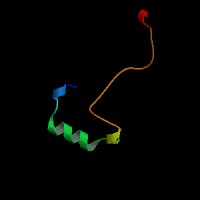
ModBase Predicted Comparative 3D Structure on O60488
FrontTopSide
The pictures above may be empty if there is no ModBase structure for the protein. The ModBase structure frequently covers just a fragment of the protein. You may be asked to log onto ModBase the first time you click on the pictures. It is simplest after logging in to just click on the picture again to get to the specific info on that model.

-  Orthologous Genes in Other Species
  Orthologies between human, mouse, and rat are computed by taking the best BLASTP hit, and filtering out non-syntenic hits. For more distant species reciprocal-best BLASTP hits are used. Note that the absence of an ortholog in the table below may reflect incomplete annotations in the other species rather than a true absence of the orthologous gene.
MouseRatZebrafishD. melanogasterC. elegansS. cerevisiae
Genome BrowserGenome BrowserNo orthologNo orthologNo orthologNo ortholog
Gene Details     
Gene Sorter     
MGIRGD    
Protein SequenceProtein Sequence    
AlignmentAlignment    

-  Gene Ontology (GO) Annotations with Structured Vocabulary
  Molecular Function:
GO:0000166 nucleotide binding
GO:0003824 catalytic activity
GO:0004467 long-chain fatty acid-CoA ligase activity
GO:0005524 ATP binding
GO:0016874 ligase activity
GO:0031957 very long-chain fatty acid-CoA ligase activity
GO:0047676 arachidonate-CoA ligase activity
GO:0102391 decanoate--CoA ligase activity

Biological Process:
GO:0001676 long-chain fatty acid metabolic process
GO:0006629 lipid metabolic process
GO:0006631 fatty acid metabolic process
GO:0007584 response to nutrient
GO:0008152 metabolic process
GO:0008610 lipid biosynthetic process
GO:0015908 fatty acid transport
GO:0019432 triglyceride biosynthetic process
GO:0030182 neuron differentiation
GO:0030307 positive regulation of cell growth
GO:0032307 negative regulation of prostaglandin secretion
GO:0035338 long-chain fatty-acyl-CoA biosynthetic process
GO:0060136 embryonic process involved in female pregnancy
GO:0060996 dendritic spine development
GO:0070672 response to interleukin-15

Cellular Component:
GO:0005737 cytoplasm
GO:0005739 mitochondrion
GO:0005741 mitochondrial outer membrane
GO:0005777 peroxisome
GO:0005778 peroxisomal membrane
GO:0005783 endoplasmic reticulum
GO:0005789 endoplasmic reticulum membrane
GO:0005811 lipid particle
GO:0016020 membrane
GO:0016021 integral component of membrane
GO:0031090 organelle membrane
GO:0031966 mitochondrial membrane
GO:0043025 neuronal cell body
GO:0043231 intracellular membrane-bounded organelle
GO:0044233 ER-mitochondrion membrane contact site
GO:0070062 extracellular exosome


-  Descriptions from all associated GenBank mRNAs
  BC034959 - Homo sapiens acyl-CoA synthetase long-chain family member 4, mRNA (cDNA clone MGC:26481 IMAGE:4824121), complete cds.
AF030555 - Homo sapiens acyl-CoA synthetase 4 (ACS4) mRNA, complete cds.
AB061713 - Homo sapiens FACL4 mRNA for Acyl-CoA synthetase 4, complete cds, full-length cDNA.
AK292070 - Homo sapiens cDNA FLJ78368 complete cds, highly similar to Homo sapiens acyl-CoA synthetase long-chain family member 4 (ACSL4), transcript variant 1, mRNA.
AK294915 - Homo sapiens cDNA FLJ57028 complete cds, highly similar to Long-chain-fatty-acid--CoA ligase 4 (EC 6.2.1.3).
AB061714 - Homo sapiens FACL4 mRNA for Acyl-CoA synthetase 4, complete cds, short 3'-UTR cDNA.
Y12777 - Homo sapiens mRNA for acyl-CoA synthetase-like protein.
AK307566 - Homo sapiens cDNA, FLJ97514.
Y13058 - Homo sapiens mRNA for acyl-CoA synthetase-like protein, alternative spliced product, partial.
JD433973 - Sequence 414997 from Patent EP1572962.
JD087370 - Sequence 68394 from Patent EP1572962.
JD283978 - Sequence 265002 from Patent EP1572962.
JD531165 - Sequence 512189 from Patent EP1572962.
JD500437 - Sequence 481461 from Patent EP1572962.
JD093431 - Sequence 74455 from Patent EP1572962.
JD559179 - Sequence 540203 from Patent EP1572962.
JD449377 - Sequence 430401 from Patent EP1572962.
JD368372 - Sequence 349396 from Patent EP1572962.
JD091215 - Sequence 72239 from Patent EP1572962.
JD380347 - Sequence 361371 from Patent EP1572962.
JD281559 - Sequence 262583 from Patent EP1572962.
JD299981 - Sequence 281005 from Patent EP1572962.
JD145322 - Sequence 126346 from Patent EP1572962.
JD244746 - Sequence 225770 from Patent EP1572962.
JD241739 - Sequence 222763 from Patent EP1572962.
JD047099 - Sequence 28123 from Patent EP1572962.
JD320487 - Sequence 301511 from Patent EP1572962.
JD365217 - Sequence 346241 from Patent EP1572962.
JD422295 - Sequence 403319 from Patent EP1572962.
JD313499 - Sequence 294523 from Patent EP1572962.
JD515677 - Sequence 496701 from Patent EP1572962.
JD467574 - Sequence 448598 from Patent EP1572962.
JD185557 - Sequence 166581 from Patent EP1572962.
JD370109 - Sequence 351133 from Patent EP1572962.
JD236730 - Sequence 217754 from Patent EP1572962.
JD039749 - Sequence 20773 from Patent EP1572962.
JD309839 - Sequence 290863 from Patent EP1572962.
JD304680 - Sequence 285704 from Patent EP1572962.
JD072857 - Sequence 53881 from Patent EP1572962.
JD073532 - Sequence 54556 from Patent EP1572962.
JD503249 - Sequence 484273 from Patent EP1572962.
JD314493 - Sequence 295517 from Patent EP1572962.
JD315092 - Sequence 296116 from Patent EP1572962.
JD326283 - Sequence 307307 from Patent EP1572962.
JD501827 - Sequence 482851 from Patent EP1572962.
JD257964 - Sequence 238988 from Patent EP1572962.
JD063377 - Sequence 44401 from Patent EP1572962.
DQ890835 - Synthetic construct clone IMAGE:100003465; FLH166330.01X; RZPDo839F0786D acyl-CoA synthetase long-chain family member 4 (ACSL4) gene, encodes complete protein.
KJ896800 - Synthetic construct Homo sapiens clone ccsbBroadEn_06194 ACSL4 gene, encodes complete protein.
DQ893990 - Synthetic construct Homo sapiens clone IMAGE:100008450; FLH166326.01L; RZPDo839F0785D acyl-CoA synthetase long-chain family member 4 (ACSL4) gene, encodes complete protein.
AB527416 - Synthetic construct DNA, clone: pF1KB4264, Homo sapiens ACSL4 gene for acyl-CoA synthetase long-chain family member 4, without stop codon, in Flexi system.
DL491271 - Novel nucleic acids.
DL489911 - Novel nucleic acids.
CU689998 - Synthetic construct Homo sapiens gateway clone IMAGE:100018402 5' read ACSL4 mRNA.

-  Biochemical and Signaling Pathways
  KEGG - Kyoto Encyclopedia of Genes and Genomes
hsa00071 - Fatty acid metabolism
hsa01100 - Metabolic pathways
hsa03320 - PPAR signaling pathway
hsa04146 - Peroxisome
hsa04920 - Adipocytokine signaling pathway

Reactome (by CSHL, EBI, and GO)

Protein O60488 (Reactome details) participates in the following event(s):

R-HSA-548843 ACSL3,4 ligate CoA to AA to form AA-CoA
R-HSA-75876 Synthesis of very long-chain fatty acyl-CoAs
R-HSA-75105 Fatty acyl-CoA biosynthesis
R-HSA-8978868 Fatty acid metabolism
R-HSA-556833 Metabolism of lipids
R-HSA-1430728 Metabolism

-  Other Names for This Gene
  Alternate Gene Symbols: ACS4, ACSL4_HUMAN, D3DUY2, FACL4, LACS4, NM_004458, O60488, O60848, O60849, Q5JWV8, uc288lmy.1
UCSC ID: ENST00000672401.1
RefSeq Accession: NM_001318510.2
Protein: O60488 (aka ACSL4_HUMAN or LCF4_HUMAN)
CCDS: CCDS14549.1

-  Methods, Credits, and Use Restrictions
  Click here for details on how this gene model was made and data restrictions if any.