ID:ALDOB_HUMAN DESCRIPTION: RecName: Full=Fructose-bisphosphate aldolase B; EC=4.1.2.13; AltName: Full=Liver-type aldolase; CATALYTIC ACTIVITY: D-fructose 1,6-bisphosphate = glycerone phosphate + D-glyceraldehyde 3-phosphate. BIOPHYSICOCHEMICAL PROPERTIES: Kinetic parameters: KM=1.6 uM for fructose 1,6-bisphosphate; KM=2.3 mM for fructose 1-phosphate; PATHWAY: Carbohydrate degradation; glycolysis; D-glyceraldehyde 3- phosphate and glycerone phosphate from D-glucose: step 4/4. SUBUNIT: Homotetramer. INTERACTION: Q8NFJ9:BBS1; NbExp=4; IntAct=EBI-1045507, EBI-1805484; Q9BXC9:BBS2; NbExp=4; IntAct=EBI-1045507, EBI-748297; Q96RK4:BBS4; NbExp=4; IntAct=EBI-1045507, EBI-1805814; Q8IWZ6:BBS7; NbExp=4; IntAct=EBI-1045507, EBI-1806001; DISEASE: Defects in ALDOB are the cause of hereditary fructose intolerance (HFI) [MIM:229600]. HFI is an autosomal recessive disease that results in an inability to metabolize fructose and related sugars. Complete exclusion of fructose results in dramatic recovery; however, if not treated properly, HFI subjects suffer episodes of hypoglycemia, general ill condition, and risk of death the remainder of life. MISCELLANEOUS: In vertebrates, three forms of this ubiquitous glycolytic enzyme are found, aldolase A in muscle, aldolase B in liver and aldolase C in brain. SIMILARITY: Belongs to the class I fructose-bisphosphate aldolase family. WEB RESOURCE: Name=Atlas of Genetics and Cytogenetics in Oncology and Haematology; URL="http://atlasgeneticsoncology.org/Genes/ALDOBID44287ch9q31.html"; WEB RESOURCE: Name=GeneReviews; URL="http://www.ncbi.nlm.nih.gov/sites/GeneTests/lab/gene/ALDOB";
The RNAfold program from the Vienna RNA Package is used to perform the secondary structure predictions and folding calculations. The estimated folding energy is in kcal/mol. The more negative the energy, the more secondary structure the RNA is likely to have.
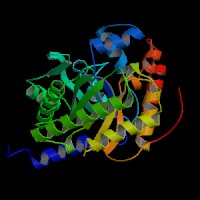
ModBase Predicted Comparative 3D Structure on P05062
Front
Top
Side
The pictures above may be empty if there is no ModBase structure for the protein. The ModBase structure frequently covers just a fragment of the protein. You may be asked to log onto ModBase the first time you click on the pictures. It is simplest after logging in to just click on the picture again to get to the specific info on that model.
Orthologous Genes in Other Species
Orthologies between human, mouse, and rat are computed by taking the best BLASTP hit, and filtering out non-syntenic hits. For more distant species reciprocal-best BLASTP hits are used. Note that the absence of an ortholog in the table below may reflect incomplete annotations in the other species rather than a true absence of the orthologous gene.
BC005314 - Homo sapiens mRNA similar to haptoglobin (cDNA clone IMAGE:3934411). X01098 - Human mRNA for aldolase B (EC 4.1.2.13). AK026411 - Homo sapiens cDNA: FLJ22758 fis, clone KAIA0811, highly similar to HUMALDB Human aldolase B mRNA. X02747 - Human mRNA for aldolase B. AK290795 - Homo sapiens cDNA FLJ76146 complete cds, highly similar to Homo sapiens aldolase B, fructose-bisphosphate (ALDOB), mRNA. JD376219 - Sequence 357243 from Patent EP1572962. JD113140 - Sequence 94164 from Patent EP1572962. JD349980 - Sequence 331004 from Patent EP1572962. BC029399 - Homo sapiens aldolase B, fructose-bisphosphate, mRNA (cDNA clone MGC:32618 IMAGE:4593670), complete cds. X00270 - Human human aldolase B messenger RNA fragment (EC 4.1.2.13). KJ901281 - Synthetic construct Homo sapiens clone ccsbBroadEn_10675 ALDOB gene, encodes complete protein. KR711264 - Synthetic construct Homo sapiens clone CCSBHm_00021956 ALDOB (ALDOB) mRNA, encodes complete protein. KR711265 - Synthetic construct Homo sapiens clone CCSBHm_00021963 ALDOB (ALDOB) mRNA, encodes complete protein. KR711266 - Synthetic construct Homo sapiens clone CCSBHm_00021970 ALDOB (ALDOB) mRNA, encodes complete protein. KR711267 - Synthetic construct Homo sapiens clone CCSBHm_00021974 ALDOB (ALDOB) mRNA, encodes complete protein. JD349991 - Sequence 331015 from Patent EP1572962. JD187663 - Sequence 168687 from Patent EP1572962.
Biochemical and Signaling Pathways
KEGG - Kyoto Encyclopedia of Genes and Genomes hsa00010 - Glycolysis / Gluconeogenesis hsa00030 - Pentose phosphate pathway hsa00051 - Fructose and mannose metabolism hsa01100 - Metabolic pathways
BioCyc Knowledge Library PWY66-373 - sucrose degradation PWY66-399 - gluconeogenesis PWY66-400 - glycolysis PWY66-407 - superpathway of conversion of glucose to acetyl CoA and entry into the TCA cycle
Reactome (by CSHL, EBI, and GO)
Protein P05062 (Reactome details) participates in the following event(s):
 Sequence and Links to Tools and Databases

 Microarray Expression Data