ID:AP2M1_HUMAN DESCRIPTION: RecName: Full=AP-2 complex subunit mu; AltName: Full=AP-2 mu chain; AltName: Full=Adapter-related protein complex 2 mu subunit; AltName: Full=Adaptin-mu2; AltName: Full=Adaptor protein complex AP-2 subunit mu; AltName: Full=Clathrin assembly protein complex 2 medium chain; AltName: Full=Clathrin coat assembly protein AP50; AltName: Full=Clathrin coat-associated protein AP50; AltName: Full=HA2 50 kDa subunit; AltName: Full=Plasma membrane adaptor AP-2 50 kDa protein; FUNCTION: Component of the adaptor protein complex 2 (AP-2). Adaptor protein complexes function in protein transport via transport vesicles in different membrane traffic pathways. Adaptor protein complexes are vesicle coat components and appear to be involved in cargo selection and vesicle formation. AP-2 is involved in clathrin-dependent endocytosis in which cargo proteins are incorporated into vesicles surrounded by clathrin (clathrin- coated vesicles, CCVs) which are destined for fusion with the early endosome. The clathrin lattice serves as a mechanical scaffold but is itself unable to bind directly to membrane components. Clathrin-associated adaptor protein (AP) complexes which can bind directly to both the clathrin lattice and to the lipid and protein components of membranes are considered to be the major clathrin adaptors contributing the CCV formation. AP-2 also serves as a cargo receptor to selectively sort the membrane proteins involved in receptor-mediated endocytosis. AP-2 seems to play a role in the recycling of synaptic vesicle membranes from the presynaptic surface. AP-2 recognizes Y-X-X-[FILMV] (Y-X-X-Phi) and [ED]-X-X-X-L-[LI] endocytosis signal motifs within the cytosolic tails of transmembrane cargo molecules. AP-2 may also play a role in maintaining normal post-endocytic trafficking through the ARF6-regulated, non-clathrin pathway. The AP-2 mu subunit binds to transmembrane cargo proteins; it recognizes the Y-X-X-Phi motifs. The surface region interacting with to the Y-X- X-Phi motif is inaccessible in cytosolic AP-2, but becomes accessible through a conformational change following phosphorylation of AP-2 mu subunit at 'Tyr-156' in membrane- associated AP-2. The membrane-specific phosphorylation event appears to involve assembled clathrin which activates the AP-2 mu kinase AAK1 (By similarity). Plays a role in endocytosis of frizzled family members upon Wnt signaling (By similarity). SUBUNIT: Adaptor protein complex 2 (AP-2) is a heterotetramer composed of two large adaptins (alpha-type subunit AP2A1 or AP2A2 and beta-type subunit AP2B1), a medium adaptin (mu-type subunit AP2M1) and a small adaptin (sigma-type subunit AP2S1). Interacts with ATP6V1H and MEGF10. Interacts with EGFR. Interacts with F2R. Interacts with PIP5K1C; tyrosine phosphorylation of PIP5K1C weakens the interaction (By similarity). Interacts with KIAA0319; required for clathrin-mediated endocytosis of KIAA0319. Interacts with DVL2 (via DEP domain) (By similarity). SUBCELLULAR LOCATION: Cell membrane. Membrane, coated pit; Peripheral membrane protein; Cytoplasmic side. Note=AP-2 appears to be excluded from internalizing CCVs and to disengage from sites of endocytosis seconds before internalization of the nascent CCV (By similarity). SIMILARITY: Belongs to the adaptor complexes medium subunit family. SIMILARITY: Contains 1 MHD (mu homology) domain. SEQUENCE CAUTION: Sequence=BAA09762.2; Type=Erroneous initiation; Note=Translation N-terminally shortened;
The RNAfold program from the Vienna RNA Package is used to perform the secondary structure predictions and folding calculations. The estimated folding energy is in kcal/mol. The more negative the energy, the more secondary structure the RNA is likely to have.
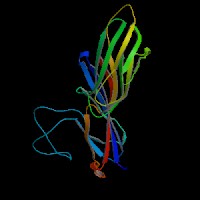
ModBase Predicted Comparative 3D Structure on Q96CW1
Front
Top
Side
The pictures above may be empty if there is no ModBase structure for the protein. The ModBase structure frequently covers just a fragment of the protein. You may be asked to log onto ModBase the first time you click on the pictures. It is simplest after logging in to just click on the picture again to get to the specific info on that model.
Orthologous Genes in Other Species
Orthologies between human, mouse, and rat are computed by taking the best BLASTP hit, and filtering out non-syntenic hits. For more distant species reciprocal-best BLASTP hits are used. Note that the absence of an ortholog in the table below may reflect incomplete annotations in the other species rather than a true absence of the orthologous gene.
Biological Process: GO:0006886 intracellular protein transport GO:0006897 endocytosis GO:0015031 protein transport GO:0016050 vesicle organization GO:0016192 vesicle-mediated transport GO:0019886 antigen processing and presentation of exogenous peptide antigen via MHC class II GO:0031623 receptor internalization GO:0032802 low-density lipoprotein particle receptor catabolic process GO:0034383 low-density lipoprotein particle clearance GO:0048013 ephrin receptor signaling pathway GO:0050690 regulation of defense response to virus by virus GO:0060071 Wnt signaling pathway, planar cell polarity pathway GO:0061024 membrane organization GO:0072583 clathrin-dependent endocytosis GO:0097494 regulation of vesicle size GO:1903077 negative regulation of protein localization to plasma membrane
KEGG - Kyoto Encyclopedia of Genes and Genomes hsa04144 - Endocytosis hsa05016 - Huntington's disease
BioCarta from NCI Cancer Genome Anatomy Project h_bArrestinPathway - ¿-arrestins in GPCR Desensitization h_ptdinsPathway - Phosphoinositides and their downstream targets. h_ndkDynaminPathway - Endocytotic role of NDK, Phosphins and Dynamin
Reactome (by CSHL, EBI, and GO)
Protein Q96CW1 (Reactome details) participates in the following event(s):
R-HSA-167633 Formation of Nef:Cd28:Clathrin-coated Pit Adapter Protein complex R-HSA-167637 Internalization of Nef:CD28:Clathrin-Coated Pit Adapter Protein Complex R-HSA-196026 Dab2 is recruited to the junctional plaques R-HSA-167537 Formation of CD4:Nef:AP-2 Complex:v-ATPase Complex R-HSA-182186 Formation of CD8:Nef:AP-2 Complex:v-ATPase Complex R-HSA-8856808 Recruitment of AP-2 complex and clathrin R-HSA-8866277 AP-2 directly binds some endocytic cargo R-HSA-8871196 Initial binding of AP-2 and clathrin to PI(4,5)P2 R-HSA-177491 Formation of clathrin-coated vesicle R-HSA-392748 L1 binds to AP-2 Clathrin complex R-HSA-2130640 Recruitment of clathrin coated vesicle by Ii R-HSA-6784735 PCSK9:LDLR bind to Clathrin R-HSA-8855131 VLDLR:PCSK9 binds Clathrin-coated vesicles R-HSA-445071 Reinsertion of L1 into the plasma membrane R-HSA-196017 Dynamin is recruited to the gap junction plaque R-HSA-167597 Internalization of the CD4:Nef:AP-2 Complex:v-ATPase Complex R-HSA-182198 Internalization of the CD8:Nef:AP-2 Complex:v-ATPase Complex R-HSA-5138433 p-DVL2 recruits AP-2 and beta-arrestin 2 to promote clathrin-mediated endocytosis R-HSA-8856813 AAK1 phosphorylates AP-2 mu subunit at T156 R-HSA-8862280 FCHo proteins bind nascent clathrin-coated pit R-HSA-2130486 Uncoating of clathrin-coated vesicles and fusion with endosomes R-HSA-8866283 ARBB recruits GPCRs into clathrin-coated pits R-HSA-8867756 CLASP proteins and cargo are recruited to the nascent clathrin-coated pit R-HSA-8871194 RAB5 and GAPVD1 bind AP-2 R-HSA-8868658 HSPA8-mediated ATP hydrolysis promotes vesicle uncoating R-HSA-8868659 Clathrin recruits auxilins to the clathrin-coated vesicle R-HSA-8868661 Dynamin-mediated GTP hydrolysis promotes vesicle scission R-HSA-8868660 Auxilin recruits HSPA8:ATP to the clathrin-coated vesicle R-HSA-8868648 SYNJ hydrolyze PI(4,5)P2 to PI(4)P R-HSA-177479 Axonal transport of NGF:Trk complexes R-HSA-177501 Endocytosis (internalization) of clathrin-coated vesicle R-HSA-374696 Phosphorylation of L1 by p90rsk R-HSA-392749 Transport of L1 into endosomes R-HSA-555065 Formation of clathrin coated vesicle R-HSA-445077 Transport of L1 from C-domain to P-domain R-HSA-445079 Phosphorylation of L1 by ERK R-HSA-6784729 PCSK9:LDLR:Clathrin-coated vesicle transport from plasma membrane to endolysosome R-HSA-190519 Internalization of gap junction plaques R-HSA-8868071 Clathrin recruits PIK3C2A R-HSA-8868230 SNX9 recruits components of the actin polymerizing machinery R-HSA-8867754 F- and N- BAR domain proteins bind the clathrin-coated pit R-HSA-8866279 Epsin family proteins bind ubiquitinated cargo R-HSA-8868236 BAR domain proteins recruit dynamin R-HSA-8868072 Clathrin-associated PIK3C2A phosphorylates PI(4)P to PI(3,4)P2 R-HSA-8868651 Endophilins recruit synaptojanins to the clathrin-coated pit R-HSA-164939 Nef mediated downregulation of CD28 cell surface expression R-HSA-196025 Formation of annular gap junctions R-HSA-164938 Nef-mediates down modulation of cell surface receptors by recruiting them to clathrin adapters R-HSA-167590 Nef Mediated CD4 Down-regulation R-HSA-182218 Nef Mediated CD8 Down-regulation R-HSA-3928665 EPH-ephrin mediated repulsion of cells R-HSA-8856828 Clathrin-mediated endocytosis R-HSA-8856825 Cargo recognition for clathrin-mediated endocytosis R-HSA-177504 Retrograde neurotrophin signalling R-HSA-437239 Recycling pathway of L1 R-HSA-2132295 MHC class II antigen presentation R-HSA-8964038 LDL clearance R-HSA-8866427 VLDLR internalisation and degradation R-HSA-190873 Gap junction degradation R-HSA-164952 The role of Nef in HIV-1 replication and disease pathogenesis R-HSA-5099900 WNT5A-dependent internalization of FZD4 R-HSA-2682334 EPH-Ephrin signaling R-HSA-199991 Membrane Trafficking R-HSA-187037 Signaling by NTRK1 (TRKA) R-HSA-373760 L1CAM interactions R-HSA-1280218 Adaptive Immune System R-HSA-8964043 Plasma lipoprotein clearance R-HSA-190828 Gap junction trafficking R-HSA-162909 Host Interactions of HIV factors R-HSA-4086400 PCP/CE pathway R-HSA-422475 Axon guidance R-HSA-5653656 Vesicle-mediated transport R-HSA-166520 Signaling by NTRKs R-HSA-168256 Immune System R-HSA-174824 Plasma lipoprotein assembly, remodeling, and clearance R-HSA-157858 Gap junction trafficking and regulation R-HSA-162906 HIV Infection R-HSA-3858494 Beta-catenin independent WNT signaling R-HSA-1266738 Developmental Biology R-HSA-9006934 Signaling by Receptor Tyrosine Kinases R-HSA-382551 Transport of small molecules R-HSA-5663205 Infectious disease R-HSA-195721 Signaling by WNT R-HSA-162582 Signal Transduction R-HSA-1643685 Disease R-HSA-416639 Trafficking of GluR2-containing AMPA receptors to extrasynaptic sites R-HSA-416993 Trafficking of GluR2-containing AMPA receptors R-HSA-399719 Trafficking of AMPA receptors R-HSA-399721 Glutamate binding, activation of AMPA receptors and synaptic plasticity R-HSA-112314 Neurotransmitter receptors and postsynaptic signal transmission R-HSA-112315 Transmission across Chemical Synapses R-HSA-112316 Neuronal System
 Sequence and Links to Tools and Databases
 Microarray Expression Data