Human Gene APOH (ENST00000205948.11) from GENCODE V50
Description: apolipoprotein H (from RefSeq NM_000042.3)Gencode Transcript: ENST00000205948.11Gencode Gene: ENSG00000091583.13Transcript (Including UTRs) Position: hg38 chr17:66,212,033-66,229,415 Size: 17,383 Total Exon Count: 8 Strand: -Coding Region Position: hg38 chr17:66,212,133-66,229,379 Size: 17,247 Coding Exon Count: 8
Data last updated at UCSC: 2026-07-12 09:30:09
Sequence and Links to Tools and Databases
Comments and Description Text from UniProtKB
ID: APOH_HUMAN DESCRIPTION: RecName: Full=Beta-2-glycoprotein 1; AltName: Full=APC inhibitor; AltName: Full=Activated protein C-binding protein; AltName: Full=Anticardiolipin cofactor; AltName: Full=Apolipoprotein H; Short=Apo-H; AltName: Full=Beta-2-glycoprotein I; Short=B2GPI; Short=Beta(2)GPI; Flags: Precursor;FUNCTION: Binds to various kinds of negatively charged substances such as heparin, phospholipids, and dextran sulfate. May prevent activation of the intrinsic blood coagulation cascade by binding to phospholipids on the surface of damaged cells.SUBCELLULAR LOCATION: Secreted.TISSUE SPECIFICITY: Expressed by the liver and secreted in plasma.PTM: N- and O-glycosylated. PubMed:6587378 also reports glycosylation on 'Asn-188' for their allele.SIMILARITY: Contains 4 Sushi (CCP/SCR) domains.WEB RESOURCE: Name=SeattleSNPs; URL="http://pga.gs.washington.edu/data/apoh/";WEB RESOURCE: Name=SHMPD; Note=The Singapore human mutation and polymorphism database; URL="http://shmpd.bii.a-star.edu.sg/gene.php?genestart=A&genename=APOH";
Primer design for this transcript
MalaCards Disease Associations
MalaCards Gene Search: APOH
Diseases sorted by gene-association score: antiphospholipid syndrome (52), syphilis (34), buerger disease (25), retinal artery occlusion (24), sneddon syndrome (23), retinal vascular occlusion (22), hypersensitivity reaction type ii disease (20), retinal vasculitis (20), catastrophic antiphospholipid syndrome (18), may-thurner syndrome (18), acanthamoeba keratitis (18), subacute delirium (18), hepatic infarction (18), transverse myelitis (18), malignant atrophic papulosis (16), central retinal vein occlusion (16), collagen disease (15), budd-chiari syndrome (15), pregnancy loss, recurrent 1 (15), retinal vein occlusion (15), protein s deficiency (14), intracranial thrombosis (13), spinal cord infarction (13), pulmonary hypertension, neonatal (12), ischemic colitis (12), vasculitis (12), pulmonary embolism (12), splenic infarction (12), hypoprothrombinemia (11), factor xii deficiency (11), thrombophilia due to activated protein c resistance (10), papilledema (10), thrombophilia (10), stroke, ischemic (10), thrombophilia due to thrombin defect (10), myelitis (9), placental abruption (9), placenta disease (9), temporal arteritis (9), peripheral vertigo (9), thrombophlebitis (9), breast reconstruction (9), sjogren's syndrome (9), hypersensitivity reaction disease (9), autoimmune hemolytic anemia (9), systemic lupus erythematosus (8), thrombophilia due to antithrombin iii deficiency (8), thrombosis (8), cerebral sinovenous thrombosis (8), livedoid vasculopathy (8), portal vein thrombosis (8), hellp syndrome (8), carotid artery occlusion (8), borderline leprosy (7), polyarteritis nodosa (7), legg-calve-perthes disease (7), erythema infectiosum (7), arteriovenous fistula (7), connective tissue disease (7), infective endocarditis (7), endocarditis (6), atrichia with papular lesions (6), purpura (6), viral exanthem (6), thrombotic thrombocytopenic purpura, acquired (6), acrocallosal syndrome (6), intermittent claudication (6), lateral medullary syndrome (6), immune system disease (5), rheumatic disease (5), severe pre-eclampsia (5), preeclampsia/eclampsia 1 (5), pyoderma (5), intracranial hypertension (5), discoid lupus erythematosus (5), branch retinal artery occlusion (5), thrombocytopenia (5), ischemic optic neuropathy (5), patent foramen ovale (5), lupus erythematosus (4), amyotrophic lateral sclerosis type 10 (4), behcet syndrome (4), vascular disease (4)
Comparative Toxicogenomics Database (CTD)
RNA-Seq Expression Data from GTEx (53 Tissues, 570 Donors)
Microarray Expression Data
mRNA Secondary Structure of 3' and 5' UTRs
Vienna RNA Package is used to perform the secondary structure predictions and folding calculations. The estimated folding energy is in kcal/mol. The more negative the energy, the more secondary structure the RNA is likely to have.
Protein Domain and Structure Information
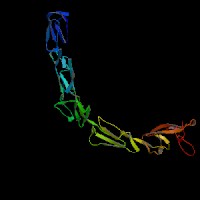
InterPro Domains: Graphical view of domain structure IPR016060 - Complement_control_moduleIPR015104 - Sushi_2IPR000436 - Sushi_SCR_CCPPfam Domains: PF00084 - Sushi repeat (SCR repeat)PF09014 - Beta-2-glycoprotein-1 fifth domainProtein Data Bank (PDB) 3-D Structure ModBase Predicted Comparative 3D Structure on P02749 The pictures above may be empty if there is no ModBase structure for the protein. The ModBase structure frequently covers just a fragment of the protein. You may be asked to log onto ModBase the first time you click on the pictures. It is simplest after logging in to just click on the picture again to get to the specific info on that model.
Orthologous Genes in Other Species
Orthologies between human, mouse, and rat are computed by taking the best BLASTP hit, and filtering out non-syntenic hits. For more distant species reciprocal-best BLASTP hits are used. Note that the absence of an ortholog in the table below may reflect incomplete annotations in the other species rather than a true absence of the orthologous gene.
Gene Ontology (GO) Annotations with Structured Vocabulary
Descriptions from all associated GenBank mRNAs
HZ170980 - WO 2015108162-A/3541: Nucleic Acids for inhibiting Expression of beta-2GPI.LV518059 - WO 2017010573-A/3541: RNAi PHARMACEUTICAL COMPOSITION FOR SUPPRESSING EXPRESSION OF beta-2GPI GENE.LV521932 - WO 2017010575-A/3541: OLIGONUCLEOTIDE CONJUGATE FOR SUPPRESSING EXPRESSION OF beta-2GPI GENE.LY399940 - KR 1020160108494-A/3541: NUCLEIC ACID CAPABLE OF INHIBITING EXPRESSION OF beta2GPI.MA427199 - JP 2018150239-A/3541: RNAi PHARMACEUTICAL COMPOSITION FOR SUPPRESSING EXPRESSION OF beta-2GPI GENE.BC026283 - Homo sapiens apolipoprotein H (beta-2-glycoprotein I), mRNA (cDNA clone MGC:23898 IMAGE:4734357), complete cds.AK298416 - Homo sapiens cDNA FLJ51265 complete cds, moderately similar to Beta-2-glycoprotein 1 precursor (Beta-2-glycoprotein I).X57847 - H.sapiens ApoH mRNA for apolipoprotein H (beta2-glycoprotein I).M62839 - Human apolipoprotein H mRNA, complete cds.X53595 - Human mRNA for beta-2-glycoprotein I (apolipoprotein H).BC020703 - Homo sapiens apolipoprotein H (beta-2-glycoprotein I), mRNA (cDNA clone MGC:22465 IMAGE:4767966), complete cds.X58100 - Human APOH mRNA for beta-2-glycoprotein I apolipoprotein H.S80305 - beta 2-glycoprotein I [human, HepG2 hepatoma cell line, mRNA, 1145 nt].HM212425 - Homo sapiens isolate 1 beta-2-glycoprotein I mRNA, partial cds.GQ891331 - Homo sapiens clone HEL-S-102d epididymis secretory sperm binding protein mRNA, complete cds.AK313838 - Homo sapiens cDNA, FLJ94463, highly similar to Homo sapiens apolipoprotein H (beta-2-glycoprotein I) (APOH), mRNA.KJ890690 - Synthetic construct Homo sapiens clone ccsbBroadEn_00084 APOH gene, encodes complete protein.KR711260 - Synthetic construct Homo sapiens clone CCSBHm_00021932 APOH (APOH) mRNA, encodes complete protein.KR711261 - Synthetic construct Homo sapiens clone CCSBHm_00021933 APOH (APOH) mRNA, encodes complete protein.DQ891362 - Synthetic construct clone IMAGE:100003992; FLH176236.01X; RZPDo839B01122D apolipoprotein H (beta-2-glycoprotein I) (APOH) gene, encodes complete protein.DQ894542 - Synthetic construct Homo sapiens clone IMAGE:100009002; FLH176232.01L; RZPDo839B01121D apolipoprotein H (beta-2-glycoprotein I) (APOH) gene, encodes complete protein.AB527858 - Synthetic construct DNA, clone: pF1KB6440, Homo sapiens APOH gene for apolipoprotein H, without stop codon, in Flexi system.CU693198 - Synthetic construct Homo sapiens gateway clone IMAGE:100022179 5' read APOH mRNA.AF082883 - Homo sapiens beta-2-glycoprotein I precursor, mRNA sequence.MA858104 - WO 2019027009-A/3541: Nucleic acid complexes.
Biochemical and Signaling Pathways
Other Names for This Gene
Alternate Gene Symbols: APOH_HUMAN, B2G1, B2R9M3, ENST00000205948.1, ENST00000205948.10, ENST00000205948.2, ENST00000205948.3, ENST00000205948.4, ENST00000205948.5, ENST00000205948.6, ENST00000205948.7, ENST00000205948.8, ENST00000205948.9, NM_000042, P02749, Q9UCN7, uc002jfn.1, uc002jfn.2, uc002jfn.3, uc002jfn.4, uc002jfn.5, uc002jfn.6UCSC ID: ENST00000205948.11RefSeq Accession: NM_000042.3 Protein: P02749
(aka APOH_HUMAN)CCDS: CCDS11663.1
Methods, Credits, and Use Restrictions
Click here
for details on how this gene model was made and data restrictions if any.
 Sequence and Links to Tools and Databases

 Microarray Expression Data