Human Gene ATP6V0A2 (ENST00000330342.8) from GENCODE V50
  Description: ATPase H+ transporting V0 subunit a2 (from RefSeq NM_012463.4)
Gencode Transcript: ENST00000330342.8
Gencode Gene: ENSG00000185344.17
Transcript (Including UTRs)
   Position: hg38 chr12:123,712,353-123,761,755 Size: 49,403 Total Exon Count: 20 Strand: +
Coding Region
   Position: hg38 chr12:123,712,566-123,758,032 Size: 45,467 Coding Exon Count: 20 

Page IndexSequence and LinksUniProtKB CommentsPrimersMalaCardsCTD
RNA-Seq ExpressionMicroarray ExpressionRNA StructureProtein StructureOther SpeciesGO Annotations
mRNA DescriptionsPathwaysOther NamesGeneReviewsMethods
Data last updated at UCSC: 2026-07-12 09:30:09

-  Comments and Description Text from UniProtKB
  ID: VPP2_HUMAN
DESCRIPTION: RecName: Full=V-type proton ATPase 116 kDa subunit a isoform 2; Short=V-ATPase 116 kDa isoform a2; AltName: Full=Lysosomal H(+)-transporting ATPase V0 subunit a2; AltName: Full=TJ6; AltName: Full=Vacuolar proton translocating ATPase 116 kDa subunit a isoform 2;
FUNCTION: Part of the proton channel of V-ATPases. Essential component of the endosomal pH-sensing machinery. May play a role in maintaining the Golgi functions, such as glycosylation maturation, by controlling the Golgi pH.
SUBUNIT: The V-ATPase is a heteromultimeric enzyme composed of at least thirteen different subunits. It has a membrane peripheral V1 sector for ATP hydrolysis and an integral V0 for proton translocation. The V1 sector comprises subunits A-H, whereas V0 includes subunits a, d, c, c', and c''. Directly interacts with PSCD2 through its N-terminal cytosolic tail in an intra-endosomal acidification-dependent manner. Disruption of this interaction results in the inhibition of endocytosis.
INTERACTION: Q99418:CYTH2; NbExp=2; IntAct=EBI-988630, EBI-448974;
SUBCELLULAR LOCATION: Cell membrane; Multi-pass membrane protein. Endosome membrane. Note=In kidney proximal tubules, also detected in subapical vesicles (By similarity).
PTM: Phosphorylated upon DNA damage, probably by ATM or ATR.
DISEASE: Defects in ATP6V0A2 are the cause of cutis laxa autosomal recessive type 2A (ARCL2A) [MIM:219200]. An autosomal recessive disorder characterized by an excessive congenital skin wrinkling, a large fontanelle with delayed closure, a typical facial appearance with downslanting palpebral fissures, a general connective tissue weakness, and varying degrees of growth and developmental delay and neurological abnormalities. Some affected individuals develop seizures and mental deterioration later in life, whereas the skin phenotype tends to become milder with age. At the molecular level, an abnormal glycosylation of serum proteins is observed in many cases.
DISEASE: Defects in ATP6V0A2 are a cause of wrinkly skin syndrome (WSS) [MIM:278250]. WSS is rare autosomal recessive disorder characterized by wrinkling of the skin of the dorsum of the hands and feet, an increased number of palmar and plantar creases, wrinkled abdominal skin, multiple musculoskeletal abnormalities, microcephaly, growth failure and developmental delay.
SIMILARITY: Belongs to the V-ATPase 116 kDa subunit family.
CAUTION: The N-terminus peptide may increase IL1B secretion by peripheral blood monocytes; however as this region is probably in the cytosol, the in vivo relevance of this observation needs to be confirmed.
WEB RESOURCE: Name=GeneReviews; URL="http://www.ncbi.nlm.nih.gov/sites/GeneTests/lab/gene/ATP6V0A2";

-  Primer design for this transcript
 

Primer3Plus can design qPCR Primers that straddle exon-exon-junctions, which amplify only cDNA, not genomic DNA.
Click here to load the transcript sequence and exon structure into Primer3Plus

Exonprimer can design one pair of Sanger sequencing primers around every exon, located in non-genic sequence.
Click here to open Exonprimer with this transcript

To design primers for a non-coding sequence, zoom to a region of interest and select from the drop-down menu: View > In External Tools > Primer3


-  MalaCards Disease Associations
  MalaCards Gene Search: ATP6V0A2
Diseases sorted by gene-association score: wrinkly skin syndrome* (1279), cutis laxa, autosomal recessive, type iia* (900), autosomal recessive cutis laxa type 2, classic type* (750), atp6v0a2-related cutis laxa* (100), cutis laxa (18), myelophthisic anemia (9), lichen nitidus (5), hyperostosis, endosteal (5)
* = Manually curated disease association

-  Comparative Toxicogenomics Database (CTD)
  The following chemicals interact with this gene           more ... click here to view the complete list

-  RNA-Seq Expression Data from GTEx (53 Tissues, 570 Donors)
  Highest median expression: 5.65 RPKM in Cells - EBV-transformed lymphocytes
Total median expression: 128.79 RPKM


View in GTEx track of Genome Browser    View at GTEx portal     View GTEx Body Map

+  Microarray Expression Data
 
Expression ratio colors:

GNF Expression Atlas 2 Data from U133A and GNF1H Chips


Ratios


Absolute


Ratios


Absolute


Ratios


Absolute

-  mRNA Secondary Structure of 3' and 5' UTRs
 
RegionFold EnergyBasesEnergy/Base
Display As
5' UTR -125.10213-0.587 Picture PostScript Text
3' UTR -985.603723-0.265 Picture PostScript Text

The RNAfold program from the Vienna RNA Package is used to perform the secondary structure predictions and folding calculations. The estimated folding energy is in kcal/mol. The more negative the energy, the more secondary structure the RNA is likely to have.

-  Protein Domain and Structure Information
  InterPro Domains: Graphical view of domain structure
IPR002490 - ATPase_V0/A0_a
IPR026028 - V-type_ATPase_a

Pfam Domains:
PF01496 - V-type ATPase 116kDa subunit family

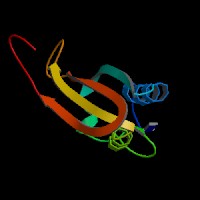
ModBase Predicted Comparative 3D Structure on Q9Y487
FrontTopSide
The pictures above may be empty if there is no ModBase structure for the protein. The ModBase structure frequently covers just a fragment of the protein. You may be asked to log onto ModBase the first time you click on the pictures. It is simplest after logging in to just click on the picture again to get to the specific info on that model.

-  Orthologous Genes in Other Species
  Orthologies between human, mouse, and rat are computed by taking the best BLASTP hit, and filtering out non-syntenic hits. For more distant species reciprocal-best BLASTP hits are used. Note that the absence of an ortholog in the table below may reflect incomplete annotations in the other species rather than a true absence of the orthologous gene.
MouseRatZebrafishD. melanogasterC. elegansS. cerevisiae
Genome BrowserGenome BrowserGenome BrowserNo orthologNo orthologNo ortholog
Gene Details     
Gene Sorter     
MGIRGDEnsembl   
Protein SequenceProtein SequenceProtein Sequence   
AlignmentAlignmentAlignment   

-  Gene Ontology (GO) Annotations with Structured Vocabulary
  Molecular Function:
GO:0005515 protein binding
GO:0015078 hydrogen ion transmembrane transporter activity
GO:0046961 proton-transporting ATPase activity, rotational mechanism
GO:0051117 ATPase binding

Biological Process:
GO:0006811 ion transport
GO:0006879 cellular iron ion homeostasis
GO:0006955 immune response
GO:0007035 vacuolar acidification
GO:0008286 insulin receptor signaling pathway
GO:0015986 ATP synthesis coupled proton transport
GO:0015991 ATP hydrolysis coupled proton transport
GO:0016241 regulation of macroautophagy
GO:0033572 transferrin transport
GO:0034220 ion transmembrane transport
GO:0036295 cellular response to increased oxygen levels
GO:0070072 vacuolar proton-transporting V-type ATPase complex assembly

Cellular Component:
GO:0000220 vacuolar proton-transporting V-type ATPase, V0 domain
GO:0001669 acrosomal vesicle
GO:0005765 lysosomal membrane
GO:0005768 endosome
GO:0005886 plasma membrane
GO:0010008 endosome membrane
GO:0016020 membrane
GO:0016021 integral component of membrane
GO:0016471 vacuolar proton-transporting V-type ATPase complex
GO:0030670 phagocytic vesicle membrane
GO:0033179 proton-transporting V-type ATPase, V0 domain


-  Descriptions from all associated GenBank mRNAs
  BC068531 - Homo sapiens ATPase, H+ transporting, lysosomal V0 subunit a2, mRNA (cDNA clone MGC:87365 IMAGE:30344468), complete cds.
LF384025 - JP 2014500723-A/191528: Polycomb-Associated Non-Coding RNAs.
MA619602 - JP 2018138019-A/191528: Polycomb-Associated Non-Coding RNAs.
BC022300 - Homo sapiens ATPase, H+ transporting, lysosomal V0 subunit a2, mRNA (cDNA clone IMAGE:4738797), complete cds.
AK289391 - Homo sapiens cDNA FLJ75560 complete cds, highly similar to Homo sapiens ATPase, H+ transporting, lysosomal V0 subunit a isoform 2 (ATP6V0A2), mRNA.
AF112972 - Homo sapiens TJ6 mRNA, complete cds.
HQ258004 - Synthetic construct Homo sapiens clone IMAGE:100072313 ATPase, H+ transporting, lysosomal V0 subunit a2 (ATP6V0A2) gene, encodes complete protein.
KJ898503 - Synthetic construct Homo sapiens clone ccsbBroadEn_07897 ATP6V0A2 gene, encodes complete protein.
KR711426 - Synthetic construct Homo sapiens clone CCSBHm_00023523 ATP6V0A2 (ATP6V0A2) mRNA, encodes complete protein.
KR711427 - Synthetic construct Homo sapiens clone CCSBHm_00023525 ATP6V0A2 (ATP6V0A2) mRNA, encodes complete protein.
KR711428 - Synthetic construct Homo sapiens clone CCSBHm_00023527 ATP6V0A2 (ATP6V0A2) mRNA, encodes complete protein.
KR711429 - Synthetic construct Homo sapiens clone CCSBHm_00023530 ATP6V0A2 (ATP6V0A2) mRNA, encodes complete protein.
AK298778 - Homo sapiens cDNA FLJ56962 complete cds, highly similar to Vacuolar proton translocating ATPase 116 kDa subunit a isoform 2.
JD546676 - Sequence 527700 from Patent EP1572962.
JD433737 - Sequence 414761 from Patent EP1572962.
JD301491 - Sequence 282515 from Patent EP1572962.
LF359690 - JP 2014500723-A/167193: Polycomb-Associated Non-Coding RNAs.
MA595267 - JP 2018138019-A/167193: Polycomb-Associated Non-Coding RNAs.
LF359691 - JP 2014500723-A/167194: Polycomb-Associated Non-Coding RNAs.
MA595268 - JP 2018138019-A/167194: Polycomb-Associated Non-Coding RNAs.
AK056800 - Homo sapiens cDNA FLJ32238 fis, clone PLACE6004993.
JD151829 - Sequence 132853 from Patent EP1572962.
BC000826 - Homo sapiens ATPase, H+ transporting, lysosomal V0 subunit a2, mRNA (cDNA clone IMAGE:3454647).
JD322272 - Sequence 303296 from Patent EP1572962.
JD264604 - Sequence 245628 from Patent EP1572962.
JD321642 - Sequence 302666 from Patent EP1572962.
JD321643 - Sequence 302667 from Patent EP1572962.
LF359692 - JP 2014500723-A/167195: Polycomb-Associated Non-Coding RNAs.
MA595269 - JP 2018138019-A/167195: Polycomb-Associated Non-Coding RNAs.

-  Biochemical and Signaling Pathways
  KEGG - Kyoto Encyclopedia of Genes and Genomes
hsa00190 - Oxidative phosphorylation
hsa01100 - Metabolic pathways
hsa04142 - Lysosome
hsa04966 - Collecting duct acid secretion
hsa05110 - Vibrio cholerae infection
hsa05120 - Epithelial cell signaling in Helicobacter pylori infection

Reactome (by CSHL, EBI, and GO)

Protein Q9Y487 (Reactome details) participates in the following event(s):

R-HSA-5252133 ATP6AP1 binds V-ATPase
R-HSA-1222516 Intraphagosomal pH is lowered to 5 by V-ATPase
R-HSA-74723 Endosome acidification
R-HSA-917841 Acidification of Tf:TfR1 containing endosome
R-HSA-77387 Insulin receptor recycling
R-HSA-917977 Transferrin endocytosis and recycling
R-HSA-983712 Ion channel transport
R-HSA-74752 Signaling by Insulin receptor
R-HSA-917937 Iron uptake and transport
R-HSA-382551 Transport of small molecules
R-HSA-1222556 ROS, RNS production in phagocytes
R-HSA-9006934 Signaling by Receptor Tyrosine Kinases
R-HSA-168249 Innate Immune System
R-HSA-162582 Signal Transduction
R-HSA-168256 Immune System

-  Other Names for This Gene
  Alternate Gene Symbols: A8K026, ENST00000330342.1, ENST00000330342.2, ENST00000330342.3, ENST00000330342.4, ENST00000330342.5, ENST00000330342.6, ENST00000330342.7, NM_012463, Q6NUM0, Q9Y487, uc001ufr.1, uc001ufr.2, uc001ufr.3, uc001ufr.4, uc001ufr.5, VPP2_HUMAN
UCSC ID: ENST00000330342.8
RefSeq Accession: NM_012463.4
Protein: Q9Y487 (aka VPP2_HUMAN)
CCDS: CCDS9254.1

-  GeneReviews for This Gene
  GeneReviews article(s) related to gene ATP6V0A2:
cutis-laxa (ATP6V0A2-Related Cutis Laxa)

-  Methods, Credits, and Use Restrictions
  Click here for details on how this gene model was made and data restrictions if any.