ID:B3GN6_HUMAN DESCRIPTION: RecName: Full=UDP-GlcNAc:betaGal beta-1,3-N-acetylglucosaminyltransferase 6; Short=BGnT-6; Short=Beta-1,3-Gn-T6; Short=Beta-1,3-N-acetylglucosaminyltransferase 6; Short=Beta3Gn-T6; EC=2.4.1.-; AltName: Full=Core 3 synthase; FUNCTION: Beta-1,3-N-acetylglucosaminyltransferase that synthesizes the core 3 structure of the O-glycan, an important precursor in the biosynthesis of mucin-type glycoproteins. Plays an important role in the synthesis of mucin-type O-glycans in digestive organs. PATHWAY: Protein modification; protein glycosylation. SUBCELLULAR LOCATION: Golgi apparatus membrane; Single-pass type II membrane protein. TISSUE SPECIFICITY: Present in stomach and colon (at protein level). Restricted in the stomach, colon and small intestine, where core 3 structure is present. INDUCTION: Down-regulated in gastric and colorectal carcinomas, suggesting that it may be used as a marker for distinguishing between benign adenomas and premalignant lesions (at protein level). MISCELLANEOUS: Injection into nude mice significantly suppress lung metastasis, indicating that the core structures of O-glycans are profoundly involved in the metastatic capacity of cancer cells. SIMILARITY: Belongs to the glycosyltransferase 31 family. WEB RESOURCE: Name=GGDB; Note=GlycoGene database; URL="http://riodb.ibase.aist.go.jp/rcmg/ggdb/Homolog?cat=symbol&symbol=B3GNT6";
The RNAfold program from the Vienna RNA Package is used to perform the secondary structure predictions and folding calculations. The estimated folding energy is in kcal/mol. The more negative the energy, the more secondary structure the RNA is likely to have.
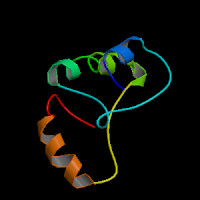
ModBase Predicted Comparative 3D Structure on Q6ZMB0
Front
Top
Side
The pictures above may be empty if there is no ModBase structure for the protein. The ModBase structure frequently covers just a fragment of the protein. You may be asked to log onto ModBase the first time you click on the pictures. It is simplest after logging in to just click on the picture again to get to the specific info on that model.
Orthologous Genes in Other Species
Orthologies between human, mouse, and rat are computed by taking the best BLASTP hit, and filtering out non-syntenic hits. For more distant species reciprocal-best BLASTP hits are used. Note that the absence of an ortholog in the table below may reflect incomplete annotations in the other species rather than a true absence of the orthologous gene.
AK292773 - Homo sapiens cDNA FLJ78031 complete cds, highly similar to Homo sapiens beta3GnT6 mRNA for beta-1,3-N-acetylglucosaminyltransferase 6. AK127544 - Homo sapiens cDNA FLJ45637 fis, clone COLON2004351, weakly similar to Probable beta-1,3-galactosyltransferase 8 (EC 2.4.1.-). AK313682 - Homo sapiens cDNA, FLJ94270, Homo sapiens beta-1,3-N-acetylglucosaminyltransferase protein(IMAGE:4907098), mRNA. AK172863 - Homo sapiens cDNA FLJ24093 fis, clone KAIA2504. BC103908 - Homo sapiens UDP-GlcNAc:betaGal beta-1,3-N-acetylglucosaminyltransferase 6 (core 3 synthase), mRNA (cDNA clone MGC:119334 IMAGE:40005856), complete cds. BC103909 - Homo sapiens UDP-GlcNAc:betaGal beta-1,3-N-acetylglucosaminyltransferase 6 (core 3 synthase), mRNA (cDNA clone MGC:119336 IMAGE:40005863), complete cds. BC103910 - Homo sapiens UDP-GlcNAc:betaGal beta-1,3-N-acetylglucosaminyltransferase 6 (core 3 synthase), mRNA (cDNA clone MGC:119337 IMAGE:40005864), complete cds. KJ905639 - Synthetic construct Homo sapiens clone ccsbBroadEn_15280 B3GNT6 gene, encodes complete protein. AB073740 - Homo sapiens beta3GnT6 mRNA for beta-1,3-N-acetylglucosaminyltransferase 6, complete cds. BC025357 - Homo sapiens UDP-GlcNAc:betaGal beta-1,3-N-acetylglucosaminyltransferase 6 (core 3 synthase), mRNA (cDNA clone IMAGE:4907098), partial cds. JD353353 - Sequence 334377 from Patent EP1572962. JD118573 - Sequence 99597 from Patent EP1572962. JD086068 - Sequence 67092 from Patent EP1572962. JD518994 - Sequence 500018 from Patent EP1572962. JD385667 - Sequence 366691 from Patent EP1572962. JD497891 - Sequence 478915 from Patent EP1572962.
Biochemical and Signaling Pathways
KEGG - Kyoto Encyclopedia of Genes and Genomes hsa00512 - O-Glycan biosynthesis hsa01100 - Metabolic pathways
Reactome (by CSHL, EBI, and GO)
Protein Q6ZMB0 (Reactome details) participates in the following event(s):
R-HSA-914010 Addition of GlcNAc to the Tn antigen forms a Core 3 glycoprotein R-HSA-913709 O-linked glycosylation of mucins R-HSA-5173105 O-linked glycosylation R-HSA-597592 Post-translational protein modification R-HSA-392499 Metabolism of proteins
 Sequence and Links to Tools and Databases