Human Gene BRAP (ENST00000419234.9) from GENCODE V50
  Description: BRCA1 associated protein (from RefSeq NM_006768.5)
Gencode Transcript: ENST00000419234.9
Gencode Gene: ENSG00000089234.18
Transcript (Including UTRs)
   Position: hg38 chr12:111,642,146-111,685,956 Size: 43,811 Total Exon Count: 12 Strand: -
Coding Region
   Position: hg38 chr12:111,644,199-111,685,792 Size: 41,594 Coding Exon Count: 12 

Page IndexSequence and LinksUniProtKB CommentsPrimersCTDRNA-Seq Expression
Microarray ExpressionRNA StructureProtein StructureOther SpeciesGO AnnotationsmRNA Descriptions
PathwaysOther NamesMethods
Data last updated at UCSC: 2026-07-12 09:30:09

-  Comments and Description Text from UniProtKB
  ID: BRAP_HUMAN
DESCRIPTION: RecName: Full=BRCA1-associated protein; EC=6.3.2.-; AltName: Full=BRAP2; AltName: Full=Impedes mitogenic signal propagation; Short=IMP; AltName: Full=RING finger protein 52; AltName: Full=Renal carcinoma antigen NY-REN-63;
FUNCTION: Negatively regulates MAP kinase activation by limiting the formation of Raf/MEK complexes probably by inactivation of the KSR1 scaffold protein. Also acts as a Ras responsive E3 ubiquitin ligase that, on activation of Ras, is modified by auto- polyubiquitination resulting in the release of inhibition of Raf/MEK complex formation. May also act as a cytoplasmic retention protein with a role in regulating nuclear transport.
PATHWAY: Protein modification; protein ubiquitination.
SUBUNIT: Interacts with the nuclear localization signal of BRCA1 and with the N-terminal of KSR1. The C-terminal portion of BCRA1 interacts with DDB1.
INTERACTION: P38398:BRCA1; NbExp=3; IntAct=EBI-349900, EBI-349905; P01112:HRAS; NbExp=3; IntAct=EBI-349900, EBI-350145;
SUBCELLULAR LOCATION: Cytoplasm.
TISSUE SPECIFICITY: Expressed in breast epithelial cell lines.
SIMILARITY: Contains 1 RING-type zinc finger.
SIMILARITY: Contains 1 UBP-type zinc finger.
SEQUENCE CAUTION: Sequence=AAC24200.1; Type=Frameshift; Positions=556;

-  Primer design for this transcript
 

Primer3Plus can design qPCR Primers that straddle exon-exon-junctions, which amplify only cDNA, not genomic DNA.
Click here to load the transcript sequence and exon structure into Primer3Plus

Exonprimer can design one pair of Sanger sequencing primers around every exon, located in non-genic sequence.
Click here to open Exonprimer with this transcript

To design primers for a non-coding sequence, zoom to a region of interest and select from the drop-down menu: View > In External Tools > Primer3


-  Comparative Toxicogenomics Database (CTD)
  The following chemicals interact with this gene           more ... click here to view the complete list

-  RNA-Seq Expression Data from GTEx (53 Tissues, 570 Donors)
  Highest median expression: 40.50 RPKM in Testis
Total median expression: 317.33 RPKM


View in GTEx track of Genome Browser    View at GTEx portal     View GTEx Body Map

+  Microarray Expression Data
 
Expression ratio colors:

GNF Expression Atlas 2 Data from U133A and GNF1H Chips


Ratios


Absolute


Ratios


Absolute


Ratios


Absolute

-  mRNA Secondary Structure of 3' and 5' UTRs
 
RegionFold EnergyBasesEnergy/Base
Display As
5' UTR -87.70164-0.535 Picture PostScript Text
3' UTR -564.602053-0.275 Picture PostScript Text

The RNAfold program from the Vienna RNA Package is used to perform the secondary structure predictions and folding calculations. The estimated folding energy is in kcal/mol. The more negative the energy, the more secondary structure the RNA is likely to have.

-  Protein Domain and Structure Information
  InterPro Domains: Graphical view of domain structure
IPR011422 - BRAP2
IPR012677 - Nucleotide-bd_a/b_plait
IPR001841 - Znf_RING
IPR013083 - Znf_RING/FYVE/PHD
IPR001607 - Znf_UBP

Pfam Domains:
PF07576 - BRCA1-associated protein 2
PF13639 - Ring finger domain
PF02148 - Zn-finger in ubiquitin-hydrolases and other protein

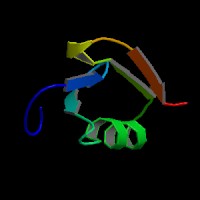
ModBase Predicted Comparative 3D Structure on Q7Z569
FrontTopSide
The pictures above may be empty if there is no ModBase structure for the protein. The ModBase structure frequently covers just a fragment of the protein. You may be asked to log onto ModBase the first time you click on the pictures. It is simplest after logging in to just click on the picture again to get to the specific info on that model.

-  Orthologous Genes in Other Species
  Orthologies between human, mouse, and rat are computed by taking the best BLASTP hit, and filtering out non-syntenic hits. For more distant species reciprocal-best BLASTP hits are used. Note that the absence of an ortholog in the table below may reflect incomplete annotations in the other species rather than a true absence of the orthologous gene.
MouseRatZebrafishD. melanogasterC. elegansS. cerevisiae
Genome BrowserGenome BrowserNo orthologNo orthologNo orthologNo ortholog
Gene Details     
Gene Sorter     
MGIRGD    
Protein SequenceProtein Sequence    
AlignmentAlignment    

-  Gene Ontology (GO) Annotations with Structured Vocabulary
  Molecular Function:
GO:0003676 nucleic acid binding
GO:0004842 ubiquitin-protein transferase activity
GO:0005515 protein binding
GO:0008139 nuclear localization sequence binding
GO:0008270 zinc ion binding
GO:0016740 transferase activity
GO:0042802 identical protein binding
GO:0046872 metal ion binding
GO:0061630 ubiquitin protein ligase activity

Biological Process:
GO:0000165 MAPK cascade
GO:0007265 Ras protein signal transduction
GO:0009968 negative regulation of signal transduction
GO:0016567 protein ubiquitination

Cellular Component:
GO:0000151 ubiquitin ligase complex
GO:0005737 cytoplasm
GO:0005829 cytosol
GO:0031965 nuclear membrane


-  Descriptions from all associated GenBank mRNAs
  AB208878 - Homo sapiens mRNA for BRCA1 associated protein variant protein.
AK299326 - Homo sapiens cDNA FLJ50182 complete cds, highly similar to BRCA1-associated protein (EC 6.3.2.-).
AK290379 - Homo sapiens cDNA FLJ76247 complete cds, highly similar to Homo sapiens BRCA1 associated protein (BRAP), mRNA.
AK308279 - Homo sapiens cDNA, FLJ98227.
AF035620 - Homo sapiens BRCA1-associated protein 2 (BRAP2) mRNA, complete cds.
AY332222 - Homo sapiens impedes mitogenic signal propagation mRNA, complete cds.
BC136698 - Homo sapiens BRCA1 associated protein, mRNA (cDNA clone MGC:168311 IMAGE:9020688), complete cds.
BC136699 - Homo sapiens BRCA1 associated protein, mRNA (cDNA clone MGC:168312 IMAGE:9020689), complete cds.
AB590810 - Synthetic construct DNA, clone: pFN21AE2014, Homo sapiens BRAP gene for BRCA1 associated protein, without stop codon, in Flexi system.
AF035950 - Homo sapiens putative DDB p127-associated protein mRNA, partial cds.
JD086137 - Sequence 67161 from Patent EP1572962.
JD328828 - Sequence 309852 from Patent EP1572962.
JD476069 - Sequence 457093 from Patent EP1572962.
JD258869 - Sequence 239893 from Patent EP1572962.

-  Biochemical and Signaling Pathways
  Reactome (by CSHL, EBI, and GO)

Protein Q7Z569 (Reactome details) participates in the following event(s):

R-HSA-5674018 BRAP binds RAS:GTP
R-HSA-5674019 BRAP binds KSR1:MARK3
R-HSA-5674022 BRAP autoubiquitinates
R-HSA-5675221 Negative regulation of MAPK pathway
R-HSA-5673001 RAF/MAP kinase cascade
R-HSA-5684996 MAPK1/MAPK3 signaling
R-HSA-5683057 MAPK family signaling cascades
R-HSA-162582 Signal Transduction

-  Other Names for This Gene
  Alternate Gene Symbols: B4DRM1, B9EGS8, BRAP , BRAP_HUMAN, ENST00000419234.1, ENST00000419234.2, ENST00000419234.3, ENST00000419234.4, ENST00000419234.5, ENST00000419234.6, ENST00000419234.7, ENST00000419234.8, NM_006768, O43238, O75341, Q7Z569, RNF52, uc001tsn.1, uc001tsn.2, uc001tsn.3, uc001tsn.4, uc001tsn.5
UCSC ID: ENST00000419234.9
RefSeq Accession: NM_006768.5
Protein: Q7Z569 (aka BRAP_HUMAN)
CCDS: CCDS9154.1

-  Methods, Credits, and Use Restrictions
  Click here for details on how this gene model was made and data restrictions if any.