Human Gene C16orf96 (ENST00000444310.5) from GENCODE V50
Description: chromosome 16 open reading frame 96, transcript variant 2 (from RefSeq NM_001387219.1)Gencode Transcript: ENST00000444310.5Gencode Gene: ENSG00000205832.9Transcript (Including UTRs) Position: hg38 chr16:4,556,340-4,600,758 Size: 44,419 Total Exon Count: 16 Strand: +Coding Region Position: hg38 chr16:4,556,490-4,600,317 Size: 43,828 Coding Exon Count: 16
Data last updated at UCSC: 2026-07-12 09:30:09
Sequence and Links to Tools and Databases
Comments and Description Text from UniProtKB
ID: CP096_HUMAN DESCRIPTION: RecName: Full=Putative uncharacterized protein C16orf96;CAUTION: Product of a dubious gene prediction.
Primer design for this transcript
RNA-Seq Expression Data from GTEx (53 Tissues, 570 Donors)
Microarray Expression Data
mRNA Secondary Structure of 3' and 5' UTRs
Vienna RNA Package is used to perform the secondary structure predictions and folding calculations. The estimated folding energy is in kcal/mol. The more negative the energy, the more secondary structure the RNA is likely to have.
Protein Domain and Structure Information
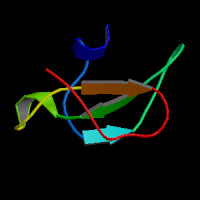
ModBase Predicted Comparative 3D Structure on A6NNT2 The pictures above may be empty if there is no ModBase structure for the protein. The ModBase structure frequently covers just a fragment of the protein. You may be asked to log onto ModBase the first time you click on the pictures. It is simplest after logging in to just click on the picture again to get to the specific info on that model.
Orthologous Genes in Other Species
Orthologies between human, mouse, and rat are computed by taking the best BLASTP hit, and filtering out non-syntenic hits. For more distant species reciprocal-best BLASTP hits are used. Note that the absence of an ortholog in the table below may reflect incomplete annotations in the other species rather than a true absence of the orthologous gene.
Descriptions from all associated GenBank mRNAs
JD058456 - Sequence 39480 from Patent EP1572962.JD198923 - Sequence 179947 from Patent EP1572962.JD103304 - Sequence 84328 from Patent EP1572962.JD399205 - Sequence 380229 from Patent EP1572962.JD065898 - Sequence 46922 from Patent EP1572962.JD213486 - Sequence 194510 from Patent EP1572962.JD535701 - Sequence 516725 from Patent EP1572962.JD200804 - Sequence 181828 from Patent EP1572962.JD424789 - Sequence 405813 from Patent EP1572962.JD454795 - Sequence 435819 from Patent EP1572962.JD267302 - Sequence 248326 from Patent EP1572962.JD182436 - Sequence 163460 from Patent EP1572962.JD394564 - Sequence 375588 from Patent EP1572962.JD186162 - Sequence 167186 from Patent EP1572962.JD431798 - Sequence 412822 from Patent EP1572962.JD063323 - Sequence 44347 from Patent EP1572962.JD059841 - Sequence 40865 from Patent EP1572962.JD360023 - Sequence 341047 from Patent EP1572962.JD052926 - Sequence 33950 from Patent EP1572962.JD162632 - Sequence 143656 from Patent EP1572962.JD475391 - Sequence 456415 from Patent EP1572962.JD437051 - Sequence 418075 from Patent EP1572962.JD310660 - Sequence 291684 from Patent EP1572962.JD145178 - Sequence 126202 from Patent EP1572962.JD379159 - Sequence 360183 from Patent EP1572962.JD039198 - Sequence 20222 from Patent EP1572962.JD045673 - Sequence 26697 from Patent EP1572962.JD048787 - Sequence 29811 from Patent EP1572962.JD488548 - Sequence 469572 from Patent EP1572962.JD292674 - Sequence 273698 from Patent EP1572962.JD221821 - Sequence 202845 from Patent EP1572962.JD395875 - Sequence 376899 from Patent EP1572962.JD047914 - Sequence 28938 from Patent EP1572962.JD521006 - Sequence 502030 from Patent EP1572962.JD112333 - Sequence 93357 from Patent EP1572962.JD480621 - Sequence 461645 from Patent EP1572962.JD362542 - Sequence 343566 from Patent EP1572962.JD160205 - Sequence 141229 from Patent EP1572962.JD141106 - Sequence 122130 from Patent EP1572962.JD291899 - Sequence 272923 from Patent EP1572962.JD149662 - Sequence 130686 from Patent EP1572962.JD174597 - Sequence 155621 from Patent EP1572962.JD176827 - Sequence 157851 from Patent EP1572962.JD310287 - Sequence 291311 from Patent EP1572962.JD332787 - Sequence 313811 from Patent EP1572962.JD449281 - Sequence 430305 from Patent EP1572962.JD183781 - Sequence 164805 from Patent EP1572962.JD449172 - Sequence 430196 from Patent EP1572962.JD399392 - Sequence 380416 from Patent EP1572962.JD463434 - Sequence 444458 from Patent EP1572962.JD537078 - Sequence 518102 from Patent EP1572962.JD133127 - Sequence 114151 from Patent EP1572962.AL049271 - Homo sapiens mRNA; cDNA DKFZp564G033 (from clone DKFZp564G033).
Other Names for This Gene
Alternate Gene Symbols: A6NNT2, C16orf96 , C9JH24, CP096_HUMAN, ENST00000444310.1, ENST00000444310.2, ENST00000444310.3, ENST00000444310.4, NM_001387219, uc010uxn.1, uc010uxn.2, uc010uxn.3, uc010uxn.4UCSC ID: ENST00000444310.5RefSeq Accession: NM_001145011.2 Protein: A6NNT2
(aka CP096_HUMAN)
Methods, Credits, and Use Restrictions
Click here
for details on how this gene model was made and data restrictions if any.
 Sequence and Links to Tools and Databases

 Microarray Expression Data