ID:CAC1H_HUMAN DESCRIPTION: RecName: Full=Voltage-dependent T-type calcium channel subunit alpha-1H; AltName: Full=Low-voltage-activated calcium channel alpha1 3.2 subunit; AltName: Full=Voltage-gated calcium channel subunit alpha Cav3.2; FUNCTION: Voltage-sensitive calcium channels (VSCC) mediate the entry of calcium ions into excitable cells and are also involved in a variety of calcium-dependent processes, including muscle contraction, hormone or neurotransmitter release, gene expression, cell motility, cell division and cell death. The isoform alpha-1H gives rise to T-type calcium currents. T-type calcium channels belong to the "low-voltage activated (LVA)" group and are strongly blocked by nickel and mibefradil. A particularity of this type of channels is an opening at quite negative potentials, and a voltage-dependent inactivation. T-type channels serve pacemaking functions in both central neurons and cardiac nodal cells and support calcium signaling in secretory cells and vascular smooth muscle. They may also be involved in the modulation of firing patterns of neurons which is important for information processing as well as in cell growth processes. SUBCELLULAR LOCATION: Membrane; Multi-pass membrane protein. TISSUE SPECIFICITY: Expressed in kidney, liver, heart, brain. Isoform 2 seems to be testis-specific. DOMAIN: Each of the four internal repeats contains five hydrophobic transmembrane segments (S1, S2, S3, S5, S6) and one positively charged transmembrane segment (S4). S4 segments probably represent the voltage-sensor and are characterized by a series of positively charged amino acids at every third position. PTM: In response to raising of intracellular calcium, the T-type channels are activated by CaM-kinase II. DISEASE: Defects in CACNA1H are a cause of susceptibility to epilepsy, idiopathic generalized type 6 (EIG6) [MIM:611942]. A disorder characterized by recurring generalized seizures in the absence of detectable brain lesions and/or metabolic abnormalities. Generalized seizures arise diffusely and simultaneously from both hemispheres of the brain. EIG6 is a polygenic and multifactorial disease. DISEASE: Defects in CACNA1H are a cause of susceptibility to epilepsy, childhood absence type 6 (ECA6) [MIM:611942]. A subtype of idiopathic generalized epilepsy characterized by an onset at age 6-7 years, frequent absence seizures (several per day) and bilateral, synchronous, symmetric 3-Hz spike waves on EEG. Tonic- clonic seizures often develop in adolescence. Absence seizures may either remit or persist into adulthood. SIMILARITY: Belongs to the calcium channel alpha-1 subunit (TC 1.A.1.11) family. CACNA1H subfamily. SEQUENCE CAUTION: Sequence=AAK61268.1; Type=Erroneous gene model prediction; Sequence=CAC42094.1; Type=Erroneous gene model prediction;
The RNAfold program from the Vienna RNA Package is used to perform the secondary structure predictions and folding calculations. The estimated folding energy is in kcal/mol. The more negative the energy, the more secondary structure the RNA is likely to have.
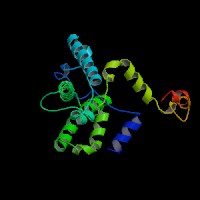
ModBase Predicted Comparative 3D Structure on O95180
Front
Top
Side
The pictures above may be empty if there is no ModBase structure for the protein. The ModBase structure frequently covers just a fragment of the protein. You may be asked to log onto ModBase the first time you click on the pictures. It is simplest after logging in to just click on the picture again to get to the specific info on that model.
Orthologous Genes in Other Species
Orthologies between human, mouse, and rat are computed by taking the best BLASTP hit, and filtering out non-syntenic hits. For more distant species reciprocal-best BLASTP hits are used. Note that the absence of an ortholog in the table below may reflect incomplete annotations in the other species rather than a true absence of the orthologous gene.
Gene Ontology (GO) Annotations with Structured Vocabulary
Molecular Function: GO:0005216 ion channel activity GO:0005244 voltage-gated ion channel activity GO:0005245 voltage-gated calcium channel activity GO:0005248 voltage-gated sodium channel activity GO:0005262 calcium channel activity GO:0005515 protein binding GO:0008332 low voltage-gated calcium channel activity GO:0046872 metal ion binding GO:0097110 scaffold protein binding
Biological Process: GO:0006811 ion transport GO:0006816 calcium ion transport GO:0006936 muscle contraction GO:0007517 muscle organ development GO:0007520 myoblast fusion GO:0008016 regulation of heart contraction GO:0019228 neuronal action potential GO:0032342 aldosterone biosynthetic process GO:0032870 cellular response to hormone stimulus GO:0034651 cortisol biosynthetic process GO:0034765 regulation of ion transmembrane transport GO:0035725 sodium ion transmembrane transport GO:0035865 cellular response to potassium ion GO:0042391 regulation of membrane potential GO:0045956 positive regulation of calcium ion-dependent exocytosis GO:0055085 transmembrane transport GO:0070509 calcium ion import GO:0070588 calcium ion transmembrane transport GO:0086010 membrane depolarization during action potential GO:0098662 inorganic cation transmembrane transport GO:2000344 positive regulation of acrosome reaction
Cellular Component: GO:0005886 plasma membrane GO:0005887 integral component of plasma membrane GO:0005891 voltage-gated calcium channel complex GO:0016020 membrane GO:0016021 integral component of membrane
Descriptions from all associated GenBank mRNAs
AF073931 - Homo sapiens low-voltage activated calcium channel alpha 1H mRNA, complete cds. AF051946 - Homo sapiens T-type calcium channel alpha 1H subunit (CACNA1H) mRNA, complete cds. AJ420779 - Homo sapiens mRNA for calcium channel, voltage-dependent, T type, alpha 1Hb subunit (CACNA1HB gene). JD129184 - Sequence 110208 from Patent EP1572962. JD206141 - Sequence 187165 from Patent EP1572962. JD462984 - Sequence 444008 from Patent EP1572962. JD141718 - Sequence 122742 from Patent EP1572962. JD484761 - Sequence 465785 from Patent EP1572962. JD462984 - Sequence 444008 from Patent EP1572962. JD141718 - Sequence 122742 from Patent EP1572962. JD484761 - Sequence 465785 from Patent EP1572962. JD459138 - Sequence 440162 from Patent EP1572962. DQ363526 - Homo sapiens low-voltage-activated calcium channel alpha1H subunit splice variant 512 (CACNA1H) mRNA, partial cds, alternatively spliced. DQ363527 - Homo sapiens low-voltage-activated calcium channel alpha1H subunit splice variant 513 (CACNA1H) mRNA, partial cds, alternatively spliced. DQ363528 - Homo sapiens low-voltage-activated calcium channel alpha1H subunit splice variant 544 (CACNA1H) mRNA, partial cds, alternatively spliced. DQ363529 - Homo sapiens low-voltage-activated calcium channel alpha1H subunit splice variant 577 (CACNA1H) mRNA, partial cds, alternatively spliced. AK074965 - Homo sapiens cDNA FLJ90484 fis, clone NT2RP3003000, highly similar to Voltage-dependent T-type calcium channel subunit alpha-1H. AF070604 - Homo sapiens clone 24597 mRNA sequence. JD223371 - Sequence 204395 from Patent EP1572962. JD219811 - Sequence 200835 from Patent EP1572962. JD179616 - Sequence 160640 from Patent EP1572962. JD167832 - Sequence 148856 from Patent EP1572962. JD116465 - Sequence 97489 from Patent EP1572962. JD290120 - Sequence 271144 from Patent EP1572962. JD396462 - Sequence 377486 from Patent EP1572962. JD329492 - Sequence 310516 from Patent EP1572962. JD538430 - Sequence 519454 from Patent EP1572962. JD140959 - Sequence 121983 from Patent EP1572962. JD544340 - Sequence 525364 from Patent EP1572962. JD121197 - Sequence 102221 from Patent EP1572962. JD405900 - Sequence 386924 from Patent EP1572962. JD102698 - Sequence 83722 from Patent EP1572962. JD205139 - Sequence 186163 from Patent EP1572962.
Biochemical and Signaling Pathways
KEGG - Kyoto Encyclopedia of Genes and Genomes hsa04010 - MAPK signaling pathway hsa04020 - Calcium signaling pathway
Reactome (by CSHL, EBI, and GO)
Protein O95180 (Reactome details) participates in the following event(s):
 Sequence and Links to Tools and Databases

 Microarray Expression Data