Human Gene CCDC6 (ENST00000263102.7) from GENCODE V50
  Description: coiled-coil domain containing 6 (from RefSeq NM_005436.5)
Gencode Transcript: ENST00000263102.7
Gencode Gene: ENSG00000108091.13
Transcript (Including UTRs)
   Position: hg38 chr10:59,788,747-59,906,556 Size: 117,810 Total Exon Count: 9 Strand: -
Coding Region
   Position: hg38 chr10:59,792,917-59,906,424 Size: 113,508 Coding Exon Count: 9 

Page IndexSequence and LinksUniProtKB CommentsPrimersMalaCardsCTD
RNA-Seq ExpressionMicroarray ExpressionRNA StructureProtein StructureOther SpeciesGO Annotations
mRNA DescriptionsPathwaysOther NamesMethods
Data last updated at UCSC: 2026-07-12 09:30:09

-  Comments and Description Text from UniProtKB
  ID: CCDC6_HUMAN
DESCRIPTION: RecName: Full=Coiled-coil domain-containing protein 6; AltName: Full=Papillary thyroid carcinoma-encoded protein; AltName: Full=Protein H4;
SUBCELLULAR LOCATION: Cytoplasm. Cytoplasm, cytoskeleton (Probable). Note=May be a cytoskeletal protein.
TISSUE SPECIFICITY: Ubiquitously expressed.
DOMAIN: The protein has mostly an alpha helical conformation similar to myosin heavy-chain tail that might adopt a coiled-coil conformation.
DISEASE: Defects in CCDC6 are a cause of thyroid papillary carcinoma (TPC) [MIM:188550]. TPC is a common tumor of the thyroid that typically arises as an irregular, solid or cystic mass from otherwise normal thyroid tissue. Papillary carcinomas are malignant neoplasm characterized by the formation of numerous, irregular, finger-like projections of fibrous stroma that is covered with a surface layer of neoplastic epithelial cells. Note=A chromosomal aberration involving CCDC6 is found in thyroid papillary carcinomas. Inversion inv(10)(q11.2;q21) generates the RET/CCDC6 (PTC1) oncogene.
SEQUENCE CAUTION: Sequence=AAC60637.1; Type=Frameshift; Positions=456;
WEB RESOURCE: Name=Atlas of Genetics and Cytogenetics in Oncology and Haematology; URL="http://atlasgeneticsoncology.org/Genes/H4ID280.html";

-  Primer design for this transcript
 

Primer3Plus can design qPCR Primers that straddle exon-exon-junctions, which amplify only cDNA, not genomic DNA.
Click here to load the transcript sequence and exon structure into Primer3Plus

Exonprimer can design one pair of Sanger sequencing primers around every exon, located in non-genic sequence.
Click here to open Exonprimer with this transcript

To design primers for a non-coding sequence, zoom to a region of interest and select from the drop-down menu: View > In External Tools > Primer3


-  MalaCards Disease Associations
  MalaCards Gene Search: CCDC6
Diseases sorted by gene-association score: differentiated thyroid carcinoma* (90), thyroid cancer (10), thyroid cancer, nonmedullary, 1 (8)
* = Manually curated disease association

-  Comparative Toxicogenomics Database (CTD)
  The following chemicals interact with this gene           more ... click here to view the complete list

-  RNA-Seq Expression Data from GTEx (53 Tissues, 570 Donors)
  Highest median expression: 21.23 RPKM in Esophagus - Mucosa
Total median expression: 617.31 RPKM


View in GTEx track of Genome Browser    View at GTEx portal     View GTEx Body Map

+  Microarray Expression Data
 
Expression ratio colors:

GTEx Gene Expression


Ratios


Absolute


Ratios


Absolute

GNF Expression Atlas 2 Data from U133A and GNF1H Chips


Ratios


Absolute


Ratios


Absolute


Ratios


Absolute

-  mRNA Secondary Structure of 3' and 5' UTRs
 
RegionFold EnergyBasesEnergy/Base
Display As
5' UTR -44.90132-0.340 Picture PostScript Text
3' UTR -1049.304170-0.252 Picture PostScript Text

The RNAfold program from the Vienna RNA Package is used to perform the secondary structure predictions and folding calculations. The estimated folding energy is in kcal/mol. The more negative the energy, the more secondary structure the RNA is likely to have.

-  Protein Domain and Structure Information
  InterPro Domains: Graphical view of domain structure
IPR019152 - DUF2046

Pfam Domains:
PF09755 - Uncharacterized conserved protein H4 (DUF2046)

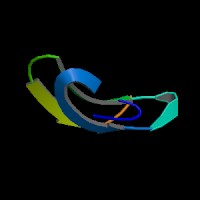
ModBase Predicted Comparative 3D Structure on Q16204
FrontTopSide
The pictures above may be empty if there is no ModBase structure for the protein. The ModBase structure frequently covers just a fragment of the protein. You may be asked to log onto ModBase the first time you click on the pictures. It is simplest after logging in to just click on the picture again to get to the specific info on that model.

-  Orthologous Genes in Other Species
  Orthologies between human, mouse, and rat are computed by taking the best BLASTP hit, and filtering out non-syntenic hits. For more distant species reciprocal-best BLASTP hits are used. Note that the absence of an ortholog in the table below may reflect incomplete annotations in the other species rather than a true absence of the orthologous gene.
MouseRatZebrafishD. melanogasterC. elegansS. cerevisiae
Genome BrowserGenome BrowserNo orthologNo orthologNo orthologNo ortholog
Gene Details     
Gene Sorter     
MGIRGD    
Protein SequenceProtein Sequence    
AlignmentAlignment    

-  Gene Ontology (GO) Annotations with Structured Vocabulary
  Molecular Function:
GO:0005200 structural constituent of cytoskeleton
GO:0005515 protein binding
GO:0017124 SH3 domain binding

Biological Process:
GO:0007010 cytoskeleton organization
GO:0008150 biological_process

Cellular Component:
GO:0005737 cytoplasm
GO:0005829 cytosol
GO:0005856 cytoskeleton


-  Descriptions from all associated GenBank mRNAs
  BC036757 - Homo sapiens coiled-coil domain containing 6, mRNA (cDNA clone MGC:46159 IMAGE:5549623), complete cds.
S72869 - H4(D10S170)=putative cytoskeletal protein [human, thyroid, mRNA, 3011 nt].
BC064391 - Homo sapiens coiled-coil domain containing 6, mRNA (cDNA clone MGC:75097 IMAGE:5745698), complete cds.
AK292593 - Homo sapiens cDNA FLJ75411 complete cds, highly similar to Homo sapiens coiled-coil domain containing 6, mRNA.
KJ897801 - Synthetic construct Homo sapiens clone ccsbBroadEn_07195 CCDC6 gene, encodes complete protein.
AB590767 - Synthetic construct DNA, clone: pFN21AE2187, Homo sapiens CCDC6 gene for coiled-coil domain containing 6, without stop codon, in Flexi system.
BC022284 - Homo sapiens coiled-coil domain containing 6, mRNA (cDNA clone IMAGE:4762273), partial cds.
AK024913 - Homo sapiens cDNA: FLJ21260 fis, clone COL01441.
AK055515 - Homo sapiens cDNA FLJ30953 fis, clone HCASM2000016.
JD562948 - Sequence 543972 from Patent EP1572962.
JD291373 - Sequence 272397 from Patent EP1572962.
AK056848 - Homo sapiens cDNA FLJ32286 fis, clone PROST2000273, highly similar to H4(D10S170) PROTEIN.
JD350407 - Sequence 331431 from Patent EP1572962.
JD292088 - Sequence 273112 from Patent EP1572962.
JD302593 - Sequence 283617 from Patent EP1572962.
JD561804 - Sequence 542828 from Patent EP1572962.
JD253373 - Sequence 234397 from Patent EP1572962.
JD102768 - Sequence 83792 from Patent EP1572962.
JD019185 - Sequence 209 from Patent EP1572962.
JD288666 - Sequence 269690 from Patent EP1572962.
JD036021 - Sequence 17045 from Patent EP1572962.
JD328611 - Sequence 309635 from Patent EP1572962.
KY623718 - Homo sapiens CCDC6-PDGFRB fusion protein mRNA, partial cds.
D90075 - Homo sapiens mRNA for ret-TPC, partial cds.
JD424053 - Sequence 405077 from Patent EP1572962.

-  Biochemical and Signaling Pathways
  KEGG - Kyoto Encyclopedia of Genes and Genomes
hsa05200 - Pathways in cancer
hsa05216 - Thyroid cancer

-  Other Names for This Gene
  Alternate Gene Symbols: CCDC6_HUMAN, D10S170, ENST00000263102.1, ENST00000263102.2, ENST00000263102.3, ENST00000263102.4, ENST00000263102.5, ENST00000263102.6, NM_005436, Q15250, Q16204, Q6GSG7, TST1, uc001jks.1, uc001jks.2, uc001jks.3, uc001jks.4, uc001jks.5, uc001jks.6
UCSC ID: ENST00000263102.7
RefSeq Accession: NM_005436.5
Protein: Q16204 (aka CCDC6_HUMAN or CCD6_HUMAN)
CCDS: CCDS7257.1

-  Methods, Credits, and Use Restrictions
  Click here for details on how this gene model was made and data restrictions if any.