ID:CLM6_HUMAN DESCRIPTION: RecName: Full=CMRF35-like molecule 6; Short=CLM-6; AltName: Full=CD300 antigen-like family member C; AltName: Full=CMRF35-A1; Short=CMRF-35; AltName: Full=Immunoglobulin superfamily member 16; Short=IgSF16; AltName: CD_antigen=CD300c; Flags: Precursor; SUBCELLULAR LOCATION: Cell membrane; Single-pass type I membrane protein (Potential). TISSUE SPECIFICITY: Present on the surface of monocytes, neutrophils, a proportion of peripheral blood T- and B-lymphocytes and lymphocytic cell lines. SIMILARITY: Belongs to the CD300 family. SIMILARITY: Contains 1 Ig-like V-type (immunoglobulin-like) domain.
The RNAfold program from the Vienna RNA Package is used to perform the secondary structure predictions and folding calculations. The estimated folding energy is in kcal/mol. The more negative the energy, the more secondary structure the RNA is likely to have.
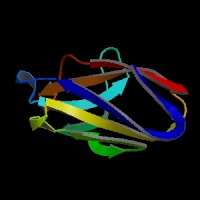
ModBase Predicted Comparative 3D Structure on Q08708
Front
Top
Side
The pictures above may be empty if there is no ModBase structure for the protein. The ModBase structure frequently covers just a fragment of the protein. You may be asked to log onto ModBase the first time you click on the pictures. It is simplest after logging in to just click on the picture again to get to the specific info on that model.
Orthologous Genes in Other Species
Orthologies between human, mouse, and rat are computed by taking the best BLASTP hit, and filtering out non-syntenic hits. For more distant species reciprocal-best BLASTP hits are used. Note that the absence of an ortholog in the table below may reflect incomplete annotations in the other species rather than a true absence of the orthologous gene.
Biological Process: GO:0002376 immune system process GO:0006968 cellular defense response GO:0007165 signal transduction GO:0050776 regulation of immune response
 Sequence and Links to Tools and Databases

 Microarray Expression Data