Human Gene CD300LF (ENST00000326165.11) from GENCODE V50
Description: CD300 molecule like family member f, transcript variant 1 (from RefSeq NM_139018.5)Gencode Transcript: ENST00000326165.11Gencode Gene: ENSG00000186074.21Transcript (Including UTRs) Position: hg38 chr17:74,694,317-74,712,923 Size: 18,607 Total Exon Count: 7 Strand: -Coding Region Position: hg38 chr17:74,695,096-74,712,866 Size: 17,771 Coding Exon Count: 7
Data last updated at UCSC: 2026-07-12 09:30:09
Sequence and Links to Tools and Databases
Comments and Description Text from UniProtKB
ID: CLM1_HUMAN DESCRIPTION: RecName: Full=CMRF35-like molecule 1; Short=CLM-1; AltName: Full=CD300 antigen-like family member F; AltName: Full=Immune receptor expressed on myeloid cells 1; Short=IREM-1; AltName: Full=Immunoglobulin superfamily member 13; Short=IgSF13; AltName: Full=NK inhibitory receptor; AltName: CD_antigen=CD300f; Flags: Precursor;FUNCTION: Acts as an inhibitory receptor for myeloid cells and mast cells. Inhibits osteoclast formation.SUBUNIT: Interacts with PTPN6/SHP-1 in a tyrosine phosphorylation dependent manner.SUBCELLULAR LOCATION: Cell membrane; Single-pass type I membrane protein (Potential).TISSUE SPECIFICITY: Highly expressed in spleen, peripheral blood leukocyte and monocyte, and lung. Weakly expressed in thymus, heart, brain, placenta, liver, skeletal muscle, kidney, pancreas, prostate, testis, ovary, small intestine or colon. Expressed selectively in monocytes and monocyte-related cells.PTM: Phosphorylated on tyrosine.SIMILARITY: Belongs to the CD300 family.SIMILARITY: Contains 1 Ig-like V-type (immunoglobulin-like) domain.
Primer design for this transcript
Comparative Toxicogenomics Database (CTD)
RNA-Seq Expression Data from GTEx (53 Tissues, 570 Donors)
mRNA Secondary Structure of 3' and 5' UTRs
Vienna RNA Package is used to perform the secondary structure predictions and folding calculations. The estimated folding energy is in kcal/mol. The more negative the energy, the more secondary structure the RNA is likely to have.
Protein Domain and Structure Information
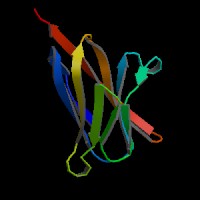
InterPro Domains: Graphical view of domain structure IPR007110 - Ig-likeIPR013783 - Ig-like_foldIPR003599 - Ig_subIPR013106 - Ig_V-setPfam Domains: PF07686 - Immunoglobulin V-set domainProtein Data Bank (PDB) 3-D Structure ModBase Predicted Comparative 3D Structure on Q8TDQ1 The pictures above may be empty if there is no ModBase structure for the protein. The ModBase structure frequently covers just a fragment of the protein. You may be asked to log onto ModBase the first time you click on the pictures. It is simplest after logging in to just click on the picture again to get to the specific info on that model.
Orthologous Genes in Other Species
Orthologies between human, mouse, and rat are computed by taking the best BLASTP hit, and filtering out non-syntenic hits. For more distant species reciprocal-best BLASTP hits are used. Note that the absence of an ortholog in the table below may reflect incomplete annotations in the other species rather than a true absence of the orthologous gene.
Gene Ontology (GO) Annotations with Structured Vocabulary
Molecular Function: GO:0001786 phosphatidylserine bindingGO:0005136 interleukin-4 receptor bindingGO:0008289 lipid bindingGO:0097001 ceramide bindingBiological Process: GO:0002376 immune system processGO:0033004 negative regulation of mast cell activationGO:0034125 negative regulation of MyD88-dependent toll-like receptor signaling pathwayGO:0035666 TRIF-dependent toll-like receptor signaling pathwayGO:0035772 interleukin-13-mediated signaling pathwayGO:0050776 regulation of immune responseGO:1902216 positive regulation of interleukin-4-mediated signaling pathwayGO:2000426 negative regulation of apoptotic cell clearanceGO:2000427 positive regulation of apoptotic cell clearanceCellular Component: GO:0005886 plasma membraneGO:0016020 membraneGO:0016021 integral component of membrane
Descriptions from all associated GenBank mRNAs
AF251706 - Homo sapiens NK inhibitory receptor precursor (NKIR) mRNA, complete cds.AY358545 - Homo sapiens clone DNA125200 PIGR (UNQ3105) mRNA, complete cds.BC028199 - Homo sapiens CD300 molecule-like family member f, mRNA (cDNA clone MGC:40116 IMAGE:5207520), complete cds.AK092757 - Homo sapiens cDNA FLJ35438 fis, clone SMINT2002884, weakly similar to CMRF35 ANTIGEN PRECURSOR.AX747710 - Sequence 1235 from Patent EP1308459.AK298752 - Homo sapiens cDNA FLJ52935 complete cds, highly similar to CMRF35-like-molecule 1 precursor.AY303545 - Homo sapiens inhibitory receptor IREM1 (IREM1) mRNA, complete cds.AK315165 - Homo sapiens cDNA, FLJ96140, highly similar to Homo sapiens NK inhibitory receptor precursor (NKIR), mRNA.JD151152 - Sequence 132176 from Patent EP1572962.JD250755 - Sequence 231779 from Patent EP1572962.JD148631 - Sequence 129655 from Patent EP1572962.JD516139 - Sequence 497163 from Patent EP1572962.JD038191 - Sequence 19215 from Patent EP1572962.JD092257 - Sequence 73281 from Patent EP1572962.JD473051 - Sequence 454075 from Patent EP1572962.JD508705 - Sequence 489729 from Patent EP1572962.JD053532 - Sequence 34556 from Patent EP1572962.JD157316 - Sequence 138340 from Patent EP1572962.AF375480 - Homo sapiens immune receptor expressed on myeloid cells splice variant 1 (IREM1) mRNA, complete cds; alternatively spliced.AF375481 - Homo sapiens immune receptor expressed on myeloid cells splice variant 2 (IREM1) mRNA, complete cds; alternatively spliced.JD341665 - Sequence 322689 from Patent EP1572962.JD370654 - Sequence 351678 from Patent EP1572962.JD385802 - Sequence 366826 from Patent EP1572962.KJ905002 - Synthetic construct Homo sapiens clone ccsbBroadEn_14396 CD300LF gene, encodes complete protein.DQ153249 - Homo sapiens unknown mRNA.
Biochemical and Signaling Pathways
Other Names for This Gene
Alternate Gene Symbols: B2RCL2, C9JDN3, CD300F, CLM1, CLM1_HUMAN, ENST00000326165.1, ENST00000326165.10, ENST00000326165.2, ENST00000326165.3, ENST00000326165.4, ENST00000326165.5, ENST00000326165.6, ENST00000326165.7, ENST00000326165.8, ENST00000326165.9, IGSF13, IREM1, NKIR, NM_139018, Q3Y6P0, Q6UX24, Q7Z6A6, Q7Z7I4, Q7Z7I5, Q8N6D0, Q8NAF5, Q8TDQ1, uc002jlg.1, uc002jlg.2, uc002jlg.3, uc002jlg.4, uc002jlg.5, uc002jlg.6, UNQ3105/PRO10111UCSC ID: ENST00000326165.11RefSeq Accession: NM_139018.5 Protein: Q8TDQ1
(aka CLM1_HUMAN)CCDS: CCDS11704.1 , CCDS74152.1
Methods, Credits, and Use Restrictions
Click here
for details on how this gene model was made and data restrictions if any.
 Sequence and Links to Tools and Databases