Human Gene CHRNE (ENST00000649488.2) from GENCODE V50
  Description: cholinergic receptor nicotinic epsilon subunit (from RefSeq NM_000080.4)
Gencode Transcript: ENST00000649488.2
Gencode Gene: ENSG00000108556.11
Transcript (Including UTRs)
   Position: hg38 chr17:4,897,771-4,903,098 Size: 5,328 Total Exon Count: 12 Strand: -
Coding Region
   Position: hg38 chr17:4,898,736-4,903,063 Size: 4,328 Coding Exon Count: 12 

Page IndexSequence and LinksUniProtKB CommentsPrimersMalaCardsCTD
RNA-Seq ExpressionMicroarray ExpressionRNA StructureProtein StructureOther SpeciesGO Annotations
mRNA DescriptionsPathwaysOther NamesGeneReviewsMethods
Data last updated at UCSC: 2026-07-12 09:30:09

-  Comments and Description Text from UniProtKB
  ID: ACHE_HUMAN
DESCRIPTION: RecName: Full=Acetylcholine receptor subunit epsilon; Flags: Precursor;
FUNCTION: After binding acetylcholine, the AChR responds by an extensive change in conformation that affects all subunits and leads to opening of an ion-conducting channel across the plasma membrane.
SUBUNIT: Pentamer of two alpha chains, and one each of the beta, delta, and gamma (in immature muscle) or epsilon (in mature muscle) chains.
SUBCELLULAR LOCATION: Cell junction, synapse, postsynaptic cell membrane; Multi-pass membrane protein. Cell membrane; Multi-pass membrane protein.
DISEASE: Note=The muscle AChR is the major target antigen in the autoimmune disease myasthenia gravis. Myasthenia gravis is characterized by sporadic muscular fatigability and weakness, occurring chiefly in muscles innervated by cranial nerves, and characteristically improved by cholinesterase-inhibiting drugs.
DISEASE: Defects in CHRNE are a cause of congenital myasthenic syndrome slow-channel type (SCCMS) [MIM:601462]. SCCMS is the most common congenital myasthenic syndrome. Congenital myasthenic syndromes are characterized by muscle weakness affecting the axial and limb muscles (with hypotonia in early-onset forms), the ocular muscles (leading to ptosis and ophthalmoplegia), and the facial and bulbar musculature (affecting sucking and swallowing, and leading to dysphonia). The symptoms fluctuate and worsen with physical effort. SCCMS is caused by kinetic abnormalities of the AChR, resulting in prolonged endplate currents and prolonged AChR channel opening episodes.
DISEASE: Defects in CHRNE are a cause of congenital myasthenic syndrome fast-channel type (FCCMS) [MIM:608930]. FCCMS is a congenital myasthenic syndrome characterized by kinetic abnormalities of the AChR. In most cases, FCCMS is due to mutations that decrease activity of the AChR by slowing the rate of opening of the receptor channel, speeding the rate of closure of the channel, or decreasing the number of openings of the channel during ACh occupancy. The result is failure to achieve threshold depolarization of the endplate and consequent failure to fire an action potential.
DISEASE: Defects in CHRNE are a cause of congenital myasthenic syndrome with acetylcholine receptor deficiency (CMS-ACHRD) [MIM:608931]. CMS-ACHRD is a postsynaptic congenital myasthenic syndrome. Mutations underlying AChR deficiency cause a 'loss of function' and show recessive inheritance.
SIMILARITY: Belongs to the ligand-gated ion channel (TC 1.A.9) family. Acetylcholine receptor (TC 1.A.9.1) subfamily. Epsilon/CHRNE sub-subfamily.
WEB RESOURCE: Name=GeneReviews; URL="http://www.ncbi.nlm.nih.gov/sites/GeneTests/lab/gene/CHRNE";

-  Primer design for this transcript
 

Primer3Plus can design qPCR Primers that straddle exon-exon-junctions, which amplify only cDNA, not genomic DNA.
Click here to load the transcript sequence and exon structure into Primer3Plus

Exonprimer can design one pair of Sanger sequencing primers around every exon, located in non-genic sequence.
Click here to open Exonprimer with this transcript

To design primers for a non-coding sequence, zoom to a region of interest and select from the drop-down menu: View > In External Tools > Primer3


-  Comparative Toxicogenomics Database (CTD)
  The following chemicals interact with this gene           more ... click here to view the complete list

-  RNA-Seq Expression Data from GTEx (53 Tissues, 570 Donors)
  Highest median expression: 35.31 RPKM in Heart - Atrial Appendage
Total median expression: 93.73 RPKM


View in GTEx track of Genome Browser    View at GTEx portal     View GTEx Body Map

+  Microarray Expression Data
 
Expression ratio colors:

GTEx Gene Expression


Ratios


Absolute


Ratios


Absolute

GNF Expression Atlas 2 Data from U133A and GNF1H Chips


Ratios


Absolute


Ratios


Absolute


Ratios


Absolute

-  mRNA Secondary Structure of 3' and 5' UTRs
 
RegionFold EnergyBasesEnergy/Base
Display As
5' UTR -5.5035-0.157 Picture PostScript Text
3' UTR -383.80965-0.398 Picture PostScript Text

The RNAfold program from the Vienna RNA Package is used to perform the secondary structure predictions and folding calculations. The estimated folding energy is in kcal/mol. The more negative the energy, the more secondary structure the RNA is likely to have.

-  Protein Domain and Structure Information
  InterPro Domains: Graphical view of domain structure
IPR006202 - Neur_chan_lig-bd
IPR006201 - Neur_channel
IPR006029 - Neurotrans-gated_channel_TM
IPR018000 - Neurotransmitter_ion_chnl_CS
IPR002394 - Nicotinic_acetylcholine_rcpt

Pfam Domains:
PF02931 - Neurotransmitter-gated ion-channel ligand binding domain
PF02932 - Neurotransmitter-gated ion-channel transmembrane region

Protein Data Bank (PDB) 3-D Structure
MuPIT help
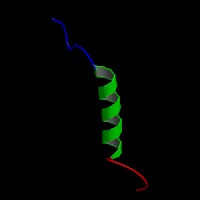
2DF9 - Model


ModBase Predicted Comparative 3D Structure on Q04844
FrontTopSide
The pictures above may be empty if there is no ModBase structure for the protein. The ModBase structure frequently covers just a fragment of the protein. You may be asked to log onto ModBase the first time you click on the pictures. It is simplest after logging in to just click on the picture again to get to the specific info on that model.

-  Orthologous Genes in Other Species
  Orthologies between human, mouse, and rat are computed by taking the best BLASTP hit, and filtering out non-syntenic hits. For more distant species reciprocal-best BLASTP hits are used. Note that the absence of an ortholog in the table below may reflect incomplete annotations in the other species rather than a true absence of the orthologous gene.
MouseRatZebrafishD. melanogasterC. elegansS. cerevisiae
Genome BrowserGenome BrowserGenome BrowserNo orthologNo orthologNo ortholog
Gene Details     
Gene Sorter     
MGIRGDEnsembl   
Protein SequenceProtein SequenceProtein Sequence   
AlignmentAlignmentAlignment   

-  Gene Ontology (GO) Annotations with Structured Vocabulary
  Molecular Function:
GO:0004888 transmembrane signaling receptor activity
GO:0005216 ion channel activity
GO:0005230 extracellular ligand-gated ion channel activity
GO:0008324 cation transmembrane transporter activity
GO:0015276 ligand-gated ion channel activity
GO:0015464 acetylcholine receptor activity
GO:0022848 acetylcholine-gated cation-selective channel activity
GO:0042166 acetylcholine binding

Biological Process:
GO:0006811 ion transport
GO:0006936 muscle contraction
GO:0007165 signal transduction
GO:0007271 synaptic transmission, cholinergic
GO:0007274 neuromuscular synaptic transmission
GO:0034220 ion transmembrane transport
GO:0035094 response to nicotine
GO:0042391 regulation of membrane potential
GO:0060078 regulation of postsynaptic membrane potential
GO:0060079 excitatory postsynaptic potential
GO:0098655 cation transmembrane transport

Cellular Component:
GO:0005886 plasma membrane
GO:0005887 integral component of plasma membrane
GO:0005892 acetylcholine-gated channel complex
GO:0016020 membrane
GO:0016021 integral component of membrane
GO:0030054 cell junction
GO:0045202 synapse
GO:0045211 postsynaptic membrane


-  Descriptions from all associated GenBank mRNAs
  X66403 - H.sapiens mRNA for acetylcholine receptor (epsilon subunit).
JD113451 - Sequence 94475 from Patent EP1572962.
JD416767 - Sequence 397791 from Patent EP1572962.
JD271390 - Sequence 252414 from Patent EP1572962.
JD477321 - Sequence 458345 from Patent EP1572962.
JD403900 - Sequence 384924 from Patent EP1572962.
JD383381 - Sequence 364405 from Patent EP1572962.
JD209958 - Sequence 190982 from Patent EP1572962.
JD164517 - Sequence 145541 from Patent EP1572962.
JD445159 - Sequence 426183 from Patent EP1572962.
JD192321 - Sequence 173345 from Patent EP1572962.
JD323427 - Sequence 304451 from Patent EP1572962.
JD379282 - Sequence 360306 from Patent EP1572962.
JD434423 - Sequence 415447 from Patent EP1572962.
JD050572 - Sequence 31596 from Patent EP1572962.
JD175072 - Sequence 156096 from Patent EP1572962.
JD372844 - Sequence 353868 from Patent EP1572962.
JD127316 - Sequence 108340 from Patent EP1572962.
JD519802 - Sequence 500826 from Patent EP1572962.
JD252060 - Sequence 233084 from Patent EP1572962.
BC157043 - Synthetic construct Homo sapiens clone IMAGE:100063329, MGC:190745 cholinergic receptor, nicotinic, epsilon (CHRNE) mRNA, encodes complete protein.
BC156077 - Synthetic construct Homo sapiens clone IMAGE:100062333, MGC:190466 cholinergic receptor, nicotinic, epsilon (CHRNE) mRNA, encodes complete protein.

-  Biochemical and Signaling Pathways
  KEGG - Kyoto Encyclopedia of Genes and Genomes
hsa04080 - Neuroactive ligand-receptor interaction

Reactome (by CSHL, EBI, and GO)

Protein Q04844 (Reactome details) participates in the following event(s):

R-HSA-622325 Activation of highly sodium permeable nicotinic acetylcholine receptors
R-HSA-629588 Binding of acetylcholine to highly sodium permeable acetylcholine receptors
R-HSA-629587 Highly sodium permeable acetylcholine nicotinic receptors
R-HSA-622323 Presynaptic nicotinic acetylcholine receptors
R-HSA-622327 Postsynaptic nicotinic acetylcholine receptors
R-HSA-629602 Activation of Nicotinic Acetylcholine Receptors
R-HSA-181431 Acetylcholine binding and downstream events
R-HSA-112314 Neurotransmitter receptors and postsynaptic signal transmission
R-HSA-112315 Transmission across Chemical Synapses
R-HSA-112316 Neuronal System

-  Other Names for This Gene
  Alternate Gene Symbols: ACHE_HUMAN, ACHRE, D3DTK6, ENST00000649488.1, NM_000080, Q04844, uc285nuv.1, uc285nuv.2
UCSC ID: ENST00000649488.2
RefSeq Accession: NM_000080.4
Protein: Q04844 (aka ACHE_HUMAN)
CCDS: CCDS11058.1

-  GeneReviews for This Gene
  GeneReviews article(s) related to gene CHRNE:
cms (Congenital Myasthenic Syndromes Overview)

-  Methods, Credits, and Use Restrictions
  Click here for details on how this gene model was made and data restrictions if any.