ID:CIDEA_HUMAN DESCRIPTION: RecName: Full=Cell death activator CIDE-A; AltName: Full=Cell death-inducing DFFA-like effector A; FUNCTION: Acts as a CEBPB coactivator in mammary epithelial cells to control the expression of a subset of CEBPB downstream target genes, including ID2, IGF1, PRLR, SOCS1, SOCS3, XDH, but not casein. By interacting with CEBPB, strengthens the association of CEBPB with the XDH promoter, increases histone acetylation and dissociates HDAC1 from the promoter (By similarity). Binds to lipid droplets and regulates their enlargement, thereby restricting lipolysis and favoring storage. At focal contact sites between lipid droplets, promotes directional net neutral lipid transfer from the smaller to larger lipid droplets. The transfer direction may be driven by the internal pressure difference between the contacting lipid droplet pair and occurs at a lower rate than that promoted by CIDEC. When overexpressed, induces apoptosis. The physiological significance of its role in apoptosis is unclear. SUBUNIT: Directly interacts with CEBPB (By similarity). Interacts with CIDEC. SUBCELLULAR LOCATION: Lipid droplet. Nucleus (By similarity). Note=Enriched at lipid droplet contact sites. Has been shown to localize to mitonchondria, where it could interact with UCP1 and hence inhibit UCP1 uncoupling activity (By similarity). These data could not be confirmed (PubMed:18509062). TISSUE SPECIFICITY: Expressed in omental and subcutaneous adipose tissue (at protein level). DISEASE: Note=In omental and subcutaneous adipose tissue of obese patients matched for BMI, expression levels correlate with insulin sensitivity. Expression is increased 5-6 fold in the group of patients with high insulin sensitivity, compared to the insulin- resistant group. This observation is consistent with the idea that triglyceride storage in adipocytes plays an important role in sequestering triglycerides and fatty acids away from the circulation and peripheral tissues, thus enhancing insulin sensitivity in liver and muscle. SIMILARITY: Contains 1 CIDE-N domain.
The RNAfold program from the Vienna RNA Package is used to perform the secondary structure predictions and folding calculations. The estimated folding energy is in kcal/mol. The more negative the energy, the more secondary structure the RNA is likely to have.
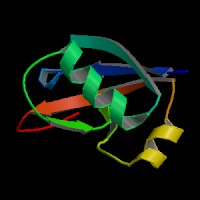
ModBase Predicted Comparative 3D Structure on O60543
Front
Top
Side
The pictures above may be empty if there is no ModBase structure for the protein. The ModBase structure frequently covers just a fragment of the protein. You may be asked to log onto ModBase the first time you click on the pictures. It is simplest after logging in to just click on the picture again to get to the specific info on that model.
Orthologous Genes in Other Species
Orthologies between human, mouse, and rat are computed by taking the best BLASTP hit, and filtering out non-syntenic hits. For more distant species reciprocal-best BLASTP hits are used. Note that the absence of an ortholog in the table below may reflect incomplete annotations in the other species rather than a true absence of the orthologous gene.
Gene Ontology (GO) Annotations with Structured Vocabulary
Molecular Function: GO:0042803 protein homodimerization activity
Biological Process: GO:0001659 temperature homeostasis GO:0006351 transcription, DNA-templated GO:0006355 regulation of transcription, DNA-templated GO:0006629 lipid metabolic process GO:0006915 apoptotic process GO:0008219 cell death GO:0010890 positive regulation of sequestering of triglyceride GO:0019915 lipid storage GO:0030512 negative regulation of transforming growth factor beta receptor signaling pathway GO:0032720 negative regulation of tumor necrosis factor production GO:0034389 lipid particle organization GO:0035634 response to stilbenoid GO:0042981 regulation of apoptotic process GO:0050710 negative regulation of cytokine secretion GO:0050995 negative regulation of lipid catabolic process GO:1900118 negative regulation of execution phase of apoptosis GO:1902510 regulation of apoptotic DNA fragmentation
 Sequence and Links to Tools and Databases

 Microarray Expression Data