ID:CLC4M_HUMAN DESCRIPTION: RecName: Full=C-type lectin domain family 4 member M; AltName: Full=CD209 antigen-like protein 1; AltName: Full=DC-SIGN-related protein; Short=DC-SIGNR; AltName: Full=Dendritic cell-specific ICAM-3-grabbing non-integrin 2; Short=DC-SIGN2; AltName: Full=Liver/lymph node-specific ICAM-3-grabbing non-integrin; Short=L-SIGN; AltName: CD_antigen=CD299; FUNCTION: Probable pathogen-recognition receptor involved in peripheral immune surveillance in liver. May mediate the endocytosis of pathogens which are subsequently degraded in lysosomal compartments. Probably recognizes in a calcium-dependent manner high mannose N-linked oligosaccharides in a variety of pathogen antigens, including HIV-1 gp120, HIV-2 gp120, SIV gp120, ebolavirus glycoproteins, HCV E2, and human SARS coronavirus protein S. Is a receptor for ICAM3, probably by binding to mannose-like carbohydrates. Is presumably a coreceptor for the SARS coronavirus. SUBUNIT: Homotetramer. Binds to many viral surface glycoproteins such as HIV-1 gp120, HIV-2 gp120, SIV gp120, ebolavirus glycoproteins, HCV E2, and human SARS coronavirus S protein. SUBCELLULAR LOCATION: Isoform 1: Cell membrane; Single-pass type II membrane protein (Potential). SUBCELLULAR LOCATION: Isoform 2: Cell membrane; Single-pass type II membrane protein (Potential). SUBCELLULAR LOCATION: Isoform 3: Cell membrane; Single-pass type II membrane protein (Potential). SUBCELLULAR LOCATION: Isoform 5: Secreted (Potential). SUBCELLULAR LOCATION: Isoform 6: Secreted (Potential). SUBCELLULAR LOCATION: Isoform 7: Secreted (Potential). SUBCELLULAR LOCATION: Isoform 10: Secreted (Potential). TISSUE SPECIFICITY: Predominantly highly expressed in liver sinusoidal endothelial cells and in lymph node. Found in placental endothelium but not in macrophages. Expressed in type II alveolar cells and lung endothelial cells. DOMAIN: The tandem repeat domain, also called neck domain, mediates oligomerization. POLYMORPHISM: The number of repeats in the tandem repeat domain is shown to vary between 3 and 9 per allele thus contributing to a further variability in addition to alternative splicing. The shown 7 repeat-containing form has been shown to be the most frequent one (53.9%) in a study with 350 Caucasian individuals. MISCELLANEOUS: In vitro, is a receptor for HIV-1 and transmits HIV-1 to permissive T-cells. SIMILARITY: Contains 1 C-type lectin domain. SEQUENCE CAUTION: Sequence=AAR04559.1; Type=Miscellaneous discrepancy; Note=Aberrant splicing; WEB RESOURCE: Name=Functional Glycomics Gateway - Glycan Binding; Note=DC-SIGNR; URL="http://www.functionalglycomics.org/glycomics/GBPServlet?&operationType=view&cbpId=cbp_hum_Ctlect_00122";
The RNAfold program from the Vienna RNA Package is used to perform the secondary structure predictions and folding calculations. The estimated folding energy is in kcal/mol. The more negative the energy, the more secondary structure the RNA is likely to have.
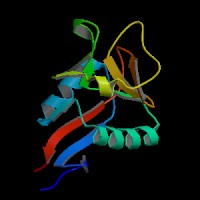
ModBase Predicted Comparative 3D Structure on Q9H2X3
Front
Top
Side
The pictures above may be empty if there is no ModBase structure for the protein. The ModBase structure frequently covers just a fragment of the protein. You may be asked to log onto ModBase the first time you click on the pictures. It is simplest after logging in to just click on the picture again to get to the specific info on that model.
Orthologous Genes in Other Species
Orthologies between human, mouse, and rat are computed by taking the best BLASTP hit, and filtering out non-syntenic hits. For more distant species reciprocal-best BLASTP hits are used. Note that the absence of an ortholog in the table below may reflect incomplete annotations in the other species rather than a true absence of the orthologous gene.
AK292278 - Homo sapiens cDNA FLJ77783 complete cds, highly similar to Homo sapiens CD209 antigen-like (CD209L), mRNA. BC038851 - Homo sapiens C-type lectin domain family 4, member M, mRNA (cDNA clone MGC:47866 IMAGE:5166966), complete cds. AF290887 - Homo sapiens L-SIGN mRNA, complete cds. AK314704 - Homo sapiens cDNA, FLJ95558. AK304499 - Homo sapiens cDNA FLJ52840 complete cds, highly similar to C-type lectin domain family 4 member M. JD231731 - Sequence 212755 from Patent EP1572962. JD206134 - Sequence 187158 from Patent EP1572962. AB015629 - Homo sapiens mRNA for type II membrane protein similar to HIV gp120-binding C-type lectin, complete cds, clone:HP01347. AF245219 - Homo sapiens probable mannose binding C-type lectin DC-SIGNR mRNA, complete cds. AK298084 - Homo sapiens cDNA FLJ55003 complete cds, highly similar to Homo sapiens C-type lectin domain family 4, member M (CLEC4M), transcript variant 6, mRNA. AK023750 - Homo sapiens cDNA FLJ13688 fis, clone PLACE2000062, highly similar to Homo sapiens mRNA for type II membrane protein. BC110614 - Homo sapiens C-type lectin domain family 4, member M, mRNA (cDNA clone MGC:129964 IMAGE:40032453), complete cds. KJ902090 - Synthetic construct Homo sapiens clone ccsbBroadEn_11484 CLEC4M gene, encodes complete protein. DQ893779 - Synthetic construct Homo sapiens clone IMAGE:100008239; FLH167490.01L; RZPDo839B0589D C-type lectin domain family 4, member M (CLEC4M) gene, encodes complete protein. KJ898195 - Synthetic construct Homo sapiens clone ccsbBroadEn_07589 CLEC4M gene, encodes complete protein. AY343913 - Homo sapiens L-SIGN variant (CD209L) mRNA, complete cds. AY042234 - Homo sapiens mDC-SIGN2 type I isoform (CD209L) mRNA, complete cds, alternatively spliced. AY042235 - Homo sapiens mDC-SIGN2 type III isoform (CD209L) mRNA, complete cds, alternatively spliced. AY042236 - Homo sapiens mDC-SIGN2 type IV isoform (CD209L) mRNA, complete cds, alternatively spliced. AY042237 - Homo sapiens mDC-SIGN2 type VI isoform (CD209L) mRNA, complete cds, alternatively spliced. AY042238 - Homo sapiens sDC-SIGN2 type I isoform (CD209L) mRNA, complete cds, alternatively spliced. AY042239 - Homo sapiens sDC-SIGN2 type II isoform (CD209L) mRNA, complete cds, alternatively spliced. AY042240 - Homo sapiens sDC-SIGN2 type III isoform (CD209L) mRNA, complete cds, alternatively spliced. JD555088 - Sequence 536112 from Patent EP1572962. JD462147 - Sequence 443171 from Patent EP1572962. JD094413 - Sequence 75437 from Patent EP1572962. JD249117 - Sequence 230141 from Patent EP1572962. JD276142 - Sequence 257166 from Patent EP1572962. JD251588 - Sequence 232612 from Patent EP1572962. JD249348 - Sequence 230372 from Patent EP1572962. JD535830 - Sequence 516854 from Patent EP1572962. JD111353 - Sequence 92377 from Patent EP1572962. JD516861 - Sequence 497885 from Patent EP1572962.
 Sequence and Links to Tools and Databases

 Microarray Expression Data