Human Gene COQ7 (ENST00000321998.10) from GENCODE V50
  Description: coenzyme Q7, hydroxylase, transcript variant 12 (from RefSeq NR_163450.1)
Gencode Transcript: ENST00000321998.10
Gencode Gene: ENSG00000167186.13
Transcript (Including UTRs)
   Position: hg38 chr16:19,067,614-19,080,095 Size: 12,482 Total Exon Count: 6 Strand: +
Coding Region
   Position: hg38 chr16:19,067,665-19,078,158 Size: 10,494 Coding Exon Count: 6 

Page IndexSequence and LinksUniProtKB CommentsPrimersMalaCardsCTD
RNA-Seq ExpressionMicroarray ExpressionRNA StructureProtein StructureOther SpeciesGO Annotations
mRNA DescriptionsPathwaysOther NamesGeneReviewsMethods
Data last updated at UCSC: 2026-07-12 09:30:09

-  Comments and Description Text from UniProtKB
  ID: COQ7_HUMAN
DESCRIPTION: RecName: Full=Ubiquinone biosynthesis protein COQ7 homolog; AltName: Full=Coenzyme Q biosynthesis protein 7 homolog; AltName: Full=Timing protein clk-1 homolog; Flags: Precursor;
FUNCTION: Involved in lifespan determination in ubiquinone- independent manner. Involved in ubiquinone biosynthesis. Potential central metabolic regulator (By similarity).
COFACTOR: Binds 2 iron ions per subunit (By similarity).
PATHWAY: Cofactor biosynthesis; ubiquinone biosynthesis.
SUBCELLULAR LOCATION: Mitochondrion inner membrane; Peripheral membrane protein; Matrix side. Note=Synthesized as a preprotein that is imported into the mitochondrial matrix, where the sequence is cleaved off and the mature protein becomes loosely associated with the inner membrane (By similarity).
TISSUE SPECIFICITY: Expressed dominantly in heart and skeletal muscle.
SIMILARITY: Belongs to the COQ7 family.

-  Primer design for this transcript
 

Primer3Plus can design qPCR Primers that straddle exon-exon-junctions, which amplify only cDNA, not genomic DNA.
Click here to load the transcript sequence and exon structure into Primer3Plus

Exonprimer can design one pair of Sanger sequencing primers around every exon, located in non-genic sequence.
Click here to open Exonprimer with this transcript

To design primers for a non-coding sequence, zoom to a region of interest and select from the drop-down menu: View > In External Tools > Primer3


-  MalaCards Disease Associations
  MalaCards Gene Search: COQ7
Diseases sorted by gene-association score: coenzyme q10 deficiency, primary, 8* (1280), coq7-related coenzyme q10 deficiency* (500)
* = Manually curated disease association

-  Comparative Toxicogenomics Database (CTD)
  The following chemicals interact with this gene           more ... click here to view the complete list

-  RNA-Seq Expression Data from GTEx (53 Tissues, 570 Donors)
  Highest median expression: 8.87 RPKM in Testis
Total median expression: 235.32 RPKM


View in GTEx track of Genome Browser    View at GTEx portal     View GTEx Body Map

+  Microarray Expression Data
 
Expression ratio colors:

GNF Expression Atlas 2 Data from U133A and GNF1H Chips


Ratios


Absolute


Ratios


Absolute


Ratios


Absolute

-  mRNA Secondary Structure of 3' and 5' UTRs
 
RegionFold EnergyBasesEnergy/Base
Display As
5' UTR -8.7051-0.171 Picture PostScript Text
3' UTR -532.301937-0.275 Picture PostScript Text

The RNAfold program from the Vienna RNA Package is used to perform the secondary structure predictions and folding calculations. The estimated folding energy is in kcal/mol. The more negative the energy, the more secondary structure the RNA is likely to have.

-  Protein Domain and Structure Information
  InterPro Domains: Graphical view of domain structure
IPR012347 - Ferritin-rel
IPR009078 - Ferritin/RNR-like
IPR011566 - Ubq_synth_Coq7

Pfam Domains:
PF03232 - Ubiquinone biosynthesis protein COQ7

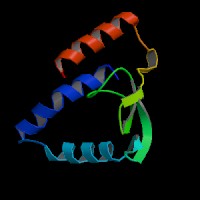
ModBase Predicted Comparative 3D Structure on Q99807
FrontTopSide
The pictures above may be empty if there is no ModBase structure for the protein. The ModBase structure frequently covers just a fragment of the protein. You may be asked to log onto ModBase the first time you click on the pictures. It is simplest after logging in to just click on the picture again to get to the specific info on that model.

-  Orthologous Genes in Other Species
  Orthologies between human, mouse, and rat are computed by taking the best BLASTP hit, and filtering out non-syntenic hits. For more distant species reciprocal-best BLASTP hits are used. Note that the absence of an ortholog in the table below may reflect incomplete annotations in the other species rather than a true absence of the orthologous gene.
MouseRatZebrafishD. melanogasterC. elegansS. cerevisiae
Genome BrowserGenome BrowserNo orthologGenome BrowserGenome BrowserNo ortholog
Gene Details     
Gene Sorter     
MGIRGD EnsemblWormBase 
Protein SequenceProtein Sequence Protein SequenceProtein Sequence 
AlignmentAlignment AlignmentAlignment 

-  Gene Ontology (GO) Annotations with Structured Vocabulary
  Molecular Function:
GO:0003682 chromatin binding
GO:0004497 monooxygenase activity
GO:0005515 protein binding
GO:0016491 oxidoreductase activity
GO:0046872 metal ion binding

Biological Process:
GO:0000122 negative regulation of transcription from RNA polymerase II promoter
GO:0006744 ubiquinone biosynthetic process
GO:0045944 positive regulation of transcription from RNA polymerase II promoter
GO:0055114 oxidation-reduction process
GO:2000377 regulation of reactive oxygen species metabolic process

Cellular Component:
GO:0005634 nucleus
GO:0005739 mitochondrion
GO:0005743 mitochondrial inner membrane
GO:0016020 membrane


-  Descriptions from all associated GenBank mRNAs
  AK315470 - Homo sapiens cDNA, FLJ96530, highly similar to Homo sapiens coenzyme Q7 homolog, ubiquinone (yeast) (COQ7), mRNA.
BC003185 - Homo sapiens coenzyme Q7 homolog, ubiquinone (yeast), mRNA (cDNA clone MGC:671 IMAGE:3503763), complete cds.
AK024291 - Homo sapiens cDNA FLJ14229 fis, clone NT2RP3004155, highly similar to Homo sapiens COQ7 protein mRNA.
AF098948 - Homo sapiens COQ7 protein mRNA, complete cds.
AK225115 - Homo sapiens mRNA for Ubiquinone biosynthesis protein COQ7 homolog, clone: CAS11281.
AB528110 - Synthetic construct DNA, clone: pF1KE0467, Homo sapiens COQ7 gene for coenzyme Q7 homolog, ubiquinone, without stop codon, in Flexi system.
AM393051 - Synthetic construct Homo sapiens clone IMAGE:100002448 for hypothetical protein (COQ7 gene).
AM393521 - Synthetic construct Homo sapiens clone IMAGE:100002447 for hypothetical protein (COQ7 gene).
KJ892969 - Synthetic construct Homo sapiens clone ccsbBroadEn_02363 COQ7 gene, encodes complete protein.
AL136647 - Homo sapiens mRNA; cDNA DKFZp564C1362 (from clone DKFZp564C1362).
BC043272 - Homo sapiens coenzyme Q7 homolog, ubiquinone (yeast), mRNA (cDNA clone MGC:44416 IMAGE:5297074), complete cds.
AF374413 - Homo sapiens placental protein KG-20 mRNA, complete cds.
AF032900 - Homo sapiens timing protein CLK-1 mRNA, complete cds.
U81276 - Human CLK-1 mRNA, partial cds.
JD362676 - Sequence 343700 from Patent EP1572962.
JD094842 - Sequence 75866 from Patent EP1572962.
JD075933 - Sequence 56957 from Patent EP1572962.
JD459164 - Sequence 440188 from Patent EP1572962.
JD396044 - Sequence 377068 from Patent EP1572962.
JD491763 - Sequence 472787 from Patent EP1572962.
JD512380 - Sequence 493404 from Patent EP1572962.
JD096872 - Sequence 77896 from Patent EP1572962.
JD367669 - Sequence 348693 from Patent EP1572962.
JD535509 - Sequence 516533 from Patent EP1572962.
JD203837 - Sequence 184861 from Patent EP1572962.
JD223673 - Sequence 204697 from Patent EP1572962.
JD522930 - Sequence 503954 from Patent EP1572962.
JD405388 - Sequence 386412 from Patent EP1572962.
JD455495 - Sequence 436519 from Patent EP1572962.
JD342347 - Sequence 323371 from Patent EP1572962.
JD480534 - Sequence 461558 from Patent EP1572962.
JD466770 - Sequence 447794 from Patent EP1572962.
JD308302 - Sequence 289326 from Patent EP1572962.
JD356694 - Sequence 337718 from Patent EP1572962.
JD238941 - Sequence 219965 from Patent EP1572962.
JD175381 - Sequence 156405 from Patent EP1572962.
JD220545 - Sequence 201569 from Patent EP1572962.
JD239030 - Sequence 220054 from Patent EP1572962.
JD527511 - Sequence 508535 from Patent EP1572962.
JD170738 - Sequence 151762 from Patent EP1572962.
JD132603 - Sequence 113627 from Patent EP1572962.
JD186163 - Sequence 167187 from Patent EP1572962.
JD103280 - Sequence 84304 from Patent EP1572962.
JD206422 - Sequence 187446 from Patent EP1572962.
JD252593 - Sequence 233617 from Patent EP1572962.
JD122333 - Sequence 103357 from Patent EP1572962.
JD081324 - Sequence 62348 from Patent EP1572962.
JD449059 - Sequence 430083 from Patent EP1572962.
JD373473 - Sequence 354497 from Patent EP1572962.
JD086473 - Sequence 67497 from Patent EP1572962.
JD038432 - Sequence 19456 from Patent EP1572962.

-  Biochemical and Signaling Pathways
  KEGG - Kyoto Encyclopedia of Genes and Genomes
hsa00130 - Ubiquinone and other terpenoid-quinone biosynthesis
hsa01100 - Metabolic pathways

BioCyc Knowledge Library
PWY-5872 - ubiquinol-10 biosynthesis

Reactome (by CSHL, EBI, and GO)

Protein Q99807 (Reactome details) participates in the following event(s):

R-HSA-2162194 COQ9 dimer:COQ7:Fe2+ hydroxylates DMQ10H2 to DeMQ10H2
R-HSA-2142789 Ubiquinol biosynthesis
R-HSA-8978934 Metabolism of cofactors
R-HSA-196854 Metabolism of vitamins and cofactors
R-HSA-1430728 Metabolism

-  Other Names for This Gene
  Alternate Gene Symbols: B2RDA9, COQ7 , COQ7_HUMAN, ENST00000321998.1, ENST00000321998.2, ENST00000321998.3, ENST00000321998.4, ENST00000321998.5, ENST00000321998.6, ENST00000321998.7, ENST00000321998.8, ENST00000321998.9, NR_163450, Q99807, Q9BTT7, Q9H0T5, Q9UEW5, Q9UNR5, uc002dfr.1, uc002dfr.2, uc002dfr.3, uc002dfr.4, uc002dfr.5
UCSC ID: ENST00000321998.10
RefSeq Accession: NM_016138.5
Protein: Q99807 (aka COQ7_HUMAN)
CCDS: CCDS10574.1

-  GeneReviews for This Gene
  GeneReviews article(s) related to gene COQ7:
coq10-def (Primary Coenzyme Q10 Deficiency Overview)
leigh-nucl-ov (Nuclear Gene-Encoded Leigh Syndrome Spectrum Overview)

-  Methods, Credits, and Use Restrictions
  Click here for details on how this gene model was made and data restrictions if any.