ID:LSM10_HUMAN DESCRIPTION: RecName: Full=U7 snRNA-associated Sm-like protein LSm10; FUNCTION: Appears to function in the U7 snRNP complex that is involved in histone 3'-end processing. Increases U7 snRNA levels but not histone 3'-end pre-mRNA processing activity, when overexpressed. Required for cell cycle progression from G1 to S phases. Binds specifically to U7 snRNA. Binds to the downstream cleavage product (DCP) of histone pre-mRNA in a U7 snRNP dependent manner. SUBUNIT: Component of the heptameric ring U7 snRNP complex, or U7 Sm protein core complex, at least composed of LSM10, LSM11, SNRPB, SNRPD3, SNRPE, SNRPF, SNRPG and U7 snRNA. Formation of the U7 snRNP is an ATP-dependent process mediated by a specialized SMN complex containing at least the Sm protein core complex and additionally, the U7-specific LSM10 and LSM11 proteins. Interacts with CLNS1A and SMN. INTERACTION: P62310:LSM3; NbExp=4; IntAct=EBI-373268, EBI-348239; SUBCELLULAR LOCATION: Nucleus. PTM: Not methylated. Methylation is not necessary for interaction with SMN. SIMILARITY: Belongs to the snRNP Sm proteins family.
The RNAfold program from the Vienna RNA Package is used to perform the secondary structure predictions and folding calculations. The estimated folding energy is in kcal/mol. The more negative the energy, the more secondary structure the RNA is likely to have.
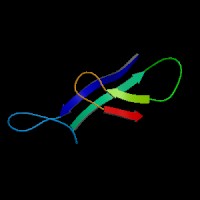
ModBase Predicted Comparative 3D Structure on Q969L4
Front
Top
Side
The pictures above may be empty if there is no ModBase structure for the protein. The ModBase structure frequently covers just a fragment of the protein. You may be asked to log onto ModBase the first time you click on the pictures. It is simplest after logging in to just click on the picture again to get to the specific info on that model.
Orthologous Genes in Other Species
Orthologies between human, mouse, and rat are computed by taking the best BLASTP hit, and filtering out non-syntenic hits. For more distant species reciprocal-best BLASTP hits are used. Note that the absence of an ortholog in the table below may reflect incomplete annotations in the other species rather than a true absence of the orthologous gene.
AF394685 - Homo sapiens U7 snRNA-associated Sm-like protein LSM10 mRNA, complete cds. AF166092 - Homo sapiens MSTP074 (MST074) mRNA, complete cds. JD503904 - Sequence 484928 from Patent EP1572962. BC007623 - Homo sapiens LSM10, U7 small nuclear RNA associated, mRNA (cDNA clone MGC:15749 IMAGE:3357043), complete cds. JD419845 - Sequence 400869 from Patent EP1572962. JD094749 - Sequence 75773 from Patent EP1572962. JD437673 - Sequence 418697 from Patent EP1572962. JD310968 - Sequence 291992 from Patent EP1572962. JD493151 - Sequence 474175 from Patent EP1572962. JD038382 - Sequence 19406 from Patent EP1572962. JD453291 - Sequence 434315 from Patent EP1572962. JD352691 - Sequence 333715 from Patent EP1572962. JD210791 - Sequence 191815 from Patent EP1572962. KJ895061 - Synthetic construct Homo sapiens clone ccsbBroadEn_04455 LSM10 gene, encodes complete protein. AB591034 - Synthetic construct DNA, clone: pFN21AB7080, Homo sapiens LSM10 gene for LSM10, U7 small nuclear RNA associated, without stop codon, in Flexi system.
Biochemical and Signaling Pathways
Reactome (by CSHL, EBI, and GO)
Protein Q969L4 (Reactome details) participates in the following event(s):
R-HSA-77585 Recruitment of U7 snRNP:ZFP100 complex to the SLBP Bound Pre-mRNA R-HSA-111438 Recruitment of U7 snRNP:ZFP100 complex to the Histone Pre-mRNA R-HSA-77586 Cleavage of the 3'-end of Replication Dependent Histone Pre-mRNA R-HSA-111437 Cleavage of the 3'-end of the Histone Pre-mRNA R-HSA-77588 SLBP Dependent Processing of Replication-Dependent Histone Pre-mRNAs R-HSA-111367 SLBP independent Processing of Histone Pre-mRNAs R-HSA-109688 Cleavage of Growing Transcript in the Termination Region R-HSA-75067 Processing of Capped Intronless Pre-mRNA R-HSA-73856 RNA Polymerase II Transcription Termination R-HSA-8953854 Metabolism of RNA R-HSA-73857 RNA Polymerase II Transcription R-HSA-74160 Gene expression (Transcription)
 Sequence and Links to Tools and Databases

 Microarray Expression Data