Human Gene MSLN (ENST00000545450.7) from GENCODE V50 |
|
 Sequence and Links to Tools and Databases
|
|
Comments and Description Text from UniProtKB
|
|---|
| |
ID: MSLN_HUMAN
DESCRIPTION: RecName: Full=Mesothelin; AltName: Full=CAK1 antigen; AltName: Full=Pre-pro-megakaryocyte-potentiating factor; Contains: RecName: Full=Megakaryocyte-potentiating factor; Short=MPF; Contains: RecName: Full=Mesothelin, cleaved form; Flags: Precursor;
FUNCTION: Membrane-anchored forms may play a role in cellular adhesion.
FUNCTION: Megakaryocyte-potentiating factor (MPF) potentiates megakaryocyte colony formation in vitro.
SUBUNIT: Interacts with MUC16.
SUBCELLULAR LOCATION: Cell membrane; Lipid-anchor, GPI-anchor. Golgi apparatus.
SUBCELLULAR LOCATION: Megakaryocyte-potentiating factor: Secreted.
SUBCELLULAR LOCATION: Isoform 3: Secreted.
TISSUE SPECIFICITY: Expressed in lung. Expressed at low levels in heart, placenta and kidney. Expressed in mesothelial cells. Highly expressed in mesotheliomas, ovarian cancers, and some squamous cell carcinomas (at protein level).
PTM: Both MPF and the cleaved form of mesothelin are N- glycosylated.
PTM: Proteolytically cleaved by a furin-like convertase to generate megakaryocyte-potentiating factor (MPF), and the cleaved form of mesothelin.
DISEASE: Note=Antibodies against MSLN are detected in patients with mesothelioma and ovarian cancer.
SIMILARITY: Belongs to the mesothelin family.
| |
|
|
Primer design for this transcript
|
|
MalaCards Disease Associations
|
|---|
| |
MalaCards Gene Search: MSLN
Diseases sorted by gene-association score: malignant pleural mesothelioma (10), pancreatic cancer (9), ovarian cancer, somatic (6), mesothelioma, somatic (5), malignant biphasic mesothelioma (4), benign mesothelioma (4), pancreatic ductal adenocarcinoma (4), triple-receptor negative breast cancer (3), lung cancer susceptibility 3 (3), refractory hematologic cancer (2), pleural cancer (2), renal clear cell carcinoma (2), refractory hairy cell leukemia (2), connective tissue cancer (2), pancreas adenocarcinoma (2), colloid carcinoma of the pancreas (1), malignant ovarian surface epithelial-stromal neoplasm (1), ovary epithelial cancer (1), pericardium cancer (1), female reproductive organ cancer (1), pericardial mesothelioma (1)
| |
|
|
Comparative Toxicogenomics Database (CTD)
|
|
RNA-Seq Expression Data from GTEx (53 Tissues, 570 Donors)
|
|
 Microarray Expression Data
|
|
mRNA Secondary Structure of 3' and 5' UTRs
|
|---|
| |
The RNAfold program from the Vienna RNA Package is used to perform the secondary structure predictions and folding calculations. The estimated folding energy is in kcal/mol. The more negative the energy, the more secondary structure the RNA is likely to have.
| |
|
|
Protein Domain and Structure Information
|
|---|
| |
InterPro Domains: Graphical view of domain structure
IPR010335 - Mesothelin
IPR026664 - Stereocilin_related
Pfam Domains:
PF06060 - Pre-pro-megakaryocyte potentiating factor precursor (Mesothelin)
Protein Data Bank (PDB) 3-D Structure
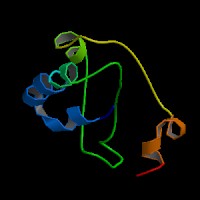
ModBase Predicted Comparative 3D Structure on Q13421
The pictures above may be empty if there is no ModBase structure for the protein. The ModBase structure frequently covers just a fragment of the protein. You may be asked to log onto ModBase the first time you click on the pictures. It is simplest after logging in to just click on the picture again to get to the specific info on that model.
| |
|
|
Orthologous Genes in Other Species
|
|---|
| |
Orthologies between human, mouse, and rat are computed by taking the best BLASTP hit, and filtering out non-syntenic hits. For more distant species reciprocal-best BLASTP hits are used. Note that the absence of an ortholog in the table below may reflect incomplete annotations in the other species rather than a true absence of the orthologous gene.
| |
|
|
Gene Ontology (GO) Annotations with Structured Vocabulary
|
|
Descriptions from all associated GenBank mRNAs
|
|---|
| |
EF420155 - Homo sapiens mesothelin (MSLN) mRNA, 5' UTR.
AY743922 - Homo sapiens mesothelin precursor (MSLN) mRNA, complete cds.
BC009272 - Homo sapiens mesothelin, mRNA (cDNA clone MGC:10273 IMAGE:3957372), complete cds.
BC003512 - Homo sapiens mesothelin, mRNA (cDNA clone MGC:10686 IMAGE:3611296), complete cds.
JD276402 - Sequence 257426 from Patent EP1572962.
U40434 - Human mesothelin or CAK1 antigen precursor mRNA, complete cds.
D49441 - Homo sapiens mRNA for pre-pro-megakaryocyte potentiating factor, complete cds.
E07943 - cDNA encoding a polypeptide having megakaryocyte potentiating activity.
DQ891948 - Synthetic construct clone IMAGE:100004578; FLH181685.01X; RZPDo839G01136D mesothelin (MSLN) gene, encodes complete protein.
EU176658 - Synthetic construct Homo sapiens clone IMAGE:100011451; FLH181684.01L; RZPDo839H11254D mesothelin (MSLN) gene, encodes complete protein.
KJ904646 - Synthetic construct Homo sapiens clone ccsbBroadEn_14040 MSLN gene, encodes complete protein.
AF180951 - Homo sapiens mesothelin/megakaryocyte potentiating factor mRNA, partial cds.
JD130652 - Sequence 111676 from Patent EP1572962.
JD394242 - Sequence 375266 from Patent EP1572962.
JD474031 - Sequence 455055 from Patent EP1572962.
| |
|
|
Biochemical and Signaling Pathways
|
|---|
| |
Reactome (by CSHL, EBI, and GO)
Protein Q13421 (Reactome details) participates in the following event(s):
R-HSA-8940388 GPLD1 hydrolyses GPI-anchors from proteins
R-HSA-8952289 FAM20C phosphorylates FAM20C substrates
R-HSA-163125 Post-translational modification: synthesis of GPI-anchored proteins
R-HSA-597592 Post-translational protein modification
R-HSA-381426 Regulation of Insulin-like Growth Factor (IGF) transport and uptake by Insulin-like Growth Factor Binding Proteins (IGFBPs)
R-HSA-8957275 Post-translational protein phosphorylation
R-HSA-392499 Metabolism of proteins
| |
|
|
Other Names for This Gene
|
|---|
| |
Alternate Gene Symbols: D3DU65, ENST00000545450.1, ENST00000545450.2, ENST00000545450.3, ENST00000545450.4, ENST00000545450.5, ENST00000545450.6, MPF, MSLN_HUMAN, NM_005823, Q13421, Q14859, Q4VQD5, Q96GR6, Q96KJ5, Q9BR17, Q9BTR2, Q9UCB2, Q9UK57, uc002cju.1, uc002cju.2, uc002cju.3
UCSC ID: ENST00000545450.7
RefSeq Accession: NM_005823.6
Protein: Q13421
(aka MSLN_HUMAN)
CCDS: CCDS32356.1, CCDS45370.1
| |
|
|
Methods, Credits, and Use Restrictions
|
|---|
| |
Click here
for details on how this gene model was made and data restrictions if any.
| |
|
|
|