Human Gene CALML5 (ENST00000380332.5) from GENCODE V50 |
|
 Sequence and Links to Tools and Databases
|
|
Comments and Description Text from UniProtKB
|
|---|
| |
ID: CALL5_HUMAN
DESCRIPTION: RecName: Full=Calmodulin-like protein 5; AltName: Full=Calmodulin-like skin protein;
FUNCTION: Binds calcium. May be involved in terminal differentiation of keratinocytes.
SUBUNIT: Associates with transglutaminase 3.
TISSUE SPECIFICITY: Particularly abundant in the epidermis where its expression is directly related to keratinocyte differentiation. Very low expression in lung.
SIMILARITY: Contains 4 EF-hand domains.
| |
|
|
Primer design for this transcript
|
|
Comparative Toxicogenomics Database (CTD)
|
|---|
| |
The following chemicals interact with this gene
| |
|
|
RNA-Seq Expression Data from GTEx (53 Tissues, 570 Donors)
|
|
 Microarray Expression Data
|
|
mRNA Secondary Structure of 3' and 5' UTRs
|
|---|
| |
The RNAfold program from the Vienna RNA Package is used to perform the secondary structure predictions and folding calculations. The estimated folding energy is in kcal/mol. The more negative the energy, the more secondary structure the RNA is likely to have.
| |
|
|
Protein Domain and Structure Information
|
|---|
| |
InterPro Domains: Graphical view of domain structure
IPR011992 - EF-hand-like_dom
IPR018247 - EF_Hand_1_Ca_BS
IPR018249 - EF_HAND_2
IPR002048 - EF_hand_Ca-bd
Protein Data Bank (PDB) 3-D Structure
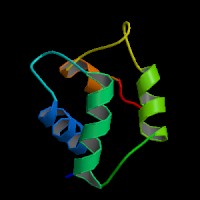
ModBase Predicted Comparative 3D Structure on Q9NZT1
The pictures above may be empty if there is no ModBase structure for the protein. The ModBase structure frequently covers just a fragment of the protein. You may be asked to log onto ModBase the first time you click on the pictures. It is simplest after logging in to just click on the picture again to get to the specific info on that model.
| |
|
|
Orthologous Genes in Other Species
|
|---|
| |
Orthologies between human, mouse, and rat are computed by taking the best BLASTP hit, and filtering out non-syntenic hits. For more distant species reciprocal-best BLASTP hits are used. Note that the absence of an ortholog in the table below may reflect incomplete annotations in the other species rather than a true absence of the orthologous gene.
| Mouse | Rat | Zebrafish | D. melanogaster | C. elegans | S. cerevisiae |
| No ortholog | No ortholog | No ortholog | No ortholog | No ortholog | No ortholog |
| | | | | | |
| | | | | | |
| | | | | | |
| | | | | | |
| | | | | | |
|
| |
|
|
Gene Ontology (GO) Annotations with Structured Vocabulary
|
|
Descriptions from all associated GenBank mRNAs
|
|---|
| |
JF432778 - Synthetic construct Homo sapiens clone IMAGE:100074022 calmodulin-like 5 (CALML5) gene, encodes complete protein.
KJ902624 - Synthetic construct Homo sapiens clone ccsbBroadEn_12018 CALML5 gene, encodes complete protein.
AK222744 - Homo sapiens mRNA for calmodulin-like skin protein variant, clone: DMC07660.
AF172852 - Homo sapiens calmodulin-like skin protein (CLSP) mRNA, complete cds.
BC039172 - Homo sapiens calmodulin-like 5, mRNA (cDNA clone MGC:20994 IMAGE:4753280), complete cds.
JD472033 - Sequence 453057 from Patent EP1572962.
JD437418 - Sequence 418442 from Patent EP1572962.
JD287650 - Sequence 268674 from Patent EP1572962.
JD129312 - Sequence 110336 from Patent EP1572962.
JD170474 - Sequence 151498 from Patent EP1572962.
JD389595 - Sequence 370619 from Patent EP1572962.
JD416012 - Sequence 397036 from Patent EP1572962.
AB590761 - Synthetic construct DNA, clone: pFN21AE1629, Homo sapiens CALML5 gene for calmodulin-like 5, without stop codon, in Flexi system.
JD406601 - Sequence 387625 from Patent EP1572962.
JD260274 - Sequence 241298 from Patent EP1572962.
| |
|
|
Biochemical and Signaling Pathways
|
|
Other Names for This Gene
|
|---|
| |
Alternate Gene Symbols: CALL5_HUMAN, CLSP, ENST00000380332.1, ENST00000380332.2, ENST00000380332.3, ENST00000380332.4, NM_017422, Q5SQI3, Q8IXU8, Q9NZT1, uc001iic.1, uc001iic.2, uc001iic.3, uc001iic.4
UCSC ID: ENST00000380332.5
RefSeq Accession: NM_017422.5
Protein: Q9NZT1
(aka CALL5_HUMAN or CAL5_HUMAN)
CCDS: CCDS7068.1
| |
|
|
Methods, Credits, and Use Restrictions
|
|---|
| |
Click here
for details on how this gene model was made and data restrictions if any.
| |
|
|
|