Human Gene TIMM10B (ENST00000254616.11) from GENCODE V50 |
|
 Sequence and Links to Tools and Databases
|
|
Comments and Description Text from UniProtKB
|
|---|
| |
ID: TIM9B_HUMAN
DESCRIPTION: RecName: Full=Mitochondrial import inner membrane translocase subunit Tim9 B; AltName: Full=Fracture callus protein 1; AltName: Full=FxC1; AltName: Full=TIMM10B; Short=Tim10b;
FUNCTION: Component of the TIM22 complex, a complex that mediates the import and insertion of multi-pass transmembrane proteins into the mitochondrial inner membrane. The TIM22 complex forms a twin- pore translocase that uses the membrane potential as external driving force. In the TIM22 complex, it may act as a docking point for the soluble 70 kDa complex that guides the target proteins in transit through the aqueous mitochondrial intermembrane space.
SUBUNIT: Component of the TIM22 complex, whose core is composed of TIMM22, associated with peripheral protein FXC1/TIM10B and the 70 kDa heterohexamer. In most cases, the 70 kDa complex is composed of TIMM9 and TIMM10. Also forms a complex composed of TIMM9, TIMM10/TIM10A and FXC1/TIM10B.
SUBCELLULAR LOCATION: Mitochondrion inner membrane; Peripheral membrane protein.
TISSUE SPECIFICITY: Ubiquitous, with highest expression in heart, kidney, liver and skeletal muscle.
DOMAIN: The twin CX3C motif contains 4 conserved Cys residues that form 2 disulfide bonds in the mitochondrial intermembrane space. However, during the transit of FXC1/TIM10B from cytoplasm into mitochondrion, the Cys residues probably coordinate zinc, thereby preventing folding and allowing its transfer across mitochondrial outer membrane (By similarity).
SIMILARITY: Belongs to the small Tim family.
| |
|
|
Primer design for this transcript
|
|
Comparative Toxicogenomics Database (CTD)
|
|
 Microarray Expression Data
|
|
mRNA Secondary Structure of 3' and 5' UTRs
|
|---|
| |
The RNAfold program from the Vienna RNA Package is used to perform the secondary structure predictions and folding calculations. The estimated folding energy is in kcal/mol. The more negative the energy, the more secondary structure the RNA is likely to have.
| |
|
|
Protein Domain and Structure Information
|
|---|
| |
InterPro Domains: Graphical view of domain structure
IPR004217 - Tim8/9/10/13_Znf-like
Pfam Domains:
PF02953 - Tim10/DDP family zinc finger
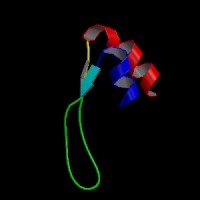
ModBase Predicted Comparative 3D Structure on Q9Y5J6
The pictures above may be empty if there is no ModBase structure for the protein. The ModBase structure frequently covers just a fragment of the protein. You may be asked to log onto ModBase the first time you click on the pictures. It is simplest after logging in to just click on the picture again to get to the specific info on that model.
| |
|
|
Orthologous Genes in Other Species
|
|---|
| |
Orthologies between human, mouse, and rat are computed by taking the best BLASTP hit, and filtering out non-syntenic hits. For more distant species reciprocal-best BLASTP hits are used. Note that the absence of an ortholog in the table below may reflect incomplete annotations in the other species rather than a true absence of the orthologous gene.
| |
|
|
Gene Ontology (GO) Annotations with Structured Vocabulary
|
|
Descriptions from all associated GenBank mRNAs
|
|---|
| |
AF183415 - Homo sapiens fracture callus mRNA, complete cds.
AF150105 - Homo sapiens small zinc finger-like protein (TIM9b) mRNA, complete cds.
AK002130 - Homo sapiens cDNA FLJ11268 fis, clone PLACE1009186, highly similar to Mitochondrial import inner membrane translocase subunit Tim9B.
AK311763 - Homo sapiens cDNA, FLJ92024, Homo sapiens fracture callus 1 homolog (rat) (FXC1), mRNA.
AK058048 - Homo sapiens cDNA FLJ25319 fis, clone TST00259.
BC011014 - Homo sapiens fracture callus 1 homolog (rat), mRNA (cDNA clone MGC:13456 IMAGE:4070042), complete cds.
AF152355 - Homo sapiens FXC1 mRNA, complete cds.
KJ898628 - Synthetic construct Homo sapiens clone ccsbBroadEn_08022 FXC1 gene, encodes complete protein.
JD023890 - Sequence 4914 from Patent EP1572962.
JD036108 - Sequence 17132 from Patent EP1572962.
JD120722 - Sequence 101746 from Patent EP1572962.
JD183750 - Sequence 164774 from Patent EP1572962.
JD039913 - Sequence 20937 from Patent EP1572962.
JD019161 - Sequence 185 from Patent EP1572962.
JD334251 - Sequence 315275 from Patent EP1572962.
JD031996 - Sequence 13020 from Patent EP1572962.
JD274552 - Sequence 255576 from Patent EP1572962.
JD353583 - Sequence 334607 from Patent EP1572962.
JD310597 - Sequence 291621 from Patent EP1572962.
JD527746 - Sequence 508770 from Patent EP1572962.
JD448570 - Sequence 429594 from Patent EP1572962.
JD108875 - Sequence 89899 from Patent EP1572962.
JD214725 - Sequence 195749 from Patent EP1572962.
JD433374 - Sequence 414398 from Patent EP1572962.
JD450487 - Sequence 431511 from Patent EP1572962.
JD202128 - Sequence 183152 from Patent EP1572962.
JD523047 - Sequence 504071 from Patent EP1572962.
JD514197 - Sequence 495221 from Patent EP1572962.
JD514195 - Sequence 495219 from Patent EP1572962.
JD514196 - Sequence 495220 from Patent EP1572962.
JD070735 - Sequence 51759 from Patent EP1572962.
JD070733 - Sequence 51757 from Patent EP1572962.
JD070734 - Sequence 51758 from Patent EP1572962.
JD256491 - Sequence 237515 from Patent EP1572962.
JD476614 - Sequence 457638 from Patent EP1572962.
JD024496 - Sequence 5520 from Patent EP1572962.
JD035807 - Sequence 16831 from Patent EP1572962.
| |
|
|
Biochemical and Signaling Pathways
|
|
Other Names for This Gene
|
|---|
| |
Alternate Gene Symbols: ENST00000254616.1, ENST00000254616.10, ENST00000254616.2, ENST00000254616.3, ENST00000254616.4, ENST00000254616.5, ENST00000254616.6, ENST00000254616.7, ENST00000254616.8, ENST00000254616.9, FXC1, NM_012192, Q96FF3, Q9Y5J6, T10B_HUMAN, TIM9B, TIMM9B, uc001mdn.1, uc001mdn.2, uc001mdn.3, uc001mdn.4, uc001mdn.5, uc001mdn.6
UCSC ID: ENST00000254616.11
RefSeq Accession: NM_012192.4
Protein: Q9Y5J6
(aka TIM9B_HUMAN)
CCDS: CCDS7766.1
| |
|
|
Methods, Credits, and Use Restrictions
|
|---|
| |
Click here
for details on how this gene model was made and data restrictions if any.
| |
|
|
|