Human Gene SYT7 (ENST00000263846.9) from GENCODE V50
Description: synaptotagmin 7, transcript variant 2 (from RefSeq NM_004200.4)Gencode Transcript: ENST00000263846.9Gencode Gene: ENSG00000011347.12Transcript (Including UTRs) Position: hg38 chr11:61,513,714-61,581,191 Size: 67,478 Total Exon Count: 9 Strand: -Coding Region Position: hg38 chr11:61,518,627-61,580,820 Size: 62,194 Coding Exon Count: 9
Data last updated at UCSC: 2026-07-12 09:30:09
Sequence and Links to Tools and Databases
Comments and Description Text from UniProtKB
ID: SYT7_HUMAN DESCRIPTION: RecName: Full=Synaptotagmin-7; AltName: Full=IPCA-7; AltName: Full=Prostate cancer-associated protein 7; AltName: Full=Synaptotagmin VII; Short=SytVII;FUNCTION: May be involved in Ca(2+)-dependent exocytosis of secretory vesicles through Ca(2+) and phospholipid binding to the C2 domain or may serve as Ca(2+) sensors in the process of vesicular trafficking and exocytosis (By similarity).COFACTOR: Binds 3 calcium ions per subunit. The ions are bound to the C2 domains (By similarity).SUBUNIT: Interacts with SYNCRIP isoform 3 C-terminus (By similarity).SUBCELLULAR LOCATION: Cytoplasmic vesicle, secretory vesicle, synaptic vesicle membrane; Single-pass membrane protein (By similarity).TISSUE SPECIFICITY: Expressed in a variety of adult and fetal tissues.DOMAIN: The second C2 domain/C2B is responsible for SYNCRIP binding (By similarity).SIMILARITY: Belongs to the synaptotagmin family.SIMILARITY: Contains 2 C2 domains.SEQUENCE CAUTION: Sequence=AAB92667.1; Type=Frameshift; Positions=6, 10, 15;
Primer design for this transcript
MalaCards Disease Associations
Comparative Toxicogenomics Database (CTD)
RNA-Seq Expression Data from GTEx (53 Tissues, 570 Donors)
mRNA Secondary Structure of 3' and 5' UTRs
Vienna RNA Package is used to perform the secondary structure predictions and folding calculations. The estimated folding energy is in kcal/mol. The more negative the energy, the more secondary structure the RNA is likely to have.
Protein Domain and Structure Information
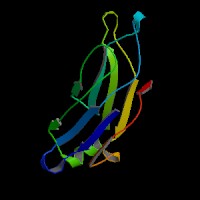
InterPro Domains: Graphical view of domain structure IPR000008 - C2_Ca-depIPR008973 - C2_Ca/lipid-bd_dom_CaLBIPR020477 - C2_domIPR018029 - C2_membr_targetingIPR001565 - SynaptotagminIPR015427 - Synaptotagmin7Pfam Domains: PF00168 - C2 domainProtein Data Bank (PDB) 3-D Structure ModBase Predicted Comparative 3D Structure on O43581 The pictures above may be empty if there is no ModBase structure for the protein. The ModBase structure frequently covers just a fragment of the protein. You may be asked to log onto ModBase the first time you click on the pictures. It is simplest after logging in to just click on the picture again to get to the specific info on that model.
Orthologous Genes in Other Species
Orthologies between human, mouse, and rat are computed by taking the best BLASTP hit, and filtering out non-syntenic hits. For more distant species reciprocal-best BLASTP hits are used. Note that the absence of an ortholog in the table below may reflect incomplete annotations in the other species rather than a true absence of the orthologous gene.
Gene Ontology (GO) Annotations with Structured Vocabulary
Descriptions from all associated GenBank mRNAs
AL137559 - Homo sapiens mRNA; cDNA DKFZp434M2120 (from clone DKFZp434M2120).BC042495 - Homo sapiens synaptotagmin VII, mRNA (cDNA clone IMAGE:5197755), with apparent retained intron.JD216771 - Sequence 197795 from Patent EP1572962.JD067254 - Sequence 48278 from Patent EP1572962.JD392039 - Sequence 373063 from Patent EP1572962.JD516324 - Sequence 497348 from Patent EP1572962.JD382801 - Sequence 363825 from Patent EP1572962.JD439599 - Sequence 420623 from Patent EP1572962.JD470523 - Sequence 451547 from Patent EP1572962.JD403909 - Sequence 384933 from Patent EP1572962.JD220233 - Sequence 201257 from Patent EP1572962.JD390513 - Sequence 371537 from Patent EP1572962.JD173127 - Sequence 154151 from Patent EP1572962.JD420466 - Sequence 401490 from Patent EP1572962.JD056589 - Sequence 37613 from Patent EP1572962.JD246400 - Sequence 227424 from Patent EP1572962.JD089204 - Sequence 70228 from Patent EP1572962.JD388018 - Sequence 369042 from Patent EP1572962.JD189347 - Sequence 170371 from Patent EP1572962.JD099211 - Sequence 80235 from Patent EP1572962.JD141621 - Sequence 122645 from Patent EP1572962.JD484134 - Sequence 465158 from Patent EP1572962.JD451971 - Sequence 432995 from Patent EP1572962.JD409505 - Sequence 390529 from Patent EP1572962.AK294636 - Homo sapiens cDNA FLJ53554 complete cds.JD507985 - Sequence 489009 from Patent EP1572962.JD253064 - Sequence 234088 from Patent EP1572962.JD213927 - Sequence 194951 from Patent EP1572962.JD439530 - Sequence 420554 from Patent EP1572962.JD488249 - Sequence 469273 from Patent EP1572962.JD151144 - Sequence 132168 from Patent EP1572962.JD444331 - Sequence 425355 from Patent EP1572962.JD375623 - Sequence 356647 from Patent EP1572962.JD385161 - Sequence 366185 from Patent EP1572962.JD422308 - Sequence 403332 from Patent EP1572962.JD565568 - Sequence 546592 from Patent EP1572962.JD507607 - Sequence 488631 from Patent EP1572962.JD200044 - Sequence 181068 from Patent EP1572962.JD051013 - Sequence 32037 from Patent EP1572962.JD274207 - Sequence 255231 from Patent EP1572962.JD081177 - Sequence 62201 from Patent EP1572962.JD099026 - Sequence 80050 from Patent EP1572962.JD174796 - Sequence 155820 from Patent EP1572962.JD525206 - Sequence 506230 from Patent EP1572962.JD351230 - Sequence 332254 from Patent EP1572962.JD126963 - Sequence 107987 from Patent EP1572962.JD262742 - Sequence 243766 from Patent EP1572962.JD556924 - Sequence 537948 from Patent EP1572962.JD186169 - Sequence 167193 from Patent EP1572962.JD402427 - Sequence 383451 from Patent EP1572962.JD193055 - Sequence 174079 from Patent EP1572962.JD518275 - Sequence 499299 from Patent EP1572962.JD372778 - Sequence 353802 from Patent EP1572962.JD319820 - Sequence 300844 from Patent EP1572962.JD357823 - Sequence 338847 from Patent EP1572962.JD248510 - Sequence 229534 from Patent EP1572962.JD414010 - Sequence 395034 from Patent EP1572962.JD389387 - Sequence 370411 from Patent EP1572962.JD348570 - Sequence 329594 from Patent EP1572962.JD102597 - Sequence 83621 from Patent EP1572962.JD486114 - Sequence 467138 from Patent EP1572962.JD218224 - Sequence 199248 from Patent EP1572962.JD242166 - Sequence 223190 from Patent EP1572962.JD457755 - Sequence 438779 from Patent EP1572962.JD205076 - Sequence 186100 from Patent EP1572962.JD170365 - Sequence 151389 from Patent EP1572962.JD062646 - Sequence 43670 from Patent EP1572962.BC125170 - Homo sapiens synaptotagmin VII, mRNA (cDNA clone MGC:150517 IMAGE:40121712), complete cds.BC125171 - Homo sapiens cDNA clone IMAGE:40121714, containing frame-shift errors.AF038535 - Homo sapiens synaptotagmin VII mRNA, partial cds.JD539831 - Sequence 520855 from Patent EP1572962.JD416657 - Sequence 397681 from Patent EP1572962.JD300459 - Sequence 281483 from Patent EP1572962.JD103252 - Sequence 84276 from Patent EP1572962.JD171152 - Sequence 152176 from Patent EP1572962.JD058695 - Sequence 39719 from Patent EP1572962.JD273859 - Sequence 254883 from Patent EP1572962.JD383462 - Sequence 364486 from Patent EP1572962.JD445862 - Sequence 426886 from Patent EP1572962.JD128049 - Sequence 109073 from Patent EP1572962.JD427267 - Sequence 408291 from Patent EP1572962.JD319731 - Sequence 300755 from Patent EP1572962.JD138534 - Sequence 119558 from Patent EP1572962.JD144040 - Sequence 125064 from Patent EP1572962.JD472754 - Sequence 453778 from Patent EP1572962.JD340289 - Sequence 321313 from Patent EP1572962.JD234306 - Sequence 215330 from Patent EP1572962.Y19240 - Homo sapiens partial mRNA for synaptotagmin 7 (SYT7 gene), exons 2, 3, 3a and 4.Y19238 - Homo sapiens partial mRNA for synaptotagmin 7 (SYT7 gene), exons 2 to 4.JD143255 - Sequence 124279 from Patent EP1572962.JD368192 - Sequence 349216 from Patent EP1572962.JD424239 - Sequence 405263 from Patent EP1572962.JD460640 - Sequence 441664 from Patent EP1572962.
Biochemical and Signaling Pathways
Other Names for This Gene
Alternate Gene Symbols: ENST00000263846.1, ENST00000263846.2, ENST00000263846.3, ENST00000263846.4, ENST00000263846.5, ENST00000263846.6, ENST00000263846.7, ENST00000263846.8, F5GZC2, F5GZU9, F5H126, F5H1N2, F5H6C1, NM_004200, O43581, PCANAP7, Q08AH6, SYT7 , SYT7_HUMAN, uc001nrv.1, uc001nrv.2, uc001nrv.3, uc001nrv.4, uc001nrv.5UCSC ID: ENST00000263846.9RefSeq Accession: NM_004200.4 Protein: O43581
(aka SYT7_HUMAN)
Methods, Credits, and Use Restrictions
Click here
for details on how this gene model was made and data restrictions if any.
 Sequence and Links to Tools and Databases