Human Gene DDIAS (ENST00000533655.6) from GENCODE V50
  Description: DNA damage induced apoptosis suppressor, transcript variant 1 (from RefSeq NM_145018.4)
Gencode Transcript: ENST00000533655.6
Gencode Gene: ENSG00000165490.15
Transcript (Including UTRs)
   Position: hg38 chr11:82,901,736-82,934,659 Size: 32,924 Total Exon Count: 6 Strand: +
Coding Region
   Position: hg38 chr11:82,914,739-82,934,335 Size: 19,597 Coding Exon Count: 4 

Page IndexSequence and LinksUniProtKB CommentsPrimersRNA-Seq ExpressionRNA Structure
Protein StructureOther SpeciesGO AnnotationsmRNA DescriptionsOther NamesMethods
Data last updated at UCSC: 2026-07-12 09:30:09

-  Comments and Description Text from UniProtKB
  ID: NOXIN_HUMAN
DESCRIPTION: RecName: Full=Nitric oxide-inducible gene protein;
FUNCTION: Acts as an anti-apoptotic factor and its absence increases cell death under normal and stress conditions. Can induce cell cycle arrest in the G1 or early S phase and this activity is independent of p53/TP53 (By similarity).
SUBCELLULAR LOCATION: Cytoplasm (By similarity). Nucleus (By similarity). Note=Accumulates in the nucleus in response to stress (By similarity).
SEQUENCE CAUTION: Sequence=BAB14764.1; Type=Erroneous initiation;

-  Primer design for this transcript
 

Primer3Plus can design qPCR Primers that straddle exon-exon-junctions, which amplify only cDNA, not genomic DNA.
Click here to load the transcript sequence and exon structure into Primer3Plus

Exonprimer can design one pair of Sanger sequencing primers around every exon, located in non-genic sequence.
Click here to open Exonprimer with this transcript

To design primers for a non-coding sequence, zoom to a region of interest and select from the drop-down menu: View > In External Tools > Primer3


-  RNA-Seq Expression Data from GTEx (53 Tissues, 570 Donors)
  Highest median expression: 3.67 RPKM in Testis
Total median expression: 16.77 RPKM


View in GTEx track of Genome Browser    View at GTEx portal     View GTEx Body Map

-  mRNA Secondary Structure of 3' and 5' UTRs
 
RegionFold EnergyBasesEnergy/Base
Display As
5' UTR -68.30203-0.336 Picture PostScript Text
3' UTR -62.50324-0.193 Picture PostScript Text

The RNAfold program from the Vienna RNA Package is used to perform the secondary structure predictions and folding calculations. The estimated folding energy is in kcal/mol. The more negative the energy, the more secondary structure the RNA is likely to have.

-  Protein Domain and Structure Information
  InterPro Domains: Graphical view of domain structure
IPR012340 - NA-bd_OB-fold
IPR016027 - NA-bd_OB-fold-like
IPR013955 - Rep_factor-A_C

Pfam Domains:
PF08646 - Replication factor-A C terminal domain

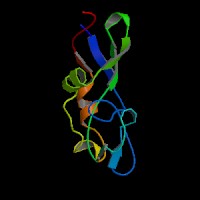
ModBase Predicted Comparative 3D Structure on Q8IXT1
FrontTopSide
The pictures above may be empty if there is no ModBase structure for the protein. The ModBase structure frequently covers just a fragment of the protein. You may be asked to log onto ModBase the first time you click on the pictures. It is simplest after logging in to just click on the picture again to get to the specific info on that model.

-  Orthologous Genes in Other Species
  Orthologies between human, mouse, and rat are computed by taking the best BLASTP hit, and filtering out non-syntenic hits. For more distant species reciprocal-best BLASTP hits are used. Note that the absence of an ortholog in the table below may reflect incomplete annotations in the other species rather than a true absence of the orthologous gene.
MouseRatZebrafishD. melanogasterC. elegansS. cerevisiae
Genome BrowserGenome BrowserNo orthologNo orthologNo orthologNo ortholog
Gene Details     
Gene Sorter     
MGIRGD    
Protein SequenceProtein Sequence    
AlignmentAlignment    

-  Gene Ontology (GO) Annotations with Structured Vocabulary
  Molecular Function:
GO:0003674 molecular_function

Biological Process:
GO:0006915 apoptotic process
GO:0007049 cell cycle
GO:0007050 cell cycle arrest
GO:1902230 negative regulation of intrinsic apoptotic signaling pathway in response to DNA damage

Cellular Component:
GO:0005575 cellular_component
GO:0005634 nucleus
GO:0005737 cytoplasm


-  Descriptions from all associated GenBank mRNAs
  AK058145 - Homo sapiens cDNA FLJ25416 fis, clone TST03452.
LP895221 - Sequence 85 from Patent EP3253886.
BC039268 - Homo sapiens chromosome 11 open reading frame 82, mRNA (cDNA clone MGC:33936 IMAGE:5296465), complete cds.
AK096157 - Homo sapiens cDNA FLJ38838 fis, clone MESAN2002940.
AK297366 - Homo sapiens cDNA FLJ61316 complete cds.
AK292399 - Homo sapiens cDNA FLJ78751 complete cds.
AK299581 - Homo sapiens cDNA FLJ58936 complete cds.
JD160893 - Sequence 141917 from Patent EP1572962.
EU832122 - Synthetic construct Homo sapiens clone HAIB:100067151; DKFZo008C1225 chromosome 11 open reading frame 82 protein (C11orf82) gene, encodes complete protein.
EU832216 - Synthetic construct Homo sapiens clone HAIB:100067245; DKFZo004C1226 chromosome 11 open reading frame 82 protein (C11orf82) gene, encodes complete protein.
KJ900464 - Synthetic construct Homo sapiens clone ccsbBroadEn_09858 C11orf82 gene, encodes complete protein.
AK023998 - Homo sapiens cDNA FLJ13936 fis, clone Y79AA1000802.
JD346250 - Sequence 327274 from Patent EP1572962.
JD528245 - Sequence 509269 from Patent EP1572962.
JD309378 - Sequence 290402 from Patent EP1572962.
JD303547 - Sequence 284571 from Patent EP1572962.

-  Other Names for This Gene
  Alternate Gene Symbols: C11orf82, DDIAS_HUMAN, ENST00000533655.1, ENST00000533655.2, ENST00000533655.3, ENST00000533655.4, ENST00000533655.5, NM_145018, NOXIN, Q8IXT1, Q96LK6, Q9H856, uc001ozt.1, uc001ozt.2, uc001ozt.3, uc001ozt.4, uc001ozt.5
UCSC ID: ENST00000533655.6
RefSeq Accession: NM_145018.4
Protein: Q8IXT1 (aka NOXIN_HUMAN)
CCDS: CCDS8263.1

-  Methods, Credits, and Use Restrictions
  Click here for details on how this gene model was made and data restrictions if any.