ID:TNR1A_HUMAN DESCRIPTION: RecName: Full=Tumor necrosis factor receptor superfamily member 1A; AltName: Full=Tumor necrosis factor receptor 1; Short=TNF-R1; AltName: Full=Tumor necrosis factor receptor type I; Short=TNF-RI; Short=TNFR-I; AltName: Full=p55; AltName: Full=p60; AltName: CD_antigen=CD120a; Contains: RecName: Full=Tumor necrosis factor receptor superfamily member 1A, membrane form; Contains: RecName: Full=Tumor necrosis factor-binding protein 1; Short=TBPI; Flags: Precursor; FUNCTION: Receptor for TNFSF2/TNF-alpha and homotrimeric TNFSF1/lymphotoxin-alpha. The adapter molecule FADD recruits caspase-8 to the activated receptor. The resulting death-inducing signaling complex (DISC) performs caspase-8 proteolytic activation which initiates the subsequent cascade of caspases (aspartate- specific cysteine proteases) mediating apoptosis. Contributes to the induction of non-cytocidal TNF effects including anti-viral state and activation of the acid sphingomyelinase. SUBUNIT: Binding of TNF to the extracellular domain leads to homotrimerization. The aggregated death domains provide a novel molecular interface that interacts specifically with the death domain of TRADD. Various TRADD-interacting proteins such as TRAFS, RIPK1 and possibly FADD, are recruited to the complex by their association with TRADD. This complex activates at least two distinct signaling cascades, apoptosis and NF-kappa-B signaling. Interacts with BAG4, BRE, FEM1B, GRB2, SQSTM1 and TRPC4AP. Interacts with HCV core protein. Interacts with human cytomegalovirus/HHV-5 protein UL138. INTERACTION: Q13546:RIPK1; NbExp=6; IntAct=EBI-299451, EBI-358507; P01375:TNF; NbExp=6; IntAct=EBI-299451, EBI-359977; Q15628:TRADD; NbExp=10; IntAct=EBI-299451, EBI-359215; SUBCELLULAR LOCATION: Cell membrane; Single-pass type I membrane protein. Secreted. DOMAIN: The domain that induces A-SMASE is probably identical to the death domain. The N-SMASE activation domain (NSD) is both necessary and sufficient for activation of N-SMASE. DOMAIN: Both the cytoplasmic membrane-proximal region and the C- terminal region containing the death domain are involved in the interaction with TRPC4AP (By similarity). PTM: The soluble form is produced from the membrane form by proteolytic processing. DISEASE: Defects in TNFRSF1A are the cause of familial hibernian fever (FHF) [MIM:142680]; also known as tumor necrosis factor receptor-associated periodic syndrome (TRAPS). FHF is a hereditary periodic fever syndrome characterized by recurrent fever, abdominal pain, localized tender skin lesions and myalgia. Reactive amyloidosis is the main complication and occurs in 25% of cases. SIMILARITY: Contains 1 death domain. SIMILARITY: Contains 4 TNFR-Cys repeats. WEB RESOURCE: Name=INFEVERS; Note=Repertory of FMF and hereditary autoinflammatory disorders mutations; URL="http://fmf.igh.cnrs.fr/ISSAID/infevers/search.php?n=2"; WEB RESOURCE: Name=GeneReviews; URL="http://www.ncbi.nlm.nih.gov/sites/GeneTests/lab/gene/TNFRSF1A"; WEB RESOURCE: Name=SeattleSNPs; URL="http://pga.gs.washington.edu/data/tnfrsf1a/";
The RNAfold program from the Vienna RNA Package is used to perform the secondary structure predictions and folding calculations. The estimated folding energy is in kcal/mol. The more negative the energy, the more secondary structure the RNA is likely to have.
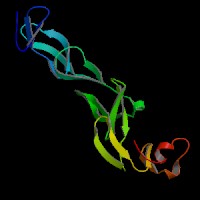
ModBase Predicted Comparative 3D Structure on P19438
Front
Top
Side
The pictures above may be empty if there is no ModBase structure for the protein. The ModBase structure frequently covers just a fragment of the protein. You may be asked to log onto ModBase the first time you click on the pictures. It is simplest after logging in to just click on the picture again to get to the specific info on that model.
Orthologous Genes in Other Species
Orthologies between human, mouse, and rat are computed by taking the best BLASTP hit, and filtering out non-syntenic hits. For more distant species reciprocal-best BLASTP hits are used. Note that the absence of an ortholog in the table below may reflect incomplete annotations in the other species rather than a true absence of the orthologous gene.
Gene Ontology (GO) Annotations with Structured Vocabulary
Molecular Function: GO:0005031 tumor necrosis factor-activated receptor activity GO:0005515 protein binding GO:0042802 identical protein binding GO:0043120 tumor necrosis factor binding
Biological Process: GO:0006693 prostaglandin metabolic process GO:0006915 apoptotic process GO:0006952 defense response GO:0006954 inflammatory response GO:0006955 immune response GO:0007165 signal transduction GO:0007166 cell surface receptor signaling pathway GO:0007249 I-kappaB kinase/NF-kappaB signaling GO:0008625 extrinsic apoptotic signaling pathway via death domain receptors GO:0008630 intrinsic apoptotic signaling pathway in response to DNA damage GO:0010803 regulation of tumor necrosis factor-mediated signaling pathway GO:0016032 viral process GO:0019221 cytokine-mediated signaling pathway GO:0032496 response to lipopolysaccharide GO:0033209 tumor necrosis factor-mediated signaling pathway GO:0042127 regulation of cell proliferation GO:0042531 positive regulation of tyrosine phosphorylation of STAT protein GO:0042742 defense response to bacterium GO:0042981 regulation of apoptotic process GO:0043123 positive regulation of I-kappaB kinase/NF-kappaB signaling GO:0045944 positive regulation of transcription from RNA polymerase II promoter GO:0050728 negative regulation of inflammatory response GO:0050729 positive regulation of inflammatory response GO:0071260 cellular response to mechanical stimulus GO:0071550 death-inducing signaling complex assembly GO:0072659 protein localization to plasma membrane GO:1903140 regulation of establishment of endothelial barrier GO:2000304 positive regulation of ceramide biosynthetic process
 Sequence and Links to Tools and Databases

 Microarray Expression Data