Human Gene KRT75 (ENST00000252245.6) from GENCODE V50
  Description: keratin 75 (from RefSeq NM_004693.3)
Gencode Transcript: ENST00000252245.6
Gencode Gene: ENSG00000170454.7
Transcript (Including UTRs)
   Position: hg38 chr12:52,424,070-52,434,371 Size: 10,302 Total Exon Count: 9 Strand: -
Coding Region
   Position: hg38 chr12:52,424,517-52,434,304 Size: 9,788 Coding Exon Count: 9 

Page IndexSequence and LinksUniProtKB CommentsPrimersMalaCardsCTD
RNA-Seq ExpressionMicroarray ExpressionRNA StructureProtein StructureOther SpeciesGO Annotations
mRNA DescriptionsPathwaysOther NamesMethods
Data last updated at UCSC: 2026-07-12 09:30:09

-  Comments and Description Text from UniProtKB
  ID: K2C75_HUMAN
DESCRIPTION: RecName: Full=Keratin, type II cytoskeletal 75; AltName: Full=Cytokeratin-75; Short=CK-75; AltName: Full=Keratin-6 hair follicle; Short=hK6hf; AltName: Full=Keratin-75; Short=K75; AltName: Full=Type II keratin-K6hf; AltName: Full=Type-II keratin Kb18;
FUNCTION: Plays a central role in hair and nail formation. Essential component of keratin intermediate filaments in the companion layer of the hair follicle.
SUBUNIT: Heterodimer of a type I and a type II keratin (By similarity). May associate with KRT17 (By similarity).
TISSUE SPECIFICITY: Highly expressed in hair follicles from scalp. Specifically expressed in the of the hair companion layer follicle, a single layered band of flat and vertically oriented cells between the cuboidal outer root sheath (ORS) cells and the inner root sheath (IRS) that stretches from the lowermost bulb region to the isthmus of the follicle. Also expressed in medullated hairs. In nails, it is almost exclusively present in the nail bed (at protein level).
POLYMORPHISM: The Thr-161 variant may increase risk to develop pseudofolliculitis barbae (PFB) [MIM:612318]. PFB is a common hair disorder characterized by a pustular foreign body inflammatory reaction that is induced by ingrown hairs of the facial and submental (barbea) regions after regular shaving. It occurs predominantly in black males, while it is rather rare and usually far less severe in Caucasian males.
DISEASE: Defects in KRT75 may be a cause of loose anagen hair syndrome (LAHS) [MIM:600628]. In LAHS, anagen hairs are easily pulled from the scalp. The hair is relatively sparse and does not grow long. Hair of fair color and hair shafts of reduced caliber, and an early age of onset are features. Usually the hairs are not fragile and there are no areas of breakage.
MISCELLANEOUS: May be used as a marker of hair differentiation.
MISCELLANEOUS: There are two types of cytoskeletal and microfibrillar keratin, I (acidic) and II (neutral to basic) (40- 55 and 56-70 kDa, respectively).
SIMILARITY: Belongs to the intermediate filament family.
SEQUENCE CAUTION: Sequence=BAG61056.1; Type=Erroneous initiation;

-  Primer design for this transcript
 

Primer3Plus can design qPCR Primers that straddle exon-exon-junctions, which amplify only cDNA, not genomic DNA.
Click here to load the transcript sequence and exon structure into Primer3Plus

Exonprimer can design one pair of Sanger sequencing primers around every exon, located in non-genic sequence.
Click here to open Exonprimer with this transcript

To design primers for a non-coding sequence, zoom to a region of interest and select from the drop-down menu: View > In External Tools > Primer3


-  MalaCards Disease Associations
  MalaCards Gene Search: KRT75
Diseases sorted by gene-association score: pseudofolliculitis barbae* (589), loose anagen hair syndrome* (352), central centrifugal cicatricial alopecia (13), marek disease (7), pachyonychia congenita 1 (4)
* = Manually curated disease association

-  Comparative Toxicogenomics Database (CTD)
  The following chemicals interact with this gene           more ... click here to view the complete list

-  RNA-Seq Expression Data from GTEx (53 Tissues, 570 Donors)
  Highest median expression: 2.81 RPKM in Skin - Not Sun Exposed (Suprapubic)
Total median expression: 5.38 RPKM


View in GTEx track of Genome Browser    View at GTEx portal     View GTEx Body Map

+  Microarray Expression Data
 
Expression ratio colors:

GTEx Gene Expression


Ratios


Absolute


Ratios


Absolute

GNF Expression Atlas 2 Data from U133A and GNF1H Chips


Ratios


Absolute


Ratios


Absolute


Ratios


Absolute

-  mRNA Secondary Structure of 3' and 5' UTRs
 
RegionFold EnergyBasesEnergy/Base
Display As
5' UTR -8.6067-0.128 Picture PostScript Text
3' UTR -144.00447-0.322 Picture PostScript Text

The RNAfold program from the Vienna RNA Package is used to perform the secondary structure predictions and folding calculations. The estimated folding energy is in kcal/mol. The more negative the energy, the more secondary structure the RNA is likely to have.

-  Protein Domain and Structure Information
  InterPro Domains: Graphical view of domain structure
IPR016044 - F
IPR001664 - IF
IPR018039 - Intermediate_filament_CS
IPR003054 - Keratin_II
IPR009053 - Prefoldin

Pfam Domains:
PF00038 - Intermediate filament protein

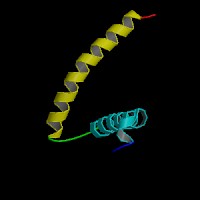
ModBase Predicted Comparative 3D Structure on O95678
FrontTopSide
The pictures above may be empty if there is no ModBase structure for the protein. The ModBase structure frequently covers just a fragment of the protein. You may be asked to log onto ModBase the first time you click on the pictures. It is simplest after logging in to just click on the picture again to get to the specific info on that model.

-  Orthologous Genes in Other Species
  Orthologies between human, mouse, and rat are computed by taking the best BLASTP hit, and filtering out non-syntenic hits. For more distant species reciprocal-best BLASTP hits are used. Note that the absence of an ortholog in the table below may reflect incomplete annotations in the other species rather than a true absence of the orthologous gene.
MouseRatZebrafishD. melanogasterC. elegansS. cerevisiae
Genome BrowserGenome BrowserNo orthologNo orthologNo orthologNo ortholog
Gene Details     
Gene Sorter     
MGIRGD    
Protein SequenceProtein Sequence    
AlignmentAlignment    

-  Gene Ontology (GO) Annotations with Structured Vocabulary
  Molecular Function:
GO:0005198 structural molecule activity

Biological Process:
GO:0002244 hematopoietic progenitor cell differentiation
GO:0031424 keratinization
GO:0070268 cornification

Cellular Component:
GO:0005622 intracellular
GO:0005829 cytosol
GO:0005882 intermediate filament
GO:0045095 keratin filament
GO:0070062 extracellular exosome


-  Descriptions from all associated GenBank mRNAs
  Y17282 - Homo sapiens mRNA for cytokeratin type II.
AK298960 - Homo sapiens cDNA FLJ60809 complete cds, highly similar to Homo sapiens cytokeratin type II (K6HF), mRNA.
AK225962 - Homo sapiens mRNA for cytokeratin type II variant, clone: FCC114C10.
BC160175 - Synthetic construct Homo sapiens clone IMAGE:100064207, MGC:193290 keratin 75 (KRT75) mRNA, encodes complete protein.
JD133337 - Sequence 114361 from Patent EP1572962.
JD426131 - Sequence 407155 from Patent EP1572962.
JD132292 - Sequence 113316 from Patent EP1572962.
JD519403 - Sequence 500427 from Patent EP1572962.
JD398414 - Sequence 379438 from Patent EP1572962.
JD203006 - Sequence 184030 from Patent EP1572962.
JD539068 - Sequence 520092 from Patent EP1572962.
JD539067 - Sequence 520091 from Patent EP1572962.
JD408336 - Sequence 389360 from Patent EP1572962.
JD250392 - Sequence 231416 from Patent EP1572962.
JD379479 - Sequence 360503 from Patent EP1572962.
JD494290 - Sequence 475314 from Patent EP1572962.
JD130098 - Sequence 111122 from Patent EP1572962.
JD384404 - Sequence 365428 from Patent EP1572962.
JD392046 - Sequence 373070 from Patent EP1572962.
JD543467 - Sequence 524491 from Patent EP1572962.
JD031368 - Sequence 12392 from Patent EP1572962.
JD365353 - Sequence 346377 from Patent EP1572962.

-  Biochemical and Signaling Pathways
  Reactome (by CSHL, EBI, and GO)

Protein O95678 (Reactome details) participates in the following event(s):

R-HSA-6805546 Keratin type I binds keratin type II
R-HSA-6805573 Keratin type I/type II heterodimers form tetramers
R-HSA-6806613 Keratin tetramers bind to form unit length filaments
R-HSA-6805567 Keratinization
R-HSA-1266738 Developmental Biology

-  Other Names for This Gene
  Alternate Gene Symbols: B4DQU4, ENST00000252245.1, ENST00000252245.2, ENST00000252245.3, ENST00000252245.4, ENST00000252245.5, K2C75_HUMAN, K6HF, KB18, NM_004693, O95678, Q9NSA9, uc001saj.1, uc001saj.2, uc001saj.3, uc001saj.4
UCSC ID: ENST00000252245.6
RefSeq Accession: NM_004693.3
Protein: O95678 (aka K2C75_HUMAN)
CCDS: CCDS8827.1

-  Methods, Credits, and Use Restrictions
  Click here for details on how this gene model was made and data restrictions if any.