Human Gene SACS (ENST00000382292.9) from GENCODE V50
  Description: sacsin molecular chaperone, transcript variant 1 (from RefSeq NM_014363.6)
Gencode Transcript: ENST00000382292.9
Gencode Gene: ENSG00000151835.18
Transcript (Including UTRs)
   Position: hg38 chr13:23,328,830-23,433,702 Size: 104,873 Total Exon Count: 10 Strand: -
Coding Region
   Position: hg38 chr13:23,330,136-23,411,239 Size: 81,104 Coding Exon Count: 9 

Page IndexSequence and LinksUniProtKB CommentsPrimersMalaCardsCTD
RNA-Seq ExpressionRNA StructureProtein StructureOther SpeciesGO AnnotationsmRNA Descriptions
Other NamesGeneReviewsMethods
Data last updated at UCSC: 2026-07-12 09:30:09

-  Comments and Description Text from UniProtKB
  ID: SACS_HUMAN
DESCRIPTION: RecName: Full=Sacsin; AltName: Full=DnaJ homolog subfamily C member 29; Short=DNAJC29;
FUNCTION: Co-chaperone which acts as a regulator of the Hsp70 chaperone machinery and may be involved in the processing of other ataxia-linked proteins.
SUBCELLULAR LOCATION: Cytoplasm. Note=Predominantly cytoplasmic, a small portion is present in the nucleus and also shows a partial mitochondrial overlap with the mitochondrial marker Hsp60.
TISSUE SPECIFICITY: Highly expressed in the central nervous system. Also found in skeletal muscle and at low levels in pancreas.
DOMAIN: The ubiquitin-like domain mediates interaction with the proteasome.
DOMAIN: The J domain is functional and is shown to stimulate E.coli dnaK ATPase activity.
DISEASE: Defects in SACS are the cause of spastic ataxia Charlevoix-Saguenay type (SACS) [MIM:270550]. It is a neurodegenerative disease characterized by early-onset cerebellar ataxia, spasticity, retinal hypermyelination, pyramidal signs, and both axonal and demyelinating neuropathy with loss of sensory nerve conduction and reduced motor conduction velocities. Other features include dysarthria, distal muscle wasting, nystagmus, defect in conjugate pursuit ocular movements, retinal striation (from prominent retinal nerves) obscuring the retinal blood vessels in places, and the frequent presence of mitral valve prolapse.
SIMILARITY: Contains 1 HEPN domain.
SIMILARITY: Contains 1 J domain.
SIMILARITY: Contains 1 ubiquitin-like domain.
SEQUENCE CAUTION: Sequence=BAC03486.1; Type=Erroneous initiation; Note=Translation N-terminally extended; Sequence=CAH18265.1; Type=Erroneous initiation; Note=Translation N-terminally extended;
WEB RESOURCE: Name=GeneReviews; URL="http://www.ncbi.nlm.nih.gov/sites/GeneTests/lab/gene/SACS";

-  Primer design for this transcript
 

Primer3Plus can design qPCR Primers that straddle exon-exon-junctions, which amplify only cDNA, not genomic DNA.
Click here to load the transcript sequence and exon structure into Primer3Plus

Exonprimer can design one pair of Sanger sequencing primers around every exon, located in non-genic sequence.
Click here to open Exonprimer with this transcript

To design primers for a non-coding sequence, zoom to a region of interest and select from the drop-down menu: View > In External Tools > Primer3


-  Comparative Toxicogenomics Database (CTD)
  The following chemicals interact with this gene           more ... click here to view the complete list

-  RNA-Seq Expression Data from GTEx (53 Tissues, 570 Donors)
  Highest median expression: 6.22 RPKM in Cells - EBV-transformed lymphocytes
Total median expression: 141.89 RPKM


View in GTEx track of Genome Browser    View at GTEx portal     View GTEx Body Map

-  mRNA Secondary Structure of 3' and 5' UTRs
 
RegionFold EnergyBasesEnergy/Base
Display As
5' UTR -142.70589-0.242 Picture PostScript Text
3' UTR -274.801306-0.210 Picture PostScript Text

The RNAfold program from the Vienna RNA Package is used to perform the secondary structure predictions and folding calculations. The estimated folding energy is in kcal/mol. The more negative the energy, the more secondary structure the RNA is likely to have.

-  Protein Domain and Structure Information
  InterPro Domains: Graphical view of domain structure
IPR003594 - ATPase-like_ATP-bd
IPR001623 - DnaJ_N
IPR007842 - HEPN
IPR000626 - Ubiquitin
IPR019955 - Ubiquitin_supergroup

Pfam Domains:
PF05168 - HEPN domain
PF00240 - Ubiquitin family

Protein Data Bank (PDB) 3-D Structure
MuPIT help
1IUR - NMR MuPIT 3O10 - X-ray MuPIT


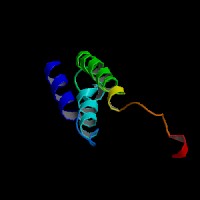
ModBase Predicted Comparative 3D Structure on Q9NZJ4
FrontTopSide
The pictures above may be empty if there is no ModBase structure for the protein. The ModBase structure frequently covers just a fragment of the protein. You may be asked to log onto ModBase the first time you click on the pictures. It is simplest after logging in to just click on the picture again to get to the specific info on that model.

-  Orthologous Genes in Other Species
  Orthologies between human, mouse, and rat are computed by taking the best BLASTP hit, and filtering out non-syntenic hits. For more distant species reciprocal-best BLASTP hits are used. Note that the absence of an ortholog in the table below may reflect incomplete annotations in the other species rather than a true absence of the orthologous gene.
MouseRatZebrafishD. melanogasterC. elegansS. cerevisiae
Genome BrowserGenome BrowserNo orthologNo orthologNo orthologNo ortholog
Gene Details     
Gene Sorter     
MGIRGD    
Protein SequenceProtein Sequence    
AlignmentAlignment    

-  Gene Ontology (GO) Annotations with Structured Vocabulary
  Molecular Function:
GO:0030544 Hsp70 protein binding
GO:0051087 chaperone binding
GO:0070628 proteasome binding

Biological Process:
GO:0006457 protein folding
GO:0090084 negative regulation of inclusion body assembly

Cellular Component:
GO:0005634 nucleus
GO:0005737 cytoplasm
GO:0005739 mitochondrion
GO:0030424 axon
GO:0030425 dendrite
GO:0070852 cell body fiber


-  Descriptions from all associated GenBank mRNAs
  AB018273 - Homo sapiens mRNA for KIAA0730 protein, partial cds.
AK090599 - Homo sapiens cDNA FLJ33280 fis, clone ASTRO2008960.
AX746526 - Sequence 51 from Patent EP1308459.
BX640926 - Homo sapiens mRNA; cDNA DKFZp779N1969 (from clone DKFZp779N1969).
AK024708 - Homo sapiens cDNA: FLJ21055 fis, clone CAS00618.
BC039418 - Homo sapiens spastic ataxia of Charlevoix-Saguenay (sacsin), mRNA (cDNA clone IMAGE:5302298).
JD526130 - Sequence 507154 from Patent EP1572962.
JD552796 - Sequence 533820 from Patent EP1572962.
JD114115 - Sequence 95139 from Patent EP1572962.
JD550987 - Sequence 532011 from Patent EP1572962.
JD327885 - Sequence 308909 from Patent EP1572962.
JD224842 - Sequence 205866 from Patent EP1572962.
JD225018 - Sequence 206042 from Patent EP1572962.
JD112043 - Sequence 93067 from Patent EP1572962.
JD309164 - Sequence 290188 from Patent EP1572962.
JD308498 - Sequence 289522 from Patent EP1572962.
JD288578 - Sequence 269602 from Patent EP1572962.
CR749427 - Homo sapiens mRNA; cDNA DKFZp686B15167 (from clone DKFZp686B15167).
AK125458 - Homo sapiens cDNA FLJ43469 fis, clone OCBBF2037340, highly similar to Sacsin.

-  Other Names for This Gene
  Alternate Gene Symbols: ENST00000382292.1, ENST00000382292.2, ENST00000382292.3, ENST00000382292.4, ENST00000382292.5, ENST00000382292.6, ENST00000382292.7, ENST00000382292.8, KIAA0730, NM_014363, O94835, Q5T9J5, Q5T9J7, Q5T9J8, Q68DF5, Q6MZR4, Q8NBF9, Q9NZJ4, SACS_HUMAN, uc001uon.1, uc001uon.2, uc001uon.3, uc001uon.4, uc001uon.5
UCSC ID: ENST00000382292.9
RefSeq Accession: NM_014363.6
Protein: Q9NZJ4 (aka SACS_HUMAN)
CCDS: CCDS9300.2

-  GeneReviews for This Gene
  GeneReviews article(s) related to gene SACS:
arsacs (ARSACS)
ataxias (Hereditary Ataxia Overview)

-  Methods, Credits, and Use Restrictions
  Click here for details on how this gene model was made and data restrictions if any.