ID:SUGT1_HUMAN DESCRIPTION: RecName: Full=Suppressor of G2 allele of SKP1 homolog; AltName: Full=Protein 40-6-3; AltName: Full=Sgt1; FUNCTION: May play a role in ubiquitination and subsequent proteasomal degradation of target proteins. SUBUNIT: Probably associates with SCF (SKP1-CUL1-F-box protein) complex through interaction with SKP1. Interacts with S100A6. Interacts with HSP90. SUBCELLULAR LOCATION: Cytoplasm. Nucleus. Note=Translocates to the nucleus upon heat shock, requiring S100A6. DOMAIN: The CS domain mediates interaction with HSP90. PTM: Phosphorylated at Ser-281 and Ser-331, dephosphorylation promotes nuclear translocation, most likely due to disruption of the SUGT1-HSP90 complex. SIMILARITY: Belongs to the SUGT1 family. SIMILARITY: Contains 1 CS domain. SIMILARITY: Contains 1 SGS domain. SIMILARITY: Contains 3 TPR repeats.
The RNAfold program from the Vienna RNA Package is used to perform the secondary structure predictions and folding calculations. The estimated folding energy is in kcal/mol. The more negative the energy, the more secondary structure the RNA is likely to have.
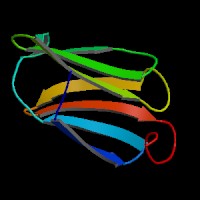
ModBase Predicted Comparative 3D Structure on Q9Y2Z0
Front
Top
Side
The pictures above may be empty if there is no ModBase structure for the protein. The ModBase structure frequently covers just a fragment of the protein. You may be asked to log onto ModBase the first time you click on the pictures. It is simplest after logging in to just click on the picture again to get to the specific info on that model.
Orthologous Genes in Other Species
Orthologies between human, mouse, and rat are computed by taking the best BLASTP hit, and filtering out non-syntenic hits. For more distant species reciprocal-best BLASTP hits are used. Note that the absence of an ortholog in the table below may reflect incomplete annotations in the other species rather than a true absence of the orthologous gene.
Biological Process: GO:0000278 mitotic cell cycle GO:0031647 regulation of protein stability GO:0043947 positive regulation by host of symbiont catalytic activity
 Sequence and Links to Tools and Databases

 Microarray Expression Data