Human Gene OSBPL7 (ENST00000007414.8) from GENCODE V50
  Description: oxysterol binding protein like 7 (from RefSeq NM_145798.3)
Gencode Transcript: ENST00000007414.8
Gencode Gene: ENSG00000006025.15
Transcript (Including UTRs)
   Position: hg38 chr17:47,807,372-47,821,794 Size: 14,423 Total Exon Count: 23 Strand: -
Coding Region
   Position: hg38 chr17:47,808,291-47,820,278 Size: 11,988 Coding Exon Count: 22 

Page IndexSequence and LinksUniProtKB CommentsPrimersCTDRNA-Seq Expression
Microarray ExpressionRNA StructureProtein StructureOther SpeciesGO AnnotationsmRNA Descriptions
PathwaysOther NamesMethods
Data last updated at UCSC: 2026-07-12 09:30:09

-  Comments and Description Text from UniProtKB
  ID: OSBL7_HUMAN
DESCRIPTION: RecName: Full=Oxysterol-binding protein-related protein 7; Short=ORP-7; Short=OSBP-related protein 7;
SIMILARITY: Belongs to the OSBP family.
SIMILARITY: Contains 1 PH domain.

-  Primer design for this transcript
 

Primer3Plus can design qPCR Primers that straddle exon-exon-junctions, which amplify only cDNA, not genomic DNA.
Click here to load the transcript sequence and exon structure into Primer3Plus

Exonprimer can design one pair of Sanger sequencing primers around every exon, located in non-genic sequence.
Click here to open Exonprimer with this transcript

To design primers for a non-coding sequence, zoom to a region of interest and select from the drop-down menu: View > In External Tools > Primer3


-  Comparative Toxicogenomics Database (CTD)
  The following chemicals interact with this gene           more ... click here to view the complete list

-  RNA-Seq Expression Data from GTEx (53 Tissues, 570 Donors)
  Highest median expression: 22.97 RPKM in Colon - Transverse
Total median expression: 362.74 RPKM


View in GTEx track of Genome Browser    View at GTEx portal     View GTEx Body Map

+  Microarray Expression Data
 
Expression ratio colors:

GNF Expression Atlas 2 Data from U133A and GNF1H Chips


Ratios


Absolute


Ratios


Absolute


Ratios


Absolute

-  mRNA Secondary Structure of 3' and 5' UTRs
 
RegionFold EnergyBasesEnergy/Base
Display As
5' UTR -93.00216-0.431 Picture PostScript Text
3' UTR -349.90919-0.381 Picture PostScript Text

The RNAfold program from the Vienna RNA Package is used to perform the secondary structure predictions and folding calculations. The estimated folding energy is in kcal/mol. The more negative the energy, the more secondary structure the RNA is likely to have.

-  Protein Domain and Structure Information
  InterPro Domains: Graphical view of domain structure
IPR000648 - Oxysterol-bd
IPR018494 - Oxysterol-bd_CS
IPR011993 - PH_like_dom
IPR001849 - Pleckstrin_homology

Pfam Domains:
PF01237 - Oxysterol-binding protein
PF00169 - PH domain

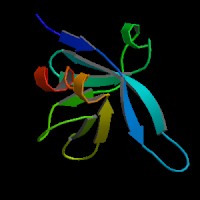
ModBase Predicted Comparative 3D Structure on Q9BZF2
FrontTopSide
The pictures above may be empty if there is no ModBase structure for the protein. The ModBase structure frequently covers just a fragment of the protein. You may be asked to log onto ModBase the first time you click on the pictures. It is simplest after logging in to just click on the picture again to get to the specific info on that model.

-  Orthologous Genes in Other Species
  Orthologies between human, mouse, and rat are computed by taking the best BLASTP hit, and filtering out non-syntenic hits. For more distant species reciprocal-best BLASTP hits are used. Note that the absence of an ortholog in the table below may reflect incomplete annotations in the other species rather than a true absence of the orthologous gene.
MouseRatZebrafishD. melanogasterC. elegansS. cerevisiae
Genome BrowserGenome BrowserNo orthologNo orthologNo orthologNo ortholog
Gene Details     
Gene Sorter     
MGIRGD    
Protein SequenceProtein Sequence    
AlignmentAlignment    

-  Gene Ontology (GO) Annotations with Structured Vocabulary
  Molecular Function:
GO:0005515 protein binding
GO:0008289 lipid binding
GO:0015248 sterol transporter activity
GO:0015485 cholesterol binding

Biological Process:
GO:0006699 bile acid biosynthetic process
GO:0006869 lipid transport
GO:0010506 regulation of autophagy
GO:0015918 sterol transport
GO:0071397 cellular response to cholesterol
GO:1901800 positive regulation of proteasomal protein catabolic process

Cellular Component:
GO:0005737 cytoplasm
GO:0005776 autophagosome
GO:0005783 endoplasmic reticulum
GO:0005789 endoplasmic reticulum membrane
GO:0005829 cytosol
GO:0005886 plasma membrane
GO:0016020 membrane
GO:0097038 perinuclear endoplasmic reticulum


-  Descriptions from all associated GenBank mRNAs
  BC065482 - Homo sapiens oxysterol binding protein-like 7, mRNA (cDNA clone MGC:71150 IMAGE:6081784), complete cds.
BC028010 - Homo sapiens oxysterol binding protein-like 7, mRNA (cDNA clone IMAGE:5213141), complete cds.
AB208886 - Homo sapiens mRNA for oxysterol-binding protein-like protein 7 variant protein.
AF392446 - Homo sapiens oxysterol-binding protein-like protein OSBPL7 (OSBPL7) mRNA, complete cds.
JD445739 - Sequence 426763 from Patent EP1572962.
JD266912 - Sequence 247936 from Patent EP1572962.
JD081414 - Sequence 62438 from Patent EP1572962.
JD068319 - Sequence 49343 from Patent EP1572962.
JD537000 - Sequence 518024 from Patent EP1572962.
JD305342 - Sequence 286366 from Patent EP1572962.
JD243332 - Sequence 224356 from Patent EP1572962.
JD453346 - Sequence 434370 from Patent EP1572962.
JD149169 - Sequence 130193 from Patent EP1572962.
JD352692 - Sequence 333716 from Patent EP1572962.
JD253414 - Sequence 234438 from Patent EP1572962.
AF323729 - Homo sapiens OSBP-related protein 7 mRNA, complete cds.
JD555443 - Sequence 536467 from Patent EP1572962.
JD152862 - Sequence 133886 from Patent EP1572962.
JD180173 - Sequence 161197 from Patent EP1572962.
JD395995 - Sequence 377019 from Patent EP1572962.
KJ900010 - Synthetic construct Homo sapiens clone ccsbBroadEn_09404 OSBPL7 gene, encodes complete protein.
AK000267 - Homo sapiens cDNA FLJ20260 fis, clone COLF7627.
AK289523 - Homo sapiens cDNA FLJ76993 complete cds, highly similar to Homo sapiens oxysterol binding protein-like 7, mRNA.
JD343368 - Sequence 324392 from Patent EP1572962.
JD417493 - Sequence 398517 from Patent EP1572962.
JD495346 - Sequence 476370 from Patent EP1572962.
JD068812 - Sequence 49836 from Patent EP1572962.
JD539844 - Sequence 520868 from Patent EP1572962.
JD368788 - Sequence 349812 from Patent EP1572962.
JD174038 - Sequence 155062 from Patent EP1572962.
JD368787 - Sequence 349811 from Patent EP1572962.
JD555749 - Sequence 536773 from Patent EP1572962.
JD279601 - Sequence 260625 from Patent EP1572962.

-  Biochemical and Signaling Pathways
  Reactome (by CSHL, EBI, and GO)

Protein Q9BZF2 (Reactome details) participates in the following event(s):

R-HSA-8867667 OSBPs transport 25OH-CHOL from ER membrane to plasma membrane
R-HSA-192105 Synthesis of bile acids and bile salts
R-HSA-194068 Bile acid and bile salt metabolism
R-HSA-8957322 Metabolism of steroids
R-HSA-556833 Metabolism of lipids
R-HSA-1430728 Metabolism

-  Other Names for This Gene
  Alternate Gene Symbols: D3DTT6, ENST00000007414.1, ENST00000007414.2, ENST00000007414.3, ENST00000007414.4, ENST00000007414.5, ENST00000007414.6, ENST00000007414.7, NM_145798, ORP7, OSBL7_HUMAN, Q6PIV6, Q9BZF2, uc002ilx.1, uc002ilx.2, uc002ilx.3
UCSC ID: ENST00000007414.8
RefSeq Accession: NM_145798.3
Protein: Q9BZF2 (aka OSBL7_HUMAN)
CCDS: CCDS11515.1

-  Methods, Credits, and Use Restrictions
  Click here for details on how this gene model was made and data restrictions if any.