ID:PI51C_HUMAN DESCRIPTION: RecName: Full=Phosphatidylinositol 4-phosphate 5-kinase type-1 gamma; Short=PIP5K1-gamma; Short=PtdIns(4)P-5-kinase 1 gamma; EC=2.7.1.68; AltName: Full=Phosphatidylinositol 4-phosphate 5-kinase type I gamma; Short=PIP5KIgamma; FUNCTION: Catalyzes the phosphorylation of phosphatidylinositol 4- phosphate (PtdIns4P) to form phosphatidylinositol 4,5-bisphosphate (PtdIns(4,5)P2). PtdIns(4,5)P2 is involved in a variety of cellular processes and is the substrate to form phosphatidylinositol 3,4,5-trisphosphate (PtdIns(3,4,5)P3), another second messenger. The majority of PtdIns(4,5)P2 is thought to occur via type I phosphatidylinositol 4-phosphate 5-kinases given the abundance of PtdIns4P. Participates in a variety of cellular processes such as vesicle mediated transport, cell adhesion, cell polarization and cell migration. Together with PIP5K1A is required for phagocytosis, but they regulate different types of actin remodeling at sequential steps. Promotes particle attachment by generating the pool of PtdIns(4,5)P2 that induces controlled actin depolymerization to facilitate Fc-gamma-R clustering. Mediates RAC1-dependent reorganization of actin filaments. Required for synaptic vesicle transport. Controls the plasma membrane pool of PtdIns(4,5)P2 implicated in synaptic vesicle endocytosis and exocytosis. Plays a role in endocytosis mediated by clathrin and AP-2 (adaptor protein complex 2). Required for clathrin-coated pits assembly at the synapse. Participates in cell junction assembly. Modulates adherens junctions formation by facilitating CDH1 trafficking. Required for focal adhesion dynamics. Modulates the targeting of talins (TLN1 and TLN2) to the plasma membrane and their efficient assembly into focal adhesions. Regulates the interaction between talins (TLN1 and TLN2) and beta-integrins. Required for uropodium formation and retraction of the cell rear during directed migration. Has a role in growth factor- stimulated directional cell migration and adhesion. Required for talin assembly into nascent adhesions forming at the leading edge toward the direction of the growth factor. Negative regulator of T-cell activation and adhesion. Negatively regulates integrin alpha-L/beta-2 (LFA-1) polarization and adhesion induced by T-cell receptor. Together with PIP5K1A have a role during embryogenesis and together with PIP5K1B may have a role immediately after birth. CATALYTIC ACTIVITY: ATP + 1-phosphatidyl-1D-myo-inositol 4- phosphate = ADP + 1-phosphatidyl-1D-myo-inositol 4,5-bisphosphate. ENZYME REGULATION: Activated by interaction with TLN2. SUBUNIT: Interacts with TLN1 (By similarity). Interacts with TLN2; interaction stimulates lipid kinase activity. May compete with beta-integrins for the same binding site on TLN1 and TLN2. Interacts with ARF6. Interacts with AP2B1. Interacts with AP2M1; phosphorylation of PIP5K1C by CSK disrupts the interaction; clathrin competes with PIP5K1C (By similarity). Interacts with CDH1. Interacts with CSK (By similarity). Interacts with PLCG1; interaction is abolished upon EGF stimulation (By similarity). SUBCELLULAR LOCATION: Cell membrane; Peripheral membrane protein; Cytoplasmic side. Endomembrane system. Cytoplasm. Cell junction, focal adhesion. Cell junction, adherens junction. Cell projection, ruffle membrane. Cell projection, phagocytic cup. Cell projection, uropodium. Note=Detected in plasma membrane invaginations. Isoform 3 is detected in intracellular vesicle-like structures. SUBCELLULAR LOCATION: Isoform 2: Cytoplasm. Nucleus. TISSUE SPECIFICITY: Isoform 1 is strongly expressed in brain and also detected in heart and lung. Isoform 2 is strongly expressed in pancreas and liver and in lesser quantities in brain, heart, lung and kidney. Isoform 3 is detected in large amounts in heart and large intestine, is also present in lung, pancreas and thyroid, and to a lesser extent in brain, stomach and kidney. PTM: Phosphorylation on Ser-650 negatively regulates binding to TLN2 and is strongly stimulated in mitosis. Phosphorylation on Tyr-649 is necessary for targeting to focal adhesions. Phosphorylation on Ser-650 and Tyr-649 are mutually exclusive. Phosphorylated by SYK and CSK (By similarity). Tyrosine phosphorylation is enhanced by PTK2 signaling. Phosphorylated at Tyr-639 upon EGF stimulation. Some studies suggest that phosphorylation on Tyr-649 enhances binding to tailins (TLN1 and TLN2). According to PubMed:15738269 phosphorylation at Tyr-649 does not directly enhance binding to tailins (TLN1 and TLN2) but may act indirectly by inhibiting phosphorylation at Ser-650. PTM: Acetylation at Lys-265 and Lys-268 seems to decrease lipid kinase activity. Deacetylation of these sites by SIRT1 positively regulates the exocytosis of TSH-containing granules from pituitary cells. DISEASE: Defects in PIP5K1C are the cause of lethal congenital contracture syndrome type 3 (LCCS3) [MIM:611369]; also known as multiple contractural syndrome Israeli Bedouin type B. LCCS is an autosomal recessive disorder characterized by early fetal hydrops and akinesia, the Pena-Shokeir phenotype, specific neuropathology with degeneration of anterior horn neurons and extreme skeletal muscle atrophy. LCCS3 patients present at birth with severe multiple joint contractures with severe muscle wasting and atrophy, mainly in the legs. LCCS3 can be distinguished from the original LCCS by the absence of hydrops, fractures, and multiple pterygia. SIMILARITY: Contains 1 PIPK domain. SEQUENCE CAUTION: Sequence=BAA25515.1; Type=Erroneous initiation; Note=Translation N-terminally shortened;
The RNAfold program from the Vienna RNA Package is used to perform the secondary structure predictions and folding calculations. The estimated folding energy is in kcal/mol. The more negative the energy, the more secondary structure the RNA is likely to have.
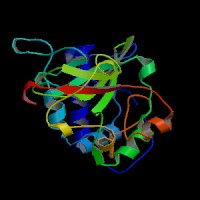
ModBase Predicted Comparative 3D Structure on O60331
Front
Top
Side
The pictures above may be empty if there is no ModBase structure for the protein. The ModBase structure frequently covers just a fragment of the protein. You may be asked to log onto ModBase the first time you click on the pictures. It is simplest after logging in to just click on the picture again to get to the specific info on that model.
Orthologous Genes in Other Species
Orthologies between human, mouse, and rat are computed by taking the best BLASTP hit, and filtering out non-syntenic hits. For more distant species reciprocal-best BLASTP hits are used. Note that the absence of an ortholog in the table below may reflect incomplete annotations in the other species rather than a true absence of the orthologous gene.
Protein O60331 (Reactome details) participates in the following event(s):
R-HSA-399936 Inhibition of integrin activation by sequestering PIP5KIgamma R-HSA-8868066 PIP5K1C phosphorylates PI(4)P to PI(4,5)P2 R-HSA-1676082 PI4P is phosphorylated to PI(4,5)P2 by PIP5K1A-C at the plasma membrane R-HSA-1675773 PI(3,4)P2 is phosphorylated to PI(3,4,5)P3 by PIP5K1A-C at the plasma membrane R-HSA-1676145 PI3P is phosphorylated to PI(3,4)P2 by PIP4K2/5K1 at the plasma membrane R-HSA-399955 SEMA3A-Plexin repulsion signaling by inhibiting Integrin adhesion R-HSA-8856828 Clathrin-mediated endocytosis R-HSA-373755 Semaphorin interactions R-HSA-1660499 Synthesis of PIPs at the plasma membrane R-HSA-6811558 PI5P, PP2A and IER3 Regulate PI3K/AKT Signaling R-HSA-199991 Membrane Trafficking R-HSA-422475 Axon guidance R-HSA-1483255 PI Metabolism R-HSA-199418 Negative regulation of the PI3K/AKT network R-HSA-5653656 Vesicle-mediated transport R-HSA-1266738 Developmental Biology R-HSA-1483257 Phospholipid metabolism R-HSA-1257604 PIP3 activates AKT signaling R-HSA-556833 Metabolism of lipids R-HSA-9006925 Intracellular signaling by second messengers R-HSA-1430728 Metabolism R-HSA-162582 Signal Transduction
 Sequence and Links to Tools and Databases

 Microarray Expression Data