Human Gene C2orf68 (ENST00000306336.6) from GENCODE V50
Description: chromosome 2 open reading frame 68 (from RefSeq NM_001013649.4)Gencode Transcript: ENST00000306336.6Gencode Gene: ENSG00000168887.13Transcript (Including UTRs) Position: hg38 chr2:85,605,254-85,612,066 Size: 6,813 Total Exon Count: 4 Strand: -Coding Region Position: hg38 chr2:85,608,945-85,611,984 Size: 3,040 Coding Exon Count: 4
Data last updated at UCSC: 2026-07-12 09:30:09
Sequence and Links to Tools and Databases
Comments and Description Text from UniProtKB
ID: CB068_HUMAN DESCRIPTION: RecName: Full=UPF0561 protein C2orf68;SIMILARITY: Belongs to the UPF0561 family.
Primer design for this transcript
MalaCards Disease Associations
Comparative Toxicogenomics Database (CTD)
The following chemicals interact with this gene
RNA-Seq Expression Data from GTEx (53 Tissues, 570 Donors)
mRNA Secondary Structure of 3' and 5' UTRs
Vienna RNA Package is used to perform the secondary structure predictions and folding calculations. The estimated folding energy is in kcal/mol. The more negative the energy, the more secondary structure the RNA is likely to have.
Protein Domain and Structure Information
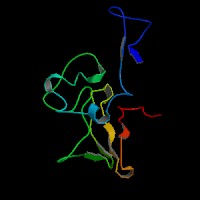
InterPro Domains: Graphical view of domain structure IPR018888 - UPF0561Pfam Domains: PF10573 - Uncharacterised protein family UPF0561ModBase Predicted Comparative 3D Structure on Q2NKX9 The pictures above may be empty if there is no ModBase structure for the protein. The ModBase structure frequently covers just a fragment of the protein. You may be asked to log onto ModBase the first time you click on the pictures. It is simplest after logging in to just click on the picture again to get to the specific info on that model.
Orthologous Genes in Other Species
Orthologies between human, mouse, and rat are computed by taking the best BLASTP hit, and filtering out non-syntenic hits. For more distant species reciprocal-best BLASTP hits are used. Note that the absence of an ortholog in the table below may reflect incomplete annotations in the other species rather than a true absence of the orthologous gene.
Descriptions from all associated GenBank mRNAs
KJ896203 - Synthetic construct Homo sapiens clone ccsbBroadEn_05597 C2orf68 gene, encodes complete protein.LF207192 - JP 2014500723-A/14695: Polycomb-Associated Non-Coding RNAs.MA442769 - JP 2018138019-A/14695: Polycomb-Associated Non-Coding RNAs.LF361881 - JP 2014500723-A/169384: Polycomb-Associated Non-Coding RNAs.MA597458 - JP 2018138019-A/169384: Polycomb-Associated Non-Coding RNAs.LF363041 - JP 2014500723-A/170544: Polycomb-Associated Non-Coding RNAs.MA598618 - JP 2018138019-A/170544: Polycomb-Associated Non-Coding RNAs.LF363040 - JP 2014500723-A/170543: Polycomb-Associated Non-Coding RNAs.MA598617 - JP 2018138019-A/170543: Polycomb-Associated Non-Coding RNAs.LF363039 - JP 2014500723-A/170542: Polycomb-Associated Non-Coding RNAs.MA598616 - JP 2018138019-A/170542: Polycomb-Associated Non-Coding RNAs.BC111483 - Homo sapiens chromosome 2 open reading frame 68, mRNA (cDNA clone MGC:131675 IMAGE:3877097), complete cds.LF363038 - JP 2014500723-A/170541: Polycomb-Associated Non-Coding RNAs.MA598615 - JP 2018138019-A/170541: Polycomb-Associated Non-Coding RNAs.AK092972 - Homo sapiens cDNA FLJ35653 fis, clone SPLEN2013690.LF363037 - JP 2014500723-A/170540: Polycomb-Associated Non-Coding RNAs.MA598614 - JP 2018138019-A/170540: Polycomb-Associated Non-Coding RNAs.LF363035 - JP 2014500723-A/170538: Polycomb-Associated Non-Coding RNAs.MA598612 - JP 2018138019-A/170538: Polycomb-Associated Non-Coding RNAs.AK311297 - Homo sapiens cDNA, FLJ18339.AK300003 - Homo sapiens cDNA FLJ51646 complete cds.LF363034 - JP 2014500723-A/170537: Polycomb-Associated Non-Coding RNAs.MA598611 - JP 2018138019-A/170537: Polycomb-Associated Non-Coding RNAs.JX960761 - Homo sapiens HCRCN81 protein (HCRCN81) mRNA, complete cds.LF363033 - JP 2014500723-A/170536: Polycomb-Associated Non-Coding RNAs.MA598610 - JP 2018138019-A/170536: Polycomb-Associated Non-Coding RNAs.BC057834 - Homo sapiens chromosome 2 open reading frame 68, mRNA (cDNA clone IMAGE:30344023), with apparent retained intron.AK024174 - Homo sapiens cDNA FLJ14112 fis, clone MAMMA1001683.AK124808 - Homo sapiens cDNA FLJ42818 fis, clone BRCAN2015371.
Other Names for This Gene
Alternate Gene Symbols: B4DT10, CB068_HUMAN, ENST00000306336.1, ENST00000306336.2, ENST00000306336.3, ENST00000306336.4, ENST00000306336.5, NM_001013649, Q2NKX9, Q4G0J7, Q6ZVA6, uc002sqc.1, uc002sqc.2, uc002sqc.3, uc002sqc.4UCSC ID: ENST00000306336.6RefSeq Accession: NM_001013649.4 Protein: Q2NKX9
(aka CB068_HUMAN)CCDS: CCDS42704.1
Methods, Credits, and Use Restrictions
Click here
for details on how this gene model was made and data restrictions if any.
 Sequence and Links to Tools and Databases