ID:IL36G_HUMAN DESCRIPTION: RecName: Full=Interleukin-36 gamma; AltName: Full=IL-1-related protein 2; Short=IL-1RP2; AltName: Full=Interleukin-1 epsilon; Short=IL-1 epsilon; AltName: Full=Interleukin-1 family member 9; Short=IL-1F9; AltName: Full=Interleukin-1 homolog 1; Short=IL-1H1; FUNCTION: Function as an agonist of NF-kappa B activation through the orphan IL-1-receptor-related protein 2. Could constitute part of an independent signaling system analogous to interleukin-1 alpha (IL-1A), beta (IL-1B) receptor agonist and interleukin-1 receptor type I (IL-1R1), that is present in epithelial barriers and takes part in local inflammatory response. SUBCELLULAR LOCATION: Secreted. TISSUE SPECIFICITY: Highly expressed in tissues containing epithelial cells: skin, lung, stomach and esophagus. In skin is expressed only in keratinocytes but not in fibroblasts, endothelial cells or melanocytes. Up-regulated in lesional psoriasis skin. INDUCTION: By TNF and by IFNG/IFN-gamma in keratinocytes. SIMILARITY: Belongs to the IL-1 family. WEB RESOURCE: Name=Wikipedia; Note=Interleukin-1 entry; URL="http://en.wikipedia.org/wiki/Interleukin_1"; WEB RESOURCE: Name=SeattleSNPs; URL="http://pga.gs.washington.edu/data/il1f9/";
The RNAfold program from the Vienna RNA Package is used to perform the secondary structure predictions and folding calculations. The estimated folding energy is in kcal/mol. The more negative the energy, the more secondary structure the RNA is likely to have.
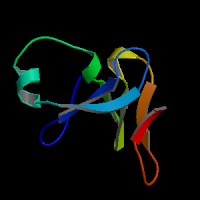
ModBase Predicted Comparative 3D Structure on Q9NZH8
Front
Top
Side
The pictures above may be empty if there is no ModBase structure for the protein. The ModBase structure frequently covers just a fragment of the protein. You may be asked to log onto ModBase the first time you click on the pictures. It is simplest after logging in to just click on the picture again to get to the specific info on that model.
Orthologous Genes in Other Species
Orthologies between human, mouse, and rat are computed by taking the best BLASTP hit, and filtering out non-syntenic hits. For more distant species reciprocal-best BLASTP hits are used. Note that the absence of an ortholog in the table below may reflect incomplete annotations in the other species rather than a true absence of the orthologous gene.
 Sequence and Links to Tools and Databases

 Microarray Expression Data