ID:GALT5_HUMAN DESCRIPTION: RecName: Full=Polypeptide N-acetylgalactosaminyltransferase 5; EC=2.4.1.41; AltName: Full=Polypeptide GalNAc transferase 5; Short=GalNAc-T5; Short=pp-GaNTase 5; AltName: Full=Protein-UDP acetylgalactosaminyltransferase 5; AltName: Full=UDP-GalNAc:polypeptide N-acetylgalactosaminyltransferase 5; FUNCTION: Catalyzes the initial reaction in O-linked oligosaccharide biosynthesis, the transfer of an N-acetyl-D- galactosamine residue to a serine or threonine residue on the protein receptor. Has activity toward EA2 peptide substrate, but has a weak activity toward Muc2 or Muc1b substrates (By similarity). CATALYTIC ACTIVITY: UDP-N-acetyl-D-galactosamine + polypeptide = UDP + N-acetyl-D-galactosaminyl-polypeptide. COFACTOR: Manganese (By similarity). COFACTOR: Calcium (By similarity). PATHWAY: Protein modification; protein glycosylation. SUBUNIT: Interacts with EXT2. Does not interact with EXT1, EXTL1 or EXTL3. SUBCELLULAR LOCATION: Golgi apparatus membrane; Single-pass type II membrane protein (By similarity). DOMAIN: There are two conserved domains in the glycosyltransferase region: the N-terminal domain (domain A, also called GT1 motif), which is probably involved in manganese coordination and substrate binding and the C-terminal domain (domain B, also called Gal/GalNAc-T motif), which is probably involved in catalytic reaction and UDP-Gal binding (By similarity). DOMAIN: The ricin B-type lectin domain binds to GalNAc and contributes to the glycopeptide specificity (By similarity). SIMILARITY: Belongs to the glycosyltransferase 2 family. GalNAc-T subfamily. SIMILARITY: Contains 1 ricin B-type lectin domain. WEB RESOURCE: Name=GGDB; Note=GlycoGene database; URL="http://riodb.ibase.aist.go.jp/rcmg/ggdb/"; WEB RESOURCE: Name=Functional Glycomics Gateway - GTase; Note=Polypeptide N-acetylgalactosaminyltransferase 5; URL="http://www.functionalglycomics.org/glycomics/molecule/jsp/glycoEnzyme/viewGlycoEnzyme.jsp?gbpId=gt_hum_487";
The RNAfold program from the Vienna RNA Package is used to perform the secondary structure predictions and folding calculations. The estimated folding energy is in kcal/mol. The more negative the energy, the more secondary structure the RNA is likely to have.
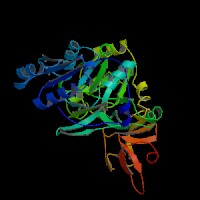
ModBase Predicted Comparative 3D Structure on Q7Z7M9
Front
Top
Side
The pictures above may be empty if there is no ModBase structure for the protein. The ModBase structure frequently covers just a fragment of the protein. You may be asked to log onto ModBase the first time you click on the pictures. It is simplest after logging in to just click on the picture again to get to the specific info on that model.
Orthologous Genes in Other Species
Orthologies between human, mouse, and rat are computed by taking the best BLASTP hit, and filtering out non-syntenic hits. For more distant species reciprocal-best BLASTP hits are used. Note that the absence of an ortholog in the table below may reflect incomplete annotations in the other species rather than a true absence of the orthologous gene.
Protein Q7Z7M9 (Reactome details) participates in the following event(s):
R-HSA-913675 GALNTs transfer GalNAc from UDP-GalNAc to mucins to form Tn antigens R-HSA-913709 O-linked glycosylation of mucins R-HSA-5173105 O-linked glycosylation R-HSA-597592 Post-translational protein modification R-HSA-392499 Metabolism of proteins
 Sequence and Links to Tools and Databases