Human Gene SLC52A3 (ENST00000645534.1) from GENCODE V50 |
|
 Sequence and Links to Tools and Databases
|
|
Comments and Description Text from UniProtKB
|
|---|
| |
ID: S52A3_HUMAN
DESCRIPTION: RecName: Full=Solute carrier family 52, riboflavin transporter, member 3; AltName: Full=Riboflavin transporter 2; Short=hRFT2;
FUNCTION: Riboflavin transporter. Riboflavin transport is Na(+)- independent but moderately pH-sensitive. Activity is strongly inhibited by riboflavin analogs, such as lumiflavin, flavin mononucleotide (FMN) and flavin adenine dinucleotide (FAD), and to a lesser extent by amiloride.
BIOPHYSICOCHEMICAL PROPERTIES: Kinetic parameters: KM=0.98 uM for riboflavin;
SUBCELLULAR LOCATION: Cell membrane; Multi-pass membrane protein.
TISSUE SPECIFICITY: Predominantly expressed in testis. Highly expressed in small intestine and prostate.
DISEASE: Defects in SLC52A3 are the cause of Brown-Vialetto-Van Laere syndrome type 1 (BVVLS1) [MIM:211530]. A rare autosomal recessive neurologic disorder characterized by sensorineural hearing loss and a variety of cranial nerve palsies, which develop over a relatively short period of time in a previously healthy individual. Sensorineural hearing loss may precede the neurological signs. The course is invariably progressive, but the rate of decline is variable within and between families. With disease evolution, long tract signs, lower motor neuron signs, cerebellar ataxia, and lower cranial nerve (III-VI) palsies develop, giving rise to a complex picture resembling amyotrophic lateral sclerosis. Diaphragmatic weakness and respiratory compromise are some of the most distressing features, leading to recurrent chest infections and respiratory failure, which are often the cause of patients' demise.
DISEASE: Defects in SLC52A3 are the cause of Fazio-Londe disease (FALOND) [MIM:211500]. A rare neurological disease characterized by progressive weakness of the muscles innervated by cranial nerves of the lower brain stem. It may present in childhood with severe neurological deterioration with hypotonia, respiratory insufficiency leading to premature death, or later in life with bulbar weakness which progresses to involve motor neurons throughout the neuroaxis. Clinical manifestations include dysarthria, dysphagia, facial weakness, tongue weakness, and fasciculations of the tongue and facial muscles.
SIMILARITY: Belongs to the riboflavin transporter family.
CAUTION: It is uncertain whether Met-1 or Met-5 is the initiator.
| |
|
|
Primer design for this transcript
|
|
MalaCards Disease Associations
|
|---|
| |
MalaCards Gene Search: SLC52A3
Diseases sorted by gene-association score: brown-vialetto-van laere syndrome 1* (1332), fazio-londe disease* (1080), brown-vialetto-van laere syndrome (65), progressive bulbar palsy (17), gastric cardia adenocarcinoma (14), multiple cranial nerve palsy (11), madras motor neuron disease (10), dysphagia (8), glossopharyngeal nerve disease (7), chronic apical periodontitis (7), gastric cardia carcinoma (6), motor neuron disease (2)
* = Manually curated disease association
| |
|
|
Comparative Toxicogenomics Database (CTD)
|
|---|
| |
The following chemicals interact with this gene
| |
|
|
RNA-Seq Expression Data from GTEx (53 Tissues, 570 Donors)
|
|
mRNA Secondary Structure of 3' and 5' UTRs
|
|---|
| |
The RNAfold program from the Vienna RNA Package is used to perform the secondary structure predictions and folding calculations. The estimated folding energy is in kcal/mol. The more negative the energy, the more secondary structure the RNA is likely to have.
| |
|
|
Protein Domain and Structure Information
|
|---|
| |
InterPro Domains: Graphical view of domain structure
IPR009357 - Endogenous_retrovirus_rcpt
Pfam Domains:
PF06237 - Protein of unknown function (DUF1011)
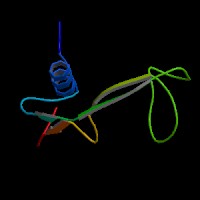
ModBase Predicted Comparative 3D Structure on Q9NQ40
The pictures above may be empty if there is no ModBase structure for the protein. The ModBase structure frequently covers just a fragment of the protein. You may be asked to log onto ModBase the first time you click on the pictures. It is simplest after logging in to just click on the picture again to get to the specific info on that model.
| |
|
|
Orthologous Genes in Other Species
|
|---|
| |
Orthologies between human, mouse, and rat are computed by taking the best BLASTP hit, and filtering out non-syntenic hits. For more distant species reciprocal-best BLASTP hits are used. Note that the absence of an ortholog in the table below may reflect incomplete annotations in the other species rather than a true absence of the orthologous gene.
| |
|
|
Gene Ontology (GO) Annotations with Structured Vocabulary
|
|
Descriptions from all associated GenBank mRNAs
|
|---|
| |
BC009750 - Homo sapiens chromosome 20 open reading frame 54, mRNA (cDNA clone MGC:10698 IMAGE:3689286), complete cds.
KY978479 - Homo sapiens SLC52A3b transcript variant 2 (SLC52A3) mRNA, complete cds.
KY978478 - Homo sapiens SLC52A3a transcript variant 1 (SLC52A3) mRNA, complete cds.
AK074650 - Homo sapiens cDNA FLJ90169 fis, clone MAMMA1000226.
JD134165 - Sequence 115189 from Patent EP1572962.
JD519616 - Sequence 500640 from Patent EP1572962.
JD309735 - Sequence 290759 from Patent EP1572962.
JD401057 - Sequence 382081 from Patent EP1572962.
JD097190 - Sequence 78214 from Patent EP1572962.
JD139332 - Sequence 120356 from Patent EP1572962.
JD191608 - Sequence 172632 from Patent EP1572962.
JD221036 - Sequence 202060 from Patent EP1572962.
JD450194 - Sequence 431218 from Patent EP1572962.
JD336007 - Sequence 317031 from Patent EP1572962.
JD057599 - Sequence 38623 from Patent EP1572962.
JD183551 - Sequence 164575 from Patent EP1572962.
JD374775 - Sequence 355799 from Patent EP1572962.
JD536220 - Sequence 517244 from Patent EP1572962.
JD282223 - Sequence 263247 from Patent EP1572962.
JD201124 - Sequence 182148 from Patent EP1572962.
JD079093 - Sequence 60117 from Patent EP1572962.
JD103699 - Sequence 84723 from Patent EP1572962.
JD187799 - Sequence 168823 from Patent EP1572962.
JD474958 - Sequence 455982 from Patent EP1572962.
JD175189 - Sequence 156213 from Patent EP1572962.
JD435701 - Sequence 416725 from Patent EP1572962.
JD141262 - Sequence 122286 from Patent EP1572962.
JD048242 - Sequence 29266 from Patent EP1572962.
JD363234 - Sequence 344258 from Patent EP1572962.
JD450516 - Sequence 431540 from Patent EP1572962.
JD534101 - Sequence 515125 from Patent EP1572962.
JD260615 - Sequence 241639 from Patent EP1572962.
JX478249 - Homo sapiens solute carrier family 52 member 3 (SLC52A3) mRNA, complete cds.
HQ448283 - Synthetic construct Homo sapiens clone IMAGE:100071686; CCSB006168_01 chromosome 20 open reading frame 54 (C20orf54) gene, encodes complete protein.
KJ899991 - Synthetic construct Homo sapiens clone ccsbBroadEn_09385 SLC52A3 gene, encodes complete protein.
AK291706 - Homo sapiens cDNA FLJ78620 complete cds.
JD254962 - Sequence 235986 from Patent EP1572962.
JD221854 - Sequence 202878 from Patent EP1572962.
JD399430 - Sequence 380454 from Patent EP1572962.
JD260922 - Sequence 241946 from Patent EP1572962.
JD559400 - Sequence 540424 from Patent EP1572962.
JD458811 - Sequence 439835 from Patent EP1572962.
JD519004 - Sequence 500028 from Patent EP1572962.
MN534336 - Homo sapiens cell line TE3 SLC52A3c lncRNA, complete sequence.
| |
|
|
Biochemical and Signaling Pathways
|
|
Other Names for This Gene
|
|---|
| |
Alternate Gene Symbols: A0A2I6BQ49, A8K6P1, C20orf54, K0A6P4, NM_033409, Q5W1A0, Q5W1A1, Q8NCL7, Q96GD5, Q9NQ40, RFT2, RFVT3, S52A3_HUMAN, uc002wed.1, uc002wed.2, uc002wed.3, uc002wed.4, uc002wed.5, uc002wed.6, uc002wed.7
UCSC ID: ENST00000645534.1
RefSeq Accession: NM_033409.4
Protein: Q9NQ40
(aka S52A3_HUMAN)
CCDS: CCDS13007.1
| |
|
|
GeneReviews for This Gene
|
|---|
| |
GeneReviews article(s) related to gene SLC52A3:
riboflavin-tn (Riboflavin Transporter Deficiency)
| |
|
|
Methods, Credits, and Use Restrictions
|
|---|
| |
Click here
for details on how this gene model was made and data restrictions if any.
| |
|
|
|