Human Gene CRKL (ENST00000354336.8) from GENCODE V50
Description: CRK like proto-oncogene, adaptor protein, transcript variant 2 (from RefSeq NR_156180.2)Gencode Transcript: ENST00000354336.8Gencode Gene: ENSG00000099942.15Transcript (Including UTRs) Position: hg38 chr22:20,917,407-20,953,747 Size: 36,341 Total Exon Count: 3 Strand: +Coding Region Position: hg38 chr22:20,917,935-20,949,845 Size: 31,911 Coding Exon Count: 3
Data last updated at UCSC: 2026-07-12 09:30:09
Sequence and Links to Tools and Databases
Comments and Description Text from UniProtKB
ID: CRKL_HUMAN DESCRIPTION: RecName: Full=Crk-like protein;FUNCTION: May mediate the transduction of intracellular signals.SUBUNIT: Interacts with INPP5D/SHIP1. Interacts with DOCK2 and EPOR. Interacts with phosphorylated CBLB and IRS4.INTERACTION: Q9EQG6:Kidins220 (xeno); NbExp=2; IntAct=EBI-910, EBI-976654; Q92918:MAP4K1; NbExp=5; IntAct=EBI-910, EBI-881;SIMILARITY: Belongs to the CRK family.SIMILARITY: Contains 1 SH2 domain.SIMILARITY: Contains 2 SH3 domains.
Primer design for this transcript
MalaCards Disease Associations
Comparative Toxicogenomics Database (CTD)
RNA-Seq Expression Data from GTEx (53 Tissues, 570 Donors)
Microarray Expression Data
mRNA Secondary Structure of 3' and 5' UTRs
Vienna RNA Package is used to perform the secondary structure predictions and folding calculations. The estimated folding energy is in kcal/mol. The more negative the energy, the more secondary structure the RNA is likely to have.
Protein Domain and Structure Information
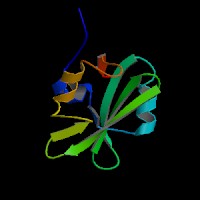
InterPro Domains: Graphical view of domain structure IPR000980 - SH2IPR011511 - SH3_2IPR001452 - SH3_domainPfam Domains: PF00017 - SH2 domainPF00018 - SH3 domainPF07653 - Variant SH3 domainProtein Data Bank (PDB) 3-D Structure ModBase Predicted Comparative 3D Structure on P46109 The pictures above may be empty if there is no ModBase structure for the protein. The ModBase structure frequently covers just a fragment of the protein. You may be asked to log onto ModBase the first time you click on the pictures. It is simplest after logging in to just click on the picture again to get to the specific info on that model.
Orthologous Genes in Other Species
Orthologies between human, mouse, and rat are computed by taking the best BLASTP hit, and filtering out non-syntenic hits. For more distant species reciprocal-best BLASTP hits are used. Note that the absence of an ortholog in the table below may reflect incomplete annotations in the other species rather than a true absence of the orthologous gene.
Gene Ontology (GO) Annotations with Structured Vocabulary
Descriptions from all associated GenBank mRNAs
AK292909 - Homo sapiens cDNA FLJ77301 complete cds, highly similar to Homo sapiens v-crk sarcoma virus CT10 oncogene homolog (avian)-like (CRKL), mRNA.X59656 - H.sapiens crk-like gene CRKL.BC026248 - Homo sapiens, v-crk sarcoma virus CT10 oncogene homolog (avian)-like, clone IMAGE:4808983, mRNA.JD282852 - Sequence 263876 from Patent EP1572962.BC043500 - Homo sapiens v-crk sarcoma virus CT10 oncogene homolog (avian)-like, mRNA (cDNA clone MGC:49914 IMAGE:6046673), complete cds.JD399452 - Sequence 380476 from Patent EP1572962.CR456423 - Homo sapiens CRKL full length open reading frame (ORF) cDNA clone (cDNA clone C22ORF:pGEM.CRKL).JD422452 - Sequence 403476 from Patent EP1572962.JD458451 - Sequence 439475 from Patent EP1572962.CU013272 - Homo sapiens CRKL, mRNA (cDNA clone IMAGE:100000049), complete cds, without stop codon, in Gateway system.CU012984 - Homo sapiens CRKL, mRNA (cDNA clone IMAGE:100000145), complete cds, with stop codon, in Gateway system.AB463342 - Synthetic construct DNA, clone: pF1KB8444, Homo sapiens CRKL gene for v-crk sarcoma virus CT10 oncogene homolog, without stop codon, in Flexi system.HV542942 - JP 2011525491-A/27: CRKL TARGETING PEPTIDES.JA083023 - Sequence 58 from Patent EP2303913.JD550461 - Sequence 531485 from Patent EP1572962.DQ586321 - Homo sapiens piRNA piR-53433, complete sequence.JD161359 - Sequence 142383 from Patent EP1572962.JD290695 - Sequence 271719 from Patent EP1572962.JD260678 - Sequence 241702 from Patent EP1572962.JD053352 - Sequence 34376 from Patent EP1572962.JD060312 - Sequence 41336 from Patent EP1572962.JD059502 - Sequence 40526 from Patent EP1572962.JD049856 - Sequence 30880 from Patent EP1572962.JD215378 - Sequence 196402 from Patent EP1572962.JD204069 - Sequence 185093 from Patent EP1572962.JD156634 - Sequence 137658 from Patent EP1572962.JD429480 - Sequence 410504 from Patent EP1572962.JD300494 - Sequence 281518 from Patent EP1572962.JD094815 - Sequence 75839 from Patent EP1572962.JD514004 - Sequence 495028 from Patent EP1572962.JD069825 - Sequence 50849 from Patent EP1572962.JD415121 - Sequence 396145 from Patent EP1572962.JD415123 - Sequence 396147 from Patent EP1572962.DQ598791 - Homo sapiens piRNA piR-36857, complete sequence.AK000311 - Homo sapiens cDNA FLJ20304 fis, clone HEP06749.JD314188 - Sequence 295212 from Patent EP1572962.BC044621 - Homo sapiens v-crk sarcoma virus CT10 oncogene homolog (avian)-like, mRNA (cDNA clone IMAGE:5273862).BC053958 - Homo sapiens v-crk sarcoma virus CT10 oncogene homolog (avian)-like, mRNA (cDNA clone IMAGE:5273798).BC033281 - Homo sapiens, clone IMAGE:4749267, mRNA.JD394708 - Sequence 375732 from Patent EP1572962.
Biochemical and Signaling Pathways
Other Names for This Gene
Alternate Gene Symbols: A8KA44, CRKL_HUMAN, D3DX35, ENST00000354336.1, ENST00000354336.2, ENST00000354336.3, ENST00000354336.4, ENST00000354336.5, ENST00000354336.6, ENST00000354336.7, NR_156180, P46109, uc002ztf.1, uc002ztf.2, uc002ztf.3UCSC ID: ENST00000354336.8RefSeq Accession: NM_005207.4 Protein: P46109
(aka CRKL_HUMAN)CCDS: CCDS13785.1
Methods, Credits, and Use Restrictions
Click here
for details on how this gene model was made and data restrictions if any.
 Sequence and Links to Tools and Databases

 Microarray Expression Data