ID:HYAL1_HUMAN DESCRIPTION: RecName: Full=Hyaluronidase-1; Short=Hyal-1; EC=3.2.1.35; AltName: Full=Hyaluronoglucosaminidase-1; AltName: Full=Lung carcinoma protein 1; Short=LuCa-1; Flags: Precursor; FUNCTION: May have a role in promoting tumor progression. May block the TGFB1-enhanced cell growth. CATALYTIC ACTIVITY: Random hydrolysis of (1->4)-linkages between N-acetyl-beta-D-glucosamine and D-glucuronate residues in hyaluronate. BIOPHYSICOCHEMICAL PROPERTIES: pH dependence: Optimum pH is about 3.8; SUBCELLULAR LOCATION: Secreted. Lysosome. TISSUE SPECIFICITY: Highly expressed in the liver, kidney and heart. Weakly expressed in lung, placenta and skeletal muscle. No expression detected in adult brain. Isoform 1 is expressed only in bladder and prostate cancer cells, G2/G3 bladder tumor tissues and lymph node specimens showing tumor invasive tumors cells. Isoform 3, isoform 4, isoform 5 and isoform 6 are expressed in normal bladder and bladder tumor tissues. DISEASE: Defects in HYAL1 are the cause of mucopolysaccharidosis type 9 (MPS9) [MIM:601492]; also called hyaluronidase deficiency. MPS9 is a lysosomal storage disease characterized by high hyaluronan (HA) concentration in the serum. The clinical features are periarticular soft tissue masses, mild short stature and acetabular erosions, and absence of neurological or visceral involvement. SIMILARITY: Belongs to the glycosyl hydrolase 56 family. SIMILARITY: Contains 1 EGF-like domain. SEQUENCE CAUTION: Sequence=AAH25774.1; Type=Erroneous initiation; WEB RESOURCE: Name=Atlas of Genetics and Cytogenetics in Oncology and Haematology; URL="http://atlasgeneticsoncology.org/Genes/HYAL1ID40903ch3p21.html"; WEB RESOURCE: Name=GeneReviews; URL="http://www.ncbi.nlm.nih.gov/sites/GeneTests/lab/gene/HYAL1";
The RNAfold program from the Vienna RNA Package is used to perform the secondary structure predictions and folding calculations. The estimated folding energy is in kcal/mol. The more negative the energy, the more secondary structure the RNA is likely to have.
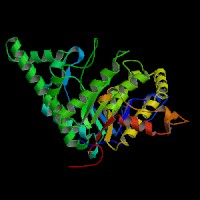
ModBase Predicted Comparative 3D Structure on Q12794
Front
Top
Side
The pictures above may be empty if there is no ModBase structure for the protein. The ModBase structure frequently covers just a fragment of the protein. You may be asked to log onto ModBase the first time you click on the pictures. It is simplest after logging in to just click on the picture again to get to the specific info on that model.
Orthologous Genes in Other Species
Orthologies between human, mouse, and rat are computed by taking the best BLASTP hit, and filtering out non-syntenic hits. For more distant species reciprocal-best BLASTP hits are used. Note that the absence of an ortholog in the table below may reflect incomplete annotations in the other species rather than a true absence of the orthologous gene.
 Sequence and Links to Tools and Databases

 Microarray Expression Data