Human Gene SIAH2 (ENST00000312960.4) from GENCODE V50
  Description: siah E3 ubiquitin protein ligase 2 (from RefSeq NM_005067.7)
Gencode Transcript: ENST00000312960.4
Gencode Gene: ENSG00000181788.6
Transcript (Including UTRs)
   Position: hg38 chr3:150,741,125-150,763,169 Size: 22,045 Total Exon Count: 2 Strand: -
Coding Region
   Position: hg38 chr3:150,742,141-150,762,849 Size: 20,709 Coding Exon Count: 2 

Page IndexSequence and LinksUniProtKB CommentsPrimersCTDRNA-Seq Expression
Microarray ExpressionRNA StructureProtein StructureOther SpeciesGO AnnotationsmRNA Descriptions
PathwaysOther NamesMethods
Data last updated at UCSC: 2026-07-12 09:30:09

-  Comments and Description Text from UniProtKB
  ID: SIAH2_HUMAN
DESCRIPTION: RecName: Full=E3 ubiquitin-protein ligase SIAH2; EC=6.3.2.-; AltName: Full=Seven in absentia homolog 2; Short=Siah-2; Short=hSiah2;
FUNCTION: E3 ubiquitin-protein ligase that mediates ubiquitination and subsequent proteasomal degradation of target proteins. E3 ubiquitin ligases accept ubiquitin from an E2 ubiquitin- conjugating enzyme in the form of a thioester and then directly transfers the ubiquitin to targeted substrates. Mediates E3 ubiquitin ligase activity either through direct binding to substrates or by functioning as the essential RING domain subunit of larger E3 complexes. Triggers the ubiquitin-mediated degradation of many substrates, including proteins involved in transcription regulation (POU2AF1, PML, NCOR1), a cell surface receptor (DCC), an antiapoptotic protein (BAG1), and a protein involved in synaptic vesicle function in neurons (SYP). It is thereby involved in apoptosis, tumor suppression, cell cycle, transcription and signaling processes. Has some overlapping function with SIAH1. Triggers the ubiquitin-mediated degradation of TRAF2, whereas SIAH1 can not. Promotes monoubiquitination of SNCA.
ENZYME REGULATION: Inhibited by interaction with SNCAIP (isoform 2, but not isoform 1). May be inhibited by interaction with PEG10.
PATHWAY: Protein modification; protein ubiquitination.
SUBUNIT: Homodimer. Interacts with UBE2E2. Interacts with PEG3 (By similarity). Interacts with VAV1, without mediating its ubiquitin- mediated degradation. Interacts with CACYBP/SIP. Probable component of some large E3 complex possibly composed of UBE2D1, SIAH2, CACYBP/SIP, SKP1, APC and TBL1X. Interacts with PEG10, which may inhibit its activity. Interacts with EGLN2 and SNCAIP.
INTERACTION: Q7Z6J0:SH3RF1; NbExp=2; IntAct=EBI-948141, EBI-311339;
SUBCELLULAR LOCATION: Cytoplasm. Nucleus (Probable). Note=Predominantly cytoplasmic (Probable). Partially nuclear (Probable).
TISSUE SPECIFICITY: Widely expressed at low level.
DOMAIN: The RING-type zinc finger domain is essential for ubiquitin ligase activity.
DOMAIN: The SBD domain (substrate-binding domain) mediates the homodimerization and the interaction with substrate proteins. It is related to the TRAF family (By similarity).
PTM: Phosphorylated at Ser-28 by MAPK14, which mediates the degradation by the proteasome of PHD3 (By similarity).
SIMILARITY: Belongs to the SINA (Seven in absentia) family.
SIMILARITY: Contains 1 RING-type zinc finger.
SIMILARITY: Contains 1 SIAH-type zinc finger.

-  Primer design for this transcript
 

Primer3Plus can design qPCR Primers that straddle exon-exon-junctions, which amplify only cDNA, not genomic DNA.
Click here to load the transcript sequence and exon structure into Primer3Plus

Exonprimer can design one pair of Sanger sequencing primers around every exon, located in non-genic sequence.
Click here to open Exonprimer with this transcript

To design primers for a non-coding sequence, zoom to a region of interest and select from the drop-down menu: View > In External Tools > Primer3


-  Comparative Toxicogenomics Database (CTD)
  The following chemicals interact with this gene           more ... click here to view the complete list

-  RNA-Seq Expression Data from GTEx (53 Tissues, 570 Donors)
  Highest median expression: 37.92 RPKM in Adrenal Gland
Total median expression: 697.20 RPKM


View in GTEx track of Genome Browser    View at GTEx portal     View GTEx Body Map

+  Microarray Expression Data
 
Expression ratio colors:

GTEx Gene Expression


Ratios


Absolute


Ratios


Absolute

GNF Expression Atlas 2 Data from U133A and GNF1H Chips


Ratios


Absolute


Ratios


Absolute


Ratios


Absolute

-  mRNA Secondary Structure of 3' and 5' UTRs
 
RegionFold EnergyBasesEnergy/Base
Display As
5' UTR -189.90320-0.593 Picture PostScript Text
3' UTR -270.701016-0.266 Picture PostScript Text

The RNAfold program from the Vienna RNA Package is used to perform the secondary structure predictions and folding calculations. The estimated folding energy is in kcal/mol. The more negative the energy, the more secondary structure the RNA is likely to have.

-  Protein Domain and Structure Information
  InterPro Domains: Graphical view of domain structure
IPR004162 - 7-in-absentia-prot
IPR018121 - 7-in-absentia-prot_TRAF-dom
IPR013323 - SIAH-type
IPR008974 - TRAF-like
IPR013322 - TRAF-type
IPR001841 - Znf_RING
IPR013083 - Znf_RING/FYVE/PHD
IPR013010 - Znf_SIAH

Pfam Domains:
PF03145 - Seven in absentia protein family

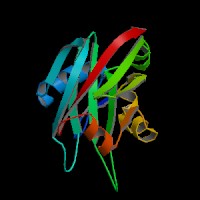
ModBase Predicted Comparative 3D Structure on O43255
FrontTopSide
The pictures above may be empty if there is no ModBase structure for the protein. The ModBase structure frequently covers just a fragment of the protein. You may be asked to log onto ModBase the first time you click on the pictures. It is simplest after logging in to just click on the picture again to get to the specific info on that model.

-  Orthologous Genes in Other Species
  Orthologies between human, mouse, and rat are computed by taking the best BLASTP hit, and filtering out non-syntenic hits. For more distant species reciprocal-best BLASTP hits are used. Note that the absence of an ortholog in the table below may reflect incomplete annotations in the other species rather than a true absence of the orthologous gene.
MouseRatZebrafishD. melanogasterC. elegansS. cerevisiae
Genome BrowserGenome BrowserNo orthologNo orthologNo orthologNo ortholog
Gene Details     
Gene Sorter     
MGIRGD    
Protein SequenceProtein Sequence    
AlignmentAlignment    

-  Gene Ontology (GO) Annotations with Structured Vocabulary
  Molecular Function:
GO:0003714 transcription corepressor activity
GO:0004842 ubiquitin-protein transferase activity
GO:0005515 protein binding
GO:0008270 zinc ion binding
GO:0016740 transferase activity
GO:0031624 ubiquitin conjugating enzyme binding
GO:0046872 metal ion binding

Biological Process:
GO:0000209 protein polyubiquitination
GO:0006511 ubiquitin-dependent protein catabolic process
GO:0006915 apoptotic process
GO:0007049 cell cycle
GO:0007264 small GTPase mediated signal transduction
GO:0007275 multicellular organism development
GO:0007411 axon guidance
GO:0016567 protein ubiquitination
GO:0016579 protein deubiquitination
GO:0031396 regulation of protein ubiquitination
GO:0043066 negative regulation of apoptotic process
GO:0043154 negative regulation of cysteine-type endopeptidase activity involved in apoptotic process
GO:0044257 cellular protein catabolic process
GO:0044267 cellular protein metabolic process
GO:0090090 negative regulation of canonical Wnt signaling pathway
GO:1903507 negative regulation of nucleic acid-templated transcription
GO:2001237 negative regulation of extrinsic apoptotic signaling pathway

Cellular Component:
GO:0005634 nucleus
GO:0005654 nucleoplasm
GO:0005737 cytoplasm
GO:0005769 early endosome
GO:0005829 cytosol
GO:0043005 neuron projection
GO:0043025 neuronal cell body
GO:0043231 intracellular membrane-bounded organelle


-  Descriptions from all associated GenBank mRNAs
  LP895474 - Sequence 338 from Patent EP3253886.
AK055290 - Homo sapiens cDNA FLJ30728 fis, clone FEBRA2000021, highly similar to Human hSIAH2 mRNA.
BC013082 - Homo sapiens seven in absentia homolog 2 (Drosophila), mRNA (cDNA clone MGC:17169 IMAGE:4153095), complete cds.
U76248 - Human hSIAH2 mRNA, complete cds.
JD139331 - Sequence 120355 from Patent EP1572962.
JD303878 - Sequence 284902 from Patent EP1572962.
DQ580231 - Homo sapiens piRNA piR-48343, complete sequence.
JD246141 - Sequence 227165 from Patent EP1572962.
AK223565 - Homo sapiens mRNA for seven in absentia homolog 2 variant, clone: FCC128C06.
JD537071 - Sequence 518095 from Patent EP1572962.
JD286148 - Sequence 267172 from Patent EP1572962.
JD291226 - Sequence 272250 from Patent EP1572962.
JD274177 - Sequence 255201 from Patent EP1572962.
Y15268 - Homo sapiens mRNA for Siah2 protein.
AB590673 - Synthetic construct DNA, clone: pFN21AB8949, Homo sapiens SIAH2 gene for seven in absentia homolog 2, without stop codon, in Flexi system.
JD128971 - Sequence 109995 from Patent EP1572962.
JD307455 - Sequence 288479 from Patent EP1572962.
JD108796 - Sequence 89820 from Patent EP1572962.

-  Biochemical and Signaling Pathways
  Reactome (by CSHL, EBI, and GO)

Protein O43255 (Reactome details) participates in the following event(s):

R-HSA-374667 DCC interaction with SIAH2
R-HSA-6781899 USP13 binds SIAH2
R-HSA-983157 Interaction of E3 with substrate and E2-Ub complex
R-HSA-983147 Release of E3 from polyubiquitinated substrate
R-HSA-5658092 SIAH1, SIAH2 bind SNCAIP
R-HSA-983140 Transfer of Ub from E2 to substrate and release of E2
R-HSA-5658496 SIAH1:UBE2L6:Ubiquitin binds SNCA
R-HSA-5660753 SIAH1:UBE2L6:Ubiquitin ubiquitinates SNCA
R-HSA-373752 Netrin-1 signaling
R-HSA-5689880 Ub-specific processing proteases
R-HSA-983168 Antigen processing: Ubiquitination & Proteasome degradation
R-HSA-977225 Amyloid fiber formation
R-HSA-422475 Axon guidance
R-HSA-5688426 Deubiquitination
R-HSA-983169 Class I MHC mediated antigen processing & presentation
R-HSA-392499 Metabolism of proteins
R-HSA-1266738 Developmental Biology
R-HSA-597592 Post-translational protein modification
R-HSA-1280218 Adaptive Immune System
R-HSA-168256 Immune System

-  Other Names for This Gene
  Alternate Gene Symbols: ENST00000312960.1, ENST00000312960.2, ENST00000312960.3, NM_005067, O43255, O43270, SIAH2_HUMAN, uc003eyi.1, uc003eyi.2, uc003eyi.3, uc003eyi.4, uc003eyi.5
UCSC ID: ENST00000312960.4
RefSeq Accession: NM_005067.7
Protein: O43255 (aka SIAH2_HUMAN or SIA2_HUMAN)
CCDS: CCDS3152.1

-  Methods, Credits, and Use Restrictions
  Click here for details on how this gene model was made and data restrictions if any.