Human Gene CPLX1 (ENST00000304062.11) from GENCODE V50 |
|
 Sequence and Links to Tools and Databases
|
|
Comments and Description Text from UniProtKB
|
|---|
| |
ID: CPLX1_HUMAN
DESCRIPTION: RecName: Full=Complexin-1; AltName: Full=Complexin I; Short=CPX I; AltName: Full=Synaphin-2;
FUNCTION: Positively regulates a late step in synaptic vesicle exocytosis. Organizes the SNAREs into a cross-linked zigzag topology that, when interposed between the vesicle and plasma membranes, is incompatible with fusion, thereby preventing SNAREs from releasing neurotransmitters until an action potential arrives at the synapse. Also involved in glucose-induced secretion of insulin by pancreatic beta-cells (By similarity).
SUBUNIT: Binds to the SNARE core complex containing SNAP25, VAMP2 and STX1A.
SUBCELLULAR LOCATION: Cytoplasm, cytosol (By similarity). Note=Enriched at synaptic-releasing sites in mature neurons (By similarity).
TISSUE SPECIFICITY: Nervous system. In hippocampus and cerebellum, expressed mainly by inhibitory neurons. Overexpressed in substantia nigra from patients with Parkinson disease.
SIMILARITY: Belongs to the complexin/synaphin family.
| |
|
|
Primer design for this transcript
|
|
Comparative Toxicogenomics Database (CTD)
|
|
RNA-Seq Expression Data from GTEx (53 Tissues, 570 Donors)
|
|
 Microarray Expression Data
|
|
mRNA Secondary Structure of 3' and 5' UTRs
|
|---|
| |
The RNAfold program from the Vienna RNA Package is used to perform the secondary structure predictions and folding calculations. The estimated folding energy is in kcal/mol. The more negative the energy, the more secondary structure the RNA is likely to have.
| |
|
|
Protein Domain and Structure Information
|
|---|
| |
InterPro Domains: Graphical view of domain structure
IPR008849 - Synaphin
Pfam Domains:
PF05835 - Synaphin protein
Protein Data Bank (PDB) 3-D Structure
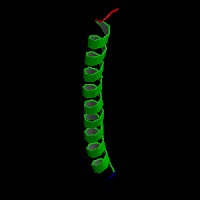
ModBase Predicted Comparative 3D Structure on O14810
The pictures above may be empty if there is no ModBase structure for the protein. The ModBase structure frequently covers just a fragment of the protein. You may be asked to log onto ModBase the first time you click on the pictures. It is simplest after logging in to just click on the picture again to get to the specific info on that model.
| |
|
|
Orthologous Genes in Other Species
|
|---|
| |
Orthologies between human, mouse, and rat are computed by taking the best BLASTP hit, and filtering out non-syntenic hits. For more distant species reciprocal-best BLASTP hits are used. Note that the absence of an ortholog in the table below may reflect incomplete annotations in the other species rather than a true absence of the orthologous gene.
| |
|
|
Gene Ontology (GO) Annotations with Structured Vocabulary
|
|
Descriptions from all associated GenBank mRNAs
|
|---|
| |
AB593095 - Homo sapiens CPLX1 mRNA for complexin-1, complete cds, clone: HP06406-RBb63D03.
BC002471 - Homo sapiens complexin 1, mRNA (cDNA clone MGC:3097 IMAGE:3349779), complete cds.
AK126578 - Homo sapiens cDNA FLJ44615 fis, clone BRACE2012838, moderately similar to Complexin 1.
JD227955 - Sequence 208979 from Patent EP1572962.
JD227214 - Sequence 208238 from Patent EP1572962.
JD557904 - Sequence 538928 from Patent EP1572962.
JD290140 - Sequence 271164 from Patent EP1572962.
JD398310 - Sequence 379334 from Patent EP1572962.
JD205823 - Sequence 186847 from Patent EP1572962.
JD039778 - Sequence 20802 from Patent EP1572962.
JD192463 - Sequence 173487 from Patent EP1572962.
JD393409 - Sequence 374433 from Patent EP1572962.
JD166912 - Sequence 147936 from Patent EP1572962.
JD408422 - Sequence 389446 from Patent EP1572962.
JD474722 - Sequence 455746 from Patent EP1572962.
JD391702 - Sequence 372726 from Patent EP1572962.
JD320862 - Sequence 301886 from Patent EP1572962.
JD508305 - Sequence 489329 from Patent EP1572962.
JD100508 - Sequence 81532 from Patent EP1572962.
JD443167 - Sequence 424191 from Patent EP1572962.
JD191252 - Sequence 172276 from Patent EP1572962.
AF022383 - Homo sapiens complexin I mRNA, complete cds.
BT007029 - Homo sapiens complexin 1 mRNA, complete cds.
AK311921 - Homo sapiens cDNA, FLJ92188, Homo sapiens complexin 1 (CPLX1), mRNA.
KJ893142 - Synthetic construct Homo sapiens clone ccsbBroadEn_02536 CPLX1 gene, encodes complete protein.
KJ534815 - Homo sapiens clone CPLX1_iso-A_adult-A01 complexin 1 isoform A (CPLX1) mRNA, partial cds, alternatively spliced.
JD442593 - Sequence 423617 from Patent EP1572962.
JD264376 - Sequence 245400 from Patent EP1572962.
JD260184 - Sequence 241208 from Patent EP1572962.
| |
|
|
Biochemical and Signaling Pathways
|
|
Other Names for This Gene
|
|---|
| |
Alternate Gene Symbols: A6NI80, B2R4R5, CPLX1_HUMAN, D3DVN3, ENST00000304062.1, ENST00000304062.10, ENST00000304062.2, ENST00000304062.3, ENST00000304062.4, ENST00000304062.5, ENST00000304062.6, ENST00000304062.7, ENST00000304062.8, ENST00000304062.9, F1T0G1, NM_006651, O14810, uc003gbi.1, uc003gbi.2, uc003gbi.3, uc003gbi.4, uc003gbi.5
UCSC ID: ENST00000304062.11
RefSeq Accession: NM_006651.4
Protein: O14810
(aka CPLX1_HUMAN or CLX1_HUMAN)
CCDS: CCDS46995.1
| |
|
|
Methods, Credits, and Use Restrictions
|
|---|
| |
Click here
for details on how this gene model was made and data restrictions if any.
| |
|
|
|