Human Gene LOX (ENST00000231004.5) from GENCODE V50
  Description: lysyl oxidase, transcript variant 1 (from RefSeq NM_002317.7)
Gencode Transcript: ENST00000231004.5
Gencode Gene: ENSG00000113083.17
Transcript (Including UTRs)
   Position: hg38 chr5:122,063,195-122,078,259 Size: 15,065 Total Exon Count: 7 Strand: -
Coding Region
   Position: hg38 chr5:122,066,743-122,077,985 Size: 11,243 Coding Exon Count: 7 

Page IndexSequence and LinksUniProtKB CommentsPrimersMalaCardsCTD
RNA-Seq ExpressionMicroarray ExpressionRNA StructureProtein StructureOther SpeciesGO Annotations
mRNA DescriptionsPathwaysOther NamesGeneReviewsMethods
Data last updated at UCSC: 2026-07-12 09:30:09

-  Comments and Description Text from UniProtKB
  ID: LYOX_HUMAN
DESCRIPTION: RecName: Full=Protein-lysine 6-oxidase; EC=1.4.3.13; AltName: Full=Lysyl oxidase; Flags: Precursor;
FUNCTION: Responsible for the post-translational oxidative deamination of peptidyl lysine residues in precursors to fibrous collagen and elastin. In addition to cross-linking of extracellular matrix proteins, may have a direct role in tumor suppression.
CATALYTIC ACTIVITY: Peptidyl-L-lysyl-peptide + O(2) + H(2)O = peptidyl-allysyl-peptide + NH(3) + H(2)O(2).
COFACTOR: Copper.
COFACTOR: Contains 1 lysine tyrosylquinone (By similarity).
INTERACTION: O95967:EFEMP2; NbExp=4; IntAct=EBI-3893481, EBI-743414; P15502:ELN; NbExp=2; IntAct=EBI-3893481, EBI-1222108; P35555:FBN1; NbExp=2; IntAct=EBI-3893481, EBI-2505934;
SUBCELLULAR LOCATION: Secreted, extracellular space.
TISSUE SPECIFICITY: Heart, placenta, skeletal muscle, kidney, lung and pancreas.
PTM: The lysine tyrosylquinone cross-link (LTQ) is generated by condensation of the epsilon-amino group of a lysine with a topaquinone produced by oxidation of tyrosine.
MISCELLANEOUS: The propeptide plays a role in directing the deposition of this enzyme to elastic fibers, via interaction with tropoelastin (By similarity).
SIMILARITY: Belongs to the lysyl oxidase family.
WEB RESOURCE: Name=Atlas of Genetics and Cytogenetics in Oncology and Haematology; URL="http://atlasgeneticsoncology.org/Genes/LOXID41191ch5q23.html";

-  Primer design for this transcript
 

Primer3Plus can design qPCR Primers that straddle exon-exon-junctions, which amplify only cDNA, not genomic DNA.
Click here to load the transcript sequence and exon structure into Primer3Plus

Exonprimer can design one pair of Sanger sequencing primers around every exon, located in non-genic sequence.
Click here to open Exonprimer with this transcript

To design primers for a non-coding sequence, zoom to a region of interest and select from the drop-down menu: View > In External Tools > Primer3


-  Comparative Toxicogenomics Database (CTD)
  The following chemicals interact with this gene           more ... click here to view the complete list

-  RNA-Seq Expression Data from GTEx (53 Tissues, 570 Donors)
  Highest median expression: 103.75 RPKM in Cells - Cultured fibroblasts
Total median expression: 301.56 RPKM


View in GTEx track of Genome Browser    View at GTEx portal     View GTEx Body Map

+  Microarray Expression Data
 
Expression ratio colors:

GNF Expression Atlas 2 Data from U133A and GNF1H Chips


Ratios


Absolute


Ratios


Absolute


Ratios


Absolute

-  mRNA Secondary Structure of 3' and 5' UTRs
 
RegionFold EnergyBasesEnergy/Base
Display As
5' UTR -92.30274-0.337 Picture PostScript Text
3' UTR -736.703548-0.208 Picture PostScript Text

The RNAfold program from the Vienna RNA Package is used to perform the secondary structure predictions and folding calculations. The estimated folding energy is in kcal/mol. The more negative the energy, the more secondary structure the RNA is likely to have.

-  Protein Domain and Structure Information
  InterPro Domains: Graphical view of domain structure
IPR001695 - Lysyl_oxidase
IPR019828 - Lysyl_oxidase_CS

Pfam Domains:
PF01186 - Lysyl oxidase

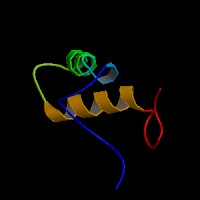
ModBase Predicted Comparative 3D Structure on P28300
FrontTopSide
The pictures above may be empty if there is no ModBase structure for the protein. The ModBase structure frequently covers just a fragment of the protein. You may be asked to log onto ModBase the first time you click on the pictures. It is simplest after logging in to just click on the picture again to get to the specific info on that model.

-  Orthologous Genes in Other Species
  Orthologies between human, mouse, and rat are computed by taking the best BLASTP hit, and filtering out non-syntenic hits. For more distant species reciprocal-best BLASTP hits are used. Note that the absence of an ortholog in the table below may reflect incomplete annotations in the other species rather than a true absence of the orthologous gene.
MouseRatZebrafishD. melanogasterC. elegansS. cerevisiae
Genome BrowserGenome BrowserGenome BrowserNo orthologNo orthologNo ortholog
Gene Details     
Gene Sorter     
MGIRGDEnsembl   
Protein SequenceProtein SequenceProtein Sequence   
AlignmentAlignmentAlignment   

-  Gene Ontology (GO) Annotations with Structured Vocabulary
  Molecular Function:
GO:0004720 protein-lysine 6-oxidase activity
GO:0005507 copper ion binding
GO:0005515 protein binding
GO:0016491 oxidoreductase activity
GO:0016641 oxidoreductase activity, acting on the CH-NH2 group of donors, oxygen as acceptor
GO:0046872 metal ion binding

Biological Process:
GO:0001568 blood vessel development
GO:0006464 cellular protein modification process
GO:0007507 heart development
GO:0009725 response to hormone
GO:0030199 collagen fibril organization
GO:0030324 lung development
GO:0035904 aorta development
GO:0042060 wound healing
GO:0042493 response to drug
GO:0048251 elastic fiber assembly
GO:0048514 blood vessel morphogenesis
GO:0048545 response to steroid hormone
GO:0055114 oxidation-reduction process

Cellular Component:
GO:0005576 extracellular region
GO:0005581 collagen trimer
GO:0005615 extracellular space
GO:0005634 nucleus


-  Descriptions from all associated GenBank mRNAs
  AK307559 - Homo sapiens cDNA, FLJ97507.
AK307732 - Homo sapiens cDNA, FLJ97680.
AK315873 - Homo sapiens cDNA, FLJ79522 complete cds, highly similar to Protein-lysine 6-oxidase precursor (EC1.4.3.13).
AK316309 - Homo sapiens cDNA, FLJ79208 complete cds, highly similar to Protein-lysine 6-oxidase precursor (EC 1.4.3.13).
AF039291 - Homo sapiens lysyl oxidase mRNA, complete cds.
AK297709 - Homo sapiens cDNA FLJ51899 complete cds, highly similar to Protein-lysine 6-oxidase precursor (EC 1.4.3.13).
BC089436 - Homo sapiens lysyl oxidase, mRNA (cDNA clone MGC:105112 IMAGE:30561279), complete cds.
AK298781 - Homo sapiens cDNA FLJ54375 complete cds, highly similar to Protein-lysine 6-oxidase precursor (EC 1.4.3.13).
JD527416 - Sequence 508440 from Patent EP1572962.
S78694 - lysyl oxidase [human, mRNA, 1780 nt].
M94054 - Human lysyl oxidase (LOX) mRNA, complete cds.
BC074872 - Homo sapiens lysyl oxidase, mRNA (cDNA clone MGC:103851 IMAGE:30915233), complete cds.
BC074820 - Homo sapiens lysyl oxidase, mRNA (cDNA clone MGC:104085 IMAGE:30915536), complete cds.
AB527922 - Synthetic construct DNA, clone: pF1KB6633, Homo sapiens LOX gene for lysyl oxidase, without stop codon, in Flexi system.
KJ891554 - Synthetic construct Homo sapiens clone ccsbBroadEn_00948 LOX gene, encodes complete protein.
S45875 - lysyl oxidase [human, skin fibroblasts, mRNA Partial, 1254 nt].
AK312269 - Homo sapiens cDNA, FLJ92566, highly similar to Homo sapiens lysyl oxidase (LOX), mRNA.
AK311354 - Homo sapiens cDNA, FLJ18396.
LF212747 - JP 2014500723-A/20250: Polycomb-Associated Non-Coding RNAs.
MA448324 - JP 2018138019-A/20250: Polycomb-Associated Non-Coding RNAs.
LF213427 - JP 2014500723-A/20930: Polycomb-Associated Non-Coding RNAs.
MA449004 - JP 2018138019-A/20930: Polycomb-Associated Non-Coding RNAs.
JD138639 - Sequence 119663 from Patent EP1572962.
JD296670 - Sequence 277694 from Patent EP1572962.
JD441898 - Sequence 422922 from Patent EP1572962.
JD483700 - Sequence 464724 from Patent EP1572962.
JD058176 - Sequence 39200 from Patent EP1572962.
JD059284 - Sequence 40308 from Patent EP1572962.
JD518363 - Sequence 499387 from Patent EP1572962.

-  Biochemical and Signaling Pathways
  Reactome (by CSHL, EBI, and GO)

Protein P28300 (Reactome details) participates in the following event(s):

R-HSA-2022141 Prolysyl oxidase activation
R-HSA-2002466 Formation of allysine by LOX
R-HSA-2395340 Formation of hydroxyallysine by LOX
R-HSA-2243919 Crosslinking of collagen fibrils
R-HSA-2022090 Assembly of collagen fibrils and other multimeric structures
R-HSA-1474290 Collagen formation
R-HSA-1566948 Elastic fibre formation
R-HSA-1474244 Extracellular matrix organization

-  Other Names for This Gene
  Alternate Gene Symbols: B2R5Q3, ENST00000231004.1, ENST00000231004.2, ENST00000231004.3, ENST00000231004.4, LYOX_HUMAN, NM_002317, P28300, Q5FWF0, uc003ksu.1, uc003ksu.2, uc003ksu.3, uc003ksu.4, uc003ksu.5
UCSC ID: ENST00000231004.5
RefSeq Accession: NM_002317.7
Protein: P28300 (aka LYOX_HUMAN)
CCDS: CCDS4129.1

-  GeneReviews for This Gene
  GeneReviews article(s) related to gene LOX:
taa (Heritable Thoracic Aortic Disease Overview)

-  Methods, Credits, and Use Restrictions
  Click here for details on how this gene model was made and data restrictions if any.