ID:KCNH2_HUMAN DESCRIPTION: RecName: Full=Potassium voltage-gated channel subfamily H member 2; AltName: Full=Eag homolog; AltName: Full=Ether-a-go-go-related gene potassium channel 1; Short=ERG-1; Short=Eag-related protein 1; Short=Ether-a-go-go-related protein 1; Short=H-ERG; Short=hERG-1; Short=hERG1; AltName: Full=Voltage-gated potassium channel subunit Kv11.1; FUNCTION: Pore-forming (alpha) subunit of voltage-gated inwardly rectifying potassium channel. Channel properties are modulated by cAMP and subunit assembly. Mediates the rapidly activating component of the delayed rectifying potassium current in heart (IKr). Isoform 3 has no channel activity by itself, but modulates channel characteristics when associated with isoform 1. SUBUNIT: The potassium channel is probably composed of a homo- or heterotetrameric complex of pore-forming alpha subunits that can associate with modulating beta subunits. Heteromultimer with KCNH6/ERG2 and KCNH7/ERG3. Interacts with ALG10B (By similarity). Heteromultimer with KCNE1 and KCNE2. Interacts with CANX. SUBCELLULAR LOCATION: Membrane; Multi-pass membrane protein. TISSUE SPECIFICITY: Highly expressed in heart and brain. DOMAIN: The segment S4 is probably the voltage-sensor and is characterized by a series of positively charged amino acids at every third position. PTM: Phosphorylated on serine and threonine residues. Phosphorylation by PKA inhibits ion conduction. DISEASE: Defects in KCNH2 are the cause of long QT syndrome type 2 (LQT2) [MIM:613688]. Long QT syndromes are heart disorders characterized by a prolonged QT interval on the ECG and polymorphic ventricular arrhythmias. They cause syncope and sudden death in response to exercise or emotional stress. Deafness is often associated with LQT2. DISEASE: Defects in KCNH2 are the cause of short QT syndrome type 1 (SQT1) [MIM:609620]. Short QT syndromes are heart disorders characterized by idiopathic persistently and uniformly short QT interval on ECG in the absence of structural heart disease in affected individuals. They cause syncope and sudden death. SIMILARITY: Belongs to the potassium channel family. H (Eag) (TC 1.A.1.20) subfamily. Kv11.1/KCNH2 sub-subfamily. SIMILARITY: Contains 1 cyclic nucleotide-binding domain. SIMILARITY: Contains 1 PAC (PAS-associated C-terminal) domain. SIMILARITY: Contains 1 PAS (PER-ARNT-SIM) domain. SEQUENCE CAUTION: Sequence=AAC69709.1; Type=Miscellaneous discrepancy; Note=Cloning artifact; Sequence=AAH01914.2; Type=Miscellaneous discrepancy; Note=Cloning artifact; Sequence=BAB19682.1; Type=Miscellaneous discrepancy; Note=Cloning artifact; Sequence=CAA09232.1; Type=Erroneous gene model prediction; WEB RESOURCE: Name=GeneReviews; URL="http://www.ncbi.nlm.nih.gov/sites/GeneTests/lab/gene/KCNH2"; WEB RESOURCE: Name=Wikipedia; Note=Ether-a-go-go potassium channels entry; URL="http://en.wikipedia.org/wiki/Ether-a-go-go_potassium_channels";
The RNAfold program from the Vienna RNA Package is used to perform the secondary structure predictions and folding calculations. The estimated folding energy is in kcal/mol. The more negative the energy, the more secondary structure the RNA is likely to have.
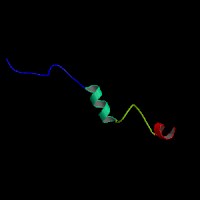
ModBase Predicted Comparative 3D Structure on Q12809
Front
Top
Side
The pictures above may be empty if there is no ModBase structure for the protein. The ModBase structure frequently covers just a fragment of the protein. You may be asked to log onto ModBase the first time you click on the pictures. It is simplest after logging in to just click on the picture again to get to the specific info on that model.
Orthologous Genes in Other Species
Orthologies between human, mouse, and rat are computed by taking the best BLASTP hit, and filtering out non-syntenic hits. For more distant species reciprocal-best BLASTP hits are used. Note that the absence of an ortholog in the table below may reflect incomplete annotations in the other species rather than a true absence of the orthologous gene.
Gene Ontology (GO) Annotations with Structured Vocabulary
Molecular Function: GO:0000155 phosphorelay sensor kinase activity GO:0005216 ion channel activity GO:0005242 inward rectifier potassium channel activity GO:0005244 voltage-gated ion channel activity GO:0005249 voltage-gated potassium channel activity GO:0005251 delayed rectifier potassium channel activity GO:0005267 potassium channel activity GO:0005515 protein binding GO:0031625 ubiquitin protein ligase binding GO:0042802 identical protein binding GO:0042803 protein homodimerization activity GO:0055131 C3HC4-type RING finger domain binding GO:0086008 voltage-gated potassium channel activity involved in cardiac muscle cell action potential repolarization GO:0097110 scaffold protein binding GO:1902282 voltage-gated potassium channel activity involved in ventricular cardiac muscle cell action potential repolarization
Biological Process: GO:0000160 phosphorelay signal transduction system GO:0003064 regulation of heart rate by hormone GO:0006811 ion transport GO:0006813 potassium ion transport GO:0023014 signal transduction by protein phosphorylation GO:0034765 regulation of ion transmembrane transport GO:0035690 cellular response to drug GO:0042391 regulation of membrane potential GO:0055075 potassium ion homeostasis GO:0055085 transmembrane transport GO:0060048 cardiac muscle contraction GO:0060306 regulation of membrane repolarization GO:0060307 regulation of ventricular cardiac muscle cell membrane repolarization GO:0071435 potassium ion export GO:0071805 potassium ion transmembrane transport GO:0086005 ventricular cardiac muscle cell action potential GO:0086009 membrane repolarization GO:0086010 membrane depolarization during action potential GO:0086011 membrane repolarization during action potential GO:0086013 membrane repolarization during cardiac muscle cell action potential GO:0086091 regulation of heart rate by cardiac conduction GO:0097623 potassium ion export across plasma membrane GO:0098915 membrane repolarization during ventricular cardiac muscle cell action potential GO:1901379 regulation of potassium ion transmembrane transport GO:1901380 negative regulation of potassium ion transmembrane transport GO:1901381 positive regulation of potassium ion transmembrane transport GO:1902303 negative regulation of potassium ion export
Cellular Component: GO:0005886 plasma membrane GO:0008076 voltage-gated potassium channel complex GO:0009986 cell surface GO:0016020 membrane GO:0016021 integral component of membrane GO:0048471 perinuclear region of cytoplasm GO:1902937 inward rectifier potassium channel complex
Descriptions from all associated GenBank mRNAs
BC004311 - Homo sapiens potassium voltage-gated channel, subfamily H (eag-related), member 2, mRNA (cDNA clone IMAGE:3627585), partial cds. FJ938021 - Homo sapiens voltage-gated potassium channel subfamily H isoform 3.1 (KCNH2) mRNA, complete cds, alternatively spliced. U04270 - Human putative potassium channel subunit (h-erg) mRNA, complete cds. DQ525913 - Homo sapiens voltage-gated potassium channel KV11.1 transcript variant 1 mRNA, complete cds. JD136914 - Sequence 117938 from Patent EP1572962. JD278048 - Sequence 259072 from Patent EP1572962. JD393346 - Sequence 374370 from Patent EP1572962. JD371545 - Sequence 352569 from Patent EP1572962. BC127672 - Homo sapiens cDNA clone IMAGE:40128611. BC127673 - Homo sapiens potassium voltage-gated channel, subfamily H (eag-related), member 2, mRNA (cDNA clone IMAGE:40128615), complete cds. JD340218 - Sequence 321242 from Patent EP1572962. JD560230 - Sequence 541254 from Patent EP1572962. JD465579 - Sequence 446603 from Patent EP1572962. BC167862 - Synthetic construct Homo sapiens clone IMAGE:100068252, MGC:195869 potassium voltage-gated channel, subfamily H (eag-related), member 2 (KCNH2) mRNA, encodes complete protein. AJ512214 - Homo sapiens mRNA for potassium channel 1b protein (HERG1b gene). AF363636 - Homo sapiens ether-a-go-go-related K+ channel protein (KCNH2) mRNA, complete cds. AF052728 - Homo sapiens HERG-USO (HERG) mRNA, alternatively spliced, partial cds. AJ609614 - Homo sapiens mRNA for potassium voltage-gated channel, subfamily H (eag-related), member 2, putative transcript variant 4, (KCNH2 gene). BC080563 - Homo sapiens cDNA clone IMAGE:6340663, **** WARNING: chimeric clone ****. BC001914 - Homo sapiens potassium voltage-gated channel, subfamily H (eag-related), member 2, mRNA (cDNA clone IMAGE:3510423), partial cds. AB044806 - Homo sapiens HERG mRNA for HERG-USO, alternatively spliced, complete cds. AY927502 - Homo sapiens mRNA sequence. BT007336 - Homo sapiens potassium voltage-gated channel, subfamily H (eag-related), member 2 mRNA, complete cds. DQ120125 - Homo sapiens voltage-gated potassium channel mRNA, 5' UTR and partial cds. DQ120124 - Homo sapiens potassium channel HERG1 (KCNH2) mRNA, 5' UTR and partial cds.
Biochemical and Signaling Pathways
Reactome (by CSHL, EBI, and GO)
Protein Q12809 (Reactome details) participates in the following event(s):
 Sequence and Links to Tools and Databases

 Microarray Expression Data