ID:TMC1_HUMAN DESCRIPTION: RecName: Full=Transmembrane channel-like protein 1; AltName: Full=Transmembrane cochlear-expressed protein 1; FUNCTION: Required for the normal function of cochlear hair cells (By similarity). SUBCELLULAR LOCATION: Membrane; Multi-pass membrane protein (Potential). TISSUE SPECIFICITY: Detected in fetal cochlea, and at low levels in placenta and testis. DISEASE: Defects in TMC1 are the cause of deafness autosomal dominant type 36 (DFNA36) [MIM:606705]. DFNA36 is a form of sensorineural hearing loss. Sensorineural deafness results from damage to the neural receptors of the inner ear, the nerve pathways to the brain, or the area of the brain that receives sound information. DFNA36 is a bilateral hearing loss, and begins at 5-10 years of age. It progresses to profound deafness within 10-15 years. DISEASE: Defects in TMC1 are the cause of deafness autosomal recessive type 7 (DFNB7) [MIM:600974]; also known as autosomal recessive neurosensory deafness type 11 (DFNB11). This hearing loss is congenital and profound. SIMILARITY: Belongs to the TMC family. SEQUENCE CAUTION: Sequence=BAC05351.1; Type=Erroneous termination; Positions=744; Note=Translated as Arg; Sequence=BAC05351.1; Type=Frameshift; Positions=588;
The RNAfold program from the Vienna RNA Package is used to perform the secondary structure predictions and folding calculations. The estimated folding energy is in kcal/mol. The more negative the energy, the more secondary structure the RNA is likely to have.
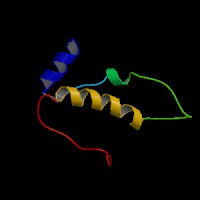
ModBase Predicted Comparative 3D Structure on Q8TDI8
Front
Top
Side
The pictures above may be empty if there is no ModBase structure for the protein. The ModBase structure frequently covers just a fragment of the protein. You may be asked to log onto ModBase the first time you click on the pictures. It is simplest after logging in to just click on the picture again to get to the specific info on that model.
Orthologous Genes in Other Species
Orthologies between human, mouse, and rat are computed by taking the best BLASTP hit, and filtering out non-syntenic hits. For more distant species reciprocal-best BLASTP hits are used. Note that the absence of an ortholog in the table below may reflect incomplete annotations in the other species rather than a true absence of the orthologous gene.
Biological Process: GO:0006811 ion transport GO:0007605 sensory perception of sound GO:0050910 detection of mechanical stimulus involved in sensory perception of sound GO:0060005 vestibular reflex GO:0060117 auditory receptor cell development GO:0070588 calcium ion transmembrane transport GO:1903169 regulation of calcium ion transmembrane transport
 Sequence and Links to Tools and Databases

 Microarray Expression Data