ID:LPHN1_HUMAN DESCRIPTION: RecName: Full=Latrophilin-1; AltName: Full=Calcium-independent alpha-latrotoxin receptor 1; Short=CIRL-1; AltName: Full=Lectomedin-2; Flags: Precursor; FUNCTION: Calcium-independent receptor of high affinity for alpha- latrotoxin, an excitatory neurotoxin present in black widow spider venom which triggers massive exocytosis from neurons and neuroendocrine cells. Receptor propably implicated in the regulation of exocytosis (By similarity). SUBUNIT: Forms a heterodimer, consisting of a large extracellular region (p120) non-covalently linked to a seven-transmembrane moiety (p85). Interacts with syntaxin and with proteins of the SHANK family via the PDZ domain (By similarity). INTERACTION: O00555:CACNA1A; NbExp=2; IntAct=EBI-3389315, EBI-766279; SUBCELLULAR LOCATION: Cell membrane; Multi-pass membrane protein. DOMAIN: The extracellular domain coupled to the a single transmembrane region are sufficient for full responsiveness to alpha-latrotoxin (By similarity). PTM: Autoproteolytically cleaved into 2 subunits, an extracellular subunit and a seven-transmembrane subunit. This proteolytic processing takes place early in the biosynthetic pathway, either in the endoplasmic reticulum or in the early compartment of the Golgi apparatus (By similarity). SIMILARITY: Belongs to the G-protein coupled receptor 2 family. LN-TM7 subfamily. SIMILARITY: Contains 1 GPS domain. SIMILARITY: Contains 1 olfactomedin-like domain. SIMILARITY: Contains 1 SUEL-type lectin domain. SEQUENCE CAUTION: Sequence=BAA74844.2; Type=Erroneous initiation;
The RNAfold program from the Vienna RNA Package is used to perform the secondary structure predictions and folding calculations. The estimated folding energy is in kcal/mol. The more negative the energy, the more secondary structure the RNA is likely to have.
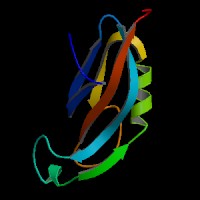
ModBase Predicted Comparative 3D Structure on O94910
Front
Top
Side
The pictures above may be empty if there is no ModBase structure for the protein. The ModBase structure frequently covers just a fragment of the protein. You may be asked to log onto ModBase the first time you click on the pictures. It is simplest after logging in to just click on the picture again to get to the specific info on that model.
Orthologous Genes in Other Species
Orthologies between human, mouse, and rat are computed by taking the best BLASTP hit, and filtering out non-syntenic hits. For more distant species reciprocal-best BLASTP hits are used. Note that the absence of an ortholog in the table below may reflect incomplete annotations in the other species rather than a true absence of the orthologous gene.
 Sequence and Links to Tools and Databases

 Microarray Expression Data