Human Gene RAD54L2 (ENST00000409535.6) from GENCODE V50
  Description: DNA helicase that modulates androgen receptor (AR)-dependent transactivation in a promoter-dependent manner. Not able to remodel mononucleosomes in vitro (By similarity). (from UniProt Q9Y4B4)
Gencode Transcript: ENST00000409535.6
Gencode Gene: ENSG00000164080.16
Transcript (Including UTRs)
   Position: hg38 chr3:51,541,580-51,668,667 Size: 127,088 Total Exon Count: 22 Strand: +
Coding Region
   Position: hg38 chr3:51,590,421-51,663,420 Size: 73,000 Coding Exon Count: 21 

Page IndexSequence and LinksUniProtKB CommentsPrimersCTDRNA-Seq Expression
Microarray ExpressionRNA StructureProtein StructureOther SpeciesGO AnnotationsmRNA Descriptions
Other NamesMethods
Data last updated at UCSC: 2026-07-12 09:30:09

-  Comments and Description Text from UniProtKB
  ID: ARIP4_HUMAN
DESCRIPTION: RecName: Full=Helicase ARIP4; EC=3.6.4.12; AltName: Full=Androgen receptor-interacting protein 4; AltName: Full=RAD54-like protein 2;
FUNCTION: DNA helicase that modulates androgen receptor (AR)- dependent transactivation in a promoter-dependent manner. Not able to remodel mononucleosomes in vitro (By similarity).
CATALYTIC ACTIVITY: ATP + H(2)O = ADP + phosphate.
ENZYME REGULATION: Enzyme activity is enhanced by dsDNA (double- stranded DNA) and ssDNA (single-stranded DNA) (By similarity).
SUBUNIT: Interacts with AR via its N-terminus. Interacts with DYRK1A. Binds DNA and mononucleosomes, but does not seem to form large multiprotein complexes (By similarity).
SUBCELLULAR LOCATION: Nucleus (By similarity). Note=Localizes in speckle-like nuclear compartments (By similarity).
DOMAIN: Leu-Xaa-Xaa-Leu-Leu (LXXLL) motifs are known to be important for the association with nuclear receptors (By similarity).
PTM: Sumoylated (By similarity).
PTM: Phosphorylated upon DNA damage, probably by ATM or ATR.
SIMILARITY: Belongs to the SNF2/RAD54 helicase family.
SIMILARITY: Contains 1 helicase ATP-binding domain.
SIMILARITY: Contains 1 helicase C-terminal domain.
SEQUENCE CAUTION: Sequence=AAH24298.1; Type=Erroneous initiation; Note=Translation N-terminally extended;

-  Primer design for this transcript
 

Primer3Plus can design qPCR Primers that straddle exon-exon-junctions, which amplify only cDNA, not genomic DNA.
Click here to load the transcript sequence and exon structure into Primer3Plus

Exonprimer can design one pair of Sanger sequencing primers around every exon, located in non-genic sequence.
Click here to open Exonprimer with this transcript

To design primers for a non-coding sequence, zoom to a region of interest and select from the drop-down menu: View > In External Tools > Primer3


-  Comparative Toxicogenomics Database (CTD)
  The following chemicals interact with this gene

-  RNA-Seq Expression Data from GTEx (53 Tissues, 570 Donors)
  Highest median expression: 4.25 RPKM in Cells - EBV-transformed lymphocytes
Total median expression: 89.87 RPKM


View in GTEx track of Genome Browser    View at GTEx portal     View GTEx Body Map

+  Microarray Expression Data
 
Expression ratio colors:

GNF Expression Atlas 2 Data from U133A and GNF1H Chips


Ratios


Absolute


Ratios


Absolute


Ratios


Absolute

-  mRNA Secondary Structure of 3' and 5' UTRs
 
RegionFold EnergyBasesEnergy/Base
Display As
5' UTR -35.10125-0.281 Picture PostScript Text
3' UTR -1805.175247-0.344 Picture PostScript Text

The RNAfold program from the Vienna RNA Package is used to perform the secondary structure predictions and folding calculations. The estimated folding energy is in kcal/mol. The more negative the energy, the more secondary structure the RNA is likely to have.

-  Protein Domain and Structure Information
  InterPro Domains: Graphical view of domain structure
IPR014001 - Helicase_ATP-bd
IPR001650 - Helicase_C
IPR000330 - SNF2_N

Pfam Domains:
PF00271 - Helicase conserved C-terminal domain
PF00176 - SNF2 family N-terminal domain

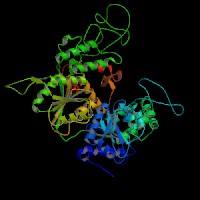
ModBase Predicted Comparative 3D Structure on Q9Y4B4
FrontTopSide
The pictures above may be empty if there is no ModBase structure for the protein. The ModBase structure frequently covers just a fragment of the protein. You may be asked to log onto ModBase the first time you click on the pictures. It is simplest after logging in to just click on the picture again to get to the specific info on that model.

-  Orthologous Genes in Other Species
  Orthologies between human, mouse, and rat are computed by taking the best BLASTP hit, and filtering out non-syntenic hits. For more distant species reciprocal-best BLASTP hits are used. Note that the absence of an ortholog in the table below may reflect incomplete annotations in the other species rather than a true absence of the orthologous gene.
MouseRatZebrafishD. melanogasterC. elegansS. cerevisiae
Genome BrowserGenome BrowserGenome BrowserNo orthologNo orthologNo ortholog
Gene Details     
Gene Sorter     
MGIRGDEnsembl   
Protein SequenceProtein SequenceProtein Sequence   
AlignmentAlignmentAlignment   

-  Gene Ontology (GO) Annotations with Structured Vocabulary
  Molecular Function:
GO:0000166 nucleotide binding
GO:0003677 DNA binding
GO:0004386 helicase activity
GO:0005515 protein binding
GO:0005524 ATP binding
GO:0016787 hydrolase activity

Cellular Component:
GO:0005634 nucleus


-  Descriptions from all associated GenBank mRNAs
  AK122683 - Homo sapiens cDNA FLJ16136 fis, clone BRACE3000520, highly similar to Mus musculus mRNA for steroid receptor-interacting SNF2 domain protein.
AK308456 - Homo sapiens cDNA, FLJ98404.
AB018352 - Homo sapiens mRNA for KIAA0809 protein, partial cds.
BC024298 - Homo sapiens RAD54-like 2 (S. cerevisiae), mRNA (cDNA clone MGC:39353 IMAGE:4578867), complete cds.
DQ895386 - Synthetic construct Homo sapiens clone IMAGE:100009846; FLH183896.01L; RZPDo839H11141D RAD54-like 2 (S. cerevisiae) (RAD54L2) gene, encodes complete protein.
KJ902288 - Synthetic construct Homo sapiens clone ccsbBroadEn_11682 RAD54L2 gene, encodes complete protein.
DQ892190 - Synthetic construct clone IMAGE:100004820; FLH183900.01X; RZPDo839H11142D RAD54-like 2 (S. cerevisiae) (RAD54L2) gene, encodes complete protein.
AK304881 - Homo sapiens cDNA FLJ58240 complete cds.
AK023824 - Homo sapiens cDNA FLJ13762 fis, clone PLACE4000014, weakly similar to X-LINKED HELICASE II.
BC001474 - Homo sapiens RAD54-like 2 (S. cerevisiae), mRNA (cDNA clone IMAGE:3138844), partial cds.
AK025049 - Homo sapiens cDNA: FLJ21396 fis, clone COL03566.
JD470499 - Sequence 451523 from Patent EP1572962.
CU692916 - Synthetic construct Homo sapiens gateway clone IMAGE:100023201 5' read RAD54L2 mRNA.
AK026053 - Homo sapiens cDNA: FLJ22400 fis, clone HRC08024.
AF161443 - Homo sapiens HSPC325 mRNA, partial cds.
JD327294 - Sequence 308318 from Patent EP1572962.
JD068840 - Sequence 49864 from Patent EP1572962.
AF088021 - Homo sapiens full length insert cDNA clone YZ18F07.
DQ570370 - Homo sapiens piRNA piR-30482, complete sequence.
JD160934 - Sequence 141958 from Patent EP1572962.
JD281492 - Sequence 262516 from Patent EP1572962.
JD356465 - Sequence 337489 from Patent EP1572962.
JD505948 - Sequence 486972 from Patent EP1572962.
DQ580229 - Homo sapiens piRNA piR-48341, complete sequence.

-  Other Names for This Gene
  Alternate Gene Symbols: AK122683, ARIP4, ARIP4_HUMAN, ENST00000409535.1, ENST00000409535.2, ENST00000409535.3, ENST00000409535.4, ENST00000409535.5, KIAA0809, Q8TB57, Q9BV54, Q9Y4B4, uc011bdt.1, uc011bdt.2, uc011bdt.3
UCSC ID: ENST00000409535.6
RefSeq Accession: NM_015106.4
Protein: Q9Y4B4 (aka ARIP4_HUMAN)
CCDS: CCDS33765.2

-  Methods, Credits, and Use Restrictions
  Click here for details on how this gene model was made and data restrictions if any.