ID:ENR1_HUMAN DESCRIPTION: RecName: Full=HERV-R_7q21.2 provirus ancestral Env polyprotein; AltName: Full=ERV-3 envelope protein; Short=ERV3 envelope protein; AltName: Full=ERV3-1 envelope protein; AltName: Full=Envelope polyprotein; AltName: Full=HERV-R envelope protein; Short=ERV-R envelope protein; Contains: RecName: Full=Surface protein; Short=SU; Contains: RecName: Full=Transmembrane protein; Short=TM; Flags: Precursor; FUNCTION: Retroviral envelope proteins mediate receptor recognition and membrane fusion during early infection. Endogenous envelope proteins may have kept, lost or modified their original function during evolution. This endogenous envelope protein has lost its fusogenic properties. It can inhibit cell growth through decrease expression of cyclin B1 and increased expression of p21 in vitro. FUNCTION: SU mediates receptor recognition (By similarity). FUNCTION: TM anchors the envelope heterodimer to the viral membrane through one transmembrane domain. The other hydrophobic domain, called fusion peptide, mediates fusion of the viral membrane with the target cell membrane (By similarity). SUBUNIT: The surface (SU) and transmembrane (TM) proteins form a heterodimer. SU and TM are attached by non-covalent interactions or by a labile interchain disulfide bond (By similarity). SUBCELLULAR LOCATION: Virion. TISSUE SPECIFICITY: Expressed at higher level in adrenal, sebaceous glands and placenta. Expressed at lower level in bone marrow, brain, breast, colon, heart, kidney, liver, lung, ovary, PBL, prostate, skin, spleen, testis, thymus, thyroid, trachea. DEVELOPMENTAL STAGE: Highly expressed in primitive adrenal cortex and placenta. Expressed at lower level in developing nervous tissues, tongue, heart, gut, kidney, columna vertebralis and liver. DOMAIN: Contains the CKS-17 immunosuppressive domain present in many retroviral envelope proteins. As a synthetic peptide, it inhibits immune function in vitro and in vivo (By similarity). PTM: Specific enzymatic cleavages in vivo yield the mature SU and TM proteins (By similarity). Has been mainly detected in vivo as an 65 kDa unprocessed polyprotein precursor. PTM: The CXXC motif is highly conserved across a broad range of retroviral envelope proteins. It is thought to participate in the formation of a labile disulfide bond possibly with the CX6CC motif present in the transmembrane protein. Isomerization of the intersubunit disulfide bond to an SU intrachain disulfide bond is thought to occur upon receptor recognition in order to allow membrane fusion (By similarity). POLYMORPHISM: This envelope gene is polymorphic with at least five different alleles. A mutation introducing a premature stop codon instead of amino acid 223 is present in approximately 1% of the Caucasian population. MISCELLANEOUS: HERV-R_7q21.2 genomic and subgenomic RNAs have been observed. MISCELLANEOUS: This provirus is intergenic, the closest flanking genes being ZNF117 and FLJ25037. SIMILARITY: Belongs to the gamma type-C retroviral envelope protein family. HERV class-I R env subfamily. CAUTION: CKS-17 sequence does not match the minimal active consensus. CAUTION: Truncated; premature stop codon upstream of the fusion peptide on TM. WEB RESOURCE: Name=Human Endogenous Retrovirus Database (HERVd); URL="http://herv.img.cas.cz/cgi-bin/draw_full_element.cgi?fid=41580";
The RNAfold program from the Vienna RNA Package is used to perform the secondary structure predictions and folding calculations. The estimated folding energy is in kcal/mol. The more negative the energy, the more secondary structure the RNA is likely to have.
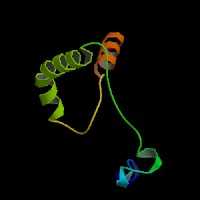
ModBase Predicted Comparative 3D Structure on Q14264
Front
Top
Side
The pictures above may be empty if there is no ModBase structure for the protein. The ModBase structure frequently covers just a fragment of the protein. You may be asked to log onto ModBase the first time you click on the pictures. It is simplest after logging in to just click on the picture again to get to the specific info on that model.
Orthologous Genes in Other Species
Orthologies between human, mouse, and rat are computed by taking the best BLASTP hit, and filtering out non-syntenic hits. For more distant species reciprocal-best BLASTP hits are used. Note that the absence of an ortholog in the table below may reflect incomplete annotations in the other species rather than a true absence of the orthologous gene.
Mouse
Rat
Zebrafish
D. melanogaster
C. elegans
S. cerevisiae
No ortholog
No ortholog
No ortholog
No ortholog
No ortholog
No ortholog
Gene Ontology (GO) Annotations with Structured Vocabulary
 Sequence and Links to Tools and Databases